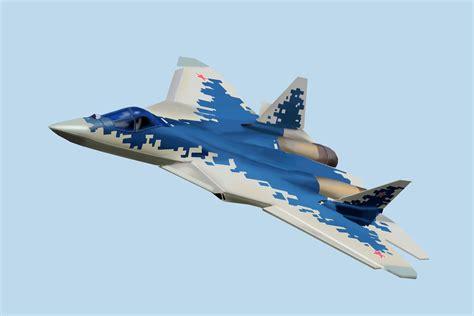
Russia’s Su-30 fighter jet fleet represents a vital pillar of its airpower strategy, serving both defensive and offensive roles across its vast military operations. As a twin-engine, supermaneuverable multirole fighter, the Su-30 is a centerpiece of the Russian Aerospace Forces, delivering long-range strike capabilities and air superiority advantages. Understanding the exact number of Su-30s Russia currently possesses is not only a matter of military curiosity but also one of strategic geopolitical interest, particularly amid ongoing conflicts like the war in Ukraine.
Despite the opacity surrounding Russian military disclosures, independent defense monitoring agencies offer the most reliable window into the country’s current inventory. Among these, the World Directory of Modern Military Aircraft (WDMMA) provides the most detailed and updated breakdown available.
The Su-30 in Russian Service: Operational Significance and Deployment
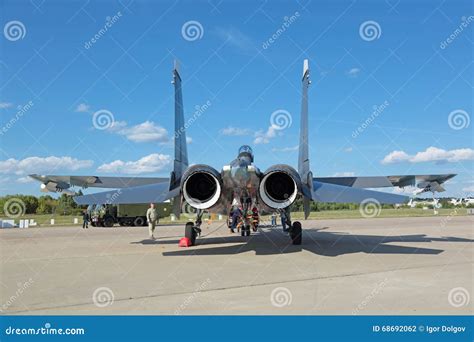
The Su-30 Flanker-C, particularly the Su-30SM variant, plays an increasingly prominent role in Russia’s aerial combat structure. Developed by Sukhoi, the Su-30 evolved from the baseline Su-27 airframe, offering advanced avionics, expanded range, and multirole capabilities. Introduced in the early 1990s, the aircraft was initially tailored for long-range interception and air dominance but has since been adapted for deep-strike missions, maritime patrol, and close air support.
The Su-30SM variant, based on the Indian Su-30MKI but optimized for Russian use, features Russian-made radar, communications, and weapons systems. It has been extensively used in Syria and Ukraine, underscoring its strategic utility. The aircraft’s two-seat configuration allows for extended missions and simultaneous operation of complex weapons systems, which is critical during high-intensity engagements.
Russia has strategically deployed Su-30 units in various regions, including the Western Military District, Southern Military District, and Kaliningrad enclave, in addition to forward-deployed squadrons in Syria and Crimea. This wide deployment footprint signifies the aircraft’s flexibility and importance in Russia’s power projection doctrine.
How Many Su-30s Does Russia Have in 2025?
Based on the latest figures from the WDMMA, the total number of Su-30s in Russian service is 110 units, split across two main variants:
- 19 Su-30M2s: These are early-generation models used primarily for training and limited operational roles. They serve as transitional platforms and share similarities with the Su-27UB.
- 91 Su-30SMs: These are the modern, fully combat-capable multirole variants tailored for the Russian Aerospace Forces. Featuring upgraded avionics, multirole systems, and compatibility with Russian munitions, the SMs are the operational backbone of Russia’s Su-30 fleet.
These 110 aircraft are integrated into various air regiments and squadrons across Russia, and their production continues under orders placed through 2023, with deliveries ongoing through 2025.
Discrepancies Between Sources: Understanding the Numbers Gap
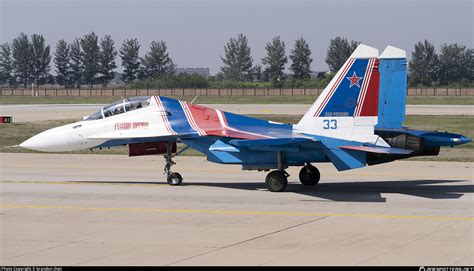
While the World Air Forces Report (2025) aggregates the broader count of Sukhoi fighters at 384 units—including Su-27s, Su-30s, and Su-35s—it does not provide a clear breakdown. In contrast, the WDMMA gives a more granular picture, listing the following:
- 101 Su-27s (of various subtypes: Su-27, Su-27UB, Su-27SM, Su-27SM3)
- 110 Su-30s (Su-30M2 and Su-30SM)
- 114 Su-35S fighters
This results in a total of 325 Sukhoi fighters, showing a 59-aircraft discrepancy with the World Air Forces’ estimate. Such gaps likely stem from differences in aircraft status categorization—whether an aircraft is counted as operational, mothballed, in storage, undergoing maintenance, or retired.
Some defense analysts also argue that aircraft listed by Russia as ‘combat-capable’ might not always meet Western standards for combat readiness. Conversely, it’s also possible that certain newer aircraft—such as late-model Su-30SM2s delivered in 2023–2025—have not yet been publicly disclosed by monitoring agencies.
Export Versions and Domestic Prioritization
Russia has sold Su-30 variants extensively abroad, including to India, China, Vietnam, Algeria, and Malaysia. However, the Su-30SM is unique to Russia, developed specifically to meet internal defense requirements. This model features the Bars-R radar, wide-range weapons compatibility (including the Kh-31 and Kh-35 missiles), and compatibility with Russian datalink and navigation suites.
Despite large-scale exports of earlier Su-30 variants, Russia has largely preserved the SM series for its own use. However, modernization of the Su-30SM fleet has lagged behind the pace of Su-35 production, leading to questions about future procurement plans.
Su-30 vs Su-35: Interoperability and Tactical Doctrine
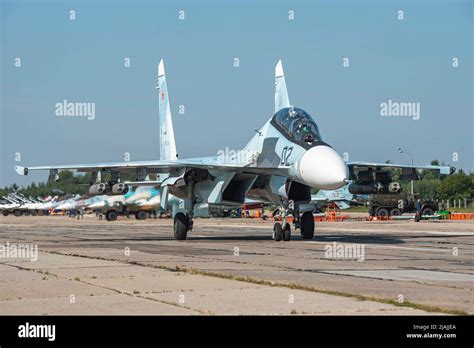
The Su-30 and Su-35 often operate side by side in Russia’s Aerospace Forces, fulfilling complementary roles. While both aircraft are based on the same design heritage, the Su-35S incorporates fifth-generation avionics, thrust-vectoring engines, and supercruise capability, making it a more advanced air-superiority platform. However, the Su-30’s two-seat configuration and multirole orientation make it better suited for strike missions, electronic warfare coordination, and maritime patrol.
This division of labor has shaped Russian doctrine to field mixed regiments where Su-30s and Su-35s fly coordinated sorties—an approach that enhances flexibility during complex joint operations. The Su-30SM’s superior endurance and payload capacity make it ideal for longer sorties in contested airspace.
Recent Combat Losses and Fleet Status in Ukraine
The full-scale invasion of Ukraine in 2022 has exacted a notable toll on Russia’s tactical airpower. Open-source intelligence and Ukrainian reports have indicated the loss of several Su-30SM aircraft in combat operations, particularly due to MANPADS and mobile air defense systems.
However, Russia’s tightly controlled media and military secrecy make exact loss counts difficult to verify. Western intelligence assessments estimate that Russia has lost between 8 and 15 Su-30SM aircraft since the start of the Ukraine conflict. Some of these losses occurred during low-altitude close-air support missions, where Su-30s were vulnerable to portable anti-aircraft systems.
Despite these losses, the Su-30SM remains a frontline fighter, with continued operations noted in Kherson, Donetsk, and eastern Ukrainian airspace. Russia’s defense procurement plans include modernizing existing Su-30SMs into Su-30SM2 standards, which feature improved engines, radar systems, and digital interfaces akin to the Su-35S.
Future Outlook: Will Russia Expand Its Su-30 Fleet?
As of mid-2025, Russia is pursuing a two-track fighter development strategy—fielding more advanced platforms like the Su-57 Felon while upgrading and maintaining its 4++ generation fighters like the Su-30SM. In 2021, the Russian Ministry of Defense signed contracts with Sukhoi for 21 additional Su-30SM2 fighters, deliveries of which began in 2023 and are expected to continue through 2026.
These upgraded models come equipped with the AL-41F-1S engines (shared with the Su-35), a new digital cockpit, and enhanced radar range. The modernization aims to unify the logistics and maintenance chain across Russia’s fighter fleet.
If production remains on schedule, Russia’s total number of Su-30s could grow to 130–140 units by the end of 2026, assuming no further significant combat losses or cancellations. However, financial constraints, international sanctions, and industrial challenges may impede full realization of this goal.
Final Tally: Su-30 Strength as of 2025
To conclude, based on the best available open-source data:
- Russia currently operates approximately 110 Su-30 aircraft (19 Su-30M2 and 91 Su-30SM)
- Additional Su-30SM2 models are on order and partially delivered as of 2025
- Combat losses in Ukraine have reduced operational numbers slightly, but production continues
The Su-30SM’s role as a flexible, long-range, two-seat multirole platform ensures it remains central to Russian air strategy. While newer platforms like the Su-57 attract attention, it’s the workhorse Su-30 that will likely form the mainstay of Russia’s airpower for the foreseeable future.