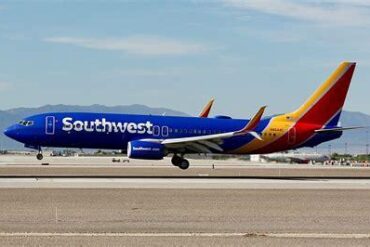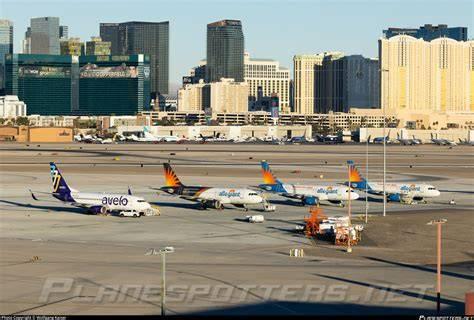
A drone incident at Harry Reid International Airport (LAS) in Las Vegas has raised fresh questions about how airports and air traffic controllers respond when an unmanned aircraft enters an active operating area. On Monday evening, police helicopters were reportedly pursuing drones near Runway 26, while a Learjet was simultaneously cleared to land on Runway 19R.
The incident is particularly notable because the aircraft continued its approach even as law enforcement was dealing with a potential drone threat elsewhere on the airfield. An audio recording of the radio exchange, reported by View From The Wing, appears to show the Learjet receiving its landing clearance without an obvious warning from air traffic control about the drone activity.
That does not necessarily establish that the controller acted improperly. Airports routinely divide operations among multiple runways, and the location, altitude, direction and movement of a drone are all critical when determining whether an aircraft can safely continue an approach. Nevertheless, the situation illustrates how quickly a seemingly small unmanned aircraft can create a complicated operational problem at one of America’s busiest airports.
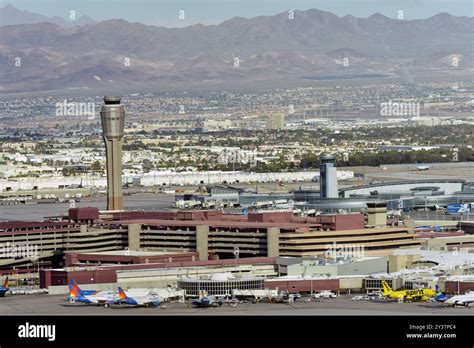
Why the Las Vegas Drone Incident Was So Concerning
The key issue was not simply that a drone had been seen near Harry Reid International Airport. The concern was that the sighting occurred while aircraft were actively using the airport and police helicopters were attempting to locate the drone operator.
Harry Reid has multiple runways, including 19R/1L and 26R/8L, allowing controllers to distribute traffic according to wind, aircraft performance and operational requirements. FAA aeronautical information lists Runway 19R as an approximately 8,988-foot-long runway, while Runway 26R extends more than 14,500 feet.
In the reported incident, the drone activity was associated with Runway 26, while the Learjet was cleared for Runway 19R. That separation may have been an important factor in the decision to continue the landing. Yet the apparent absence of a warning to the approaching crew remains significant because pilots cannot visually identify every drone threat, particularly during a busy approach in the hours around sunset or at night.
The FAA itself warns that drones near airports create a serious hazard because manned aircraft may have difficulty seeing and avoiding them. In controlled airspace around airports, drone operators generally require prior authorization, and they remain responsible for avoiding manned aircraft and preventing interference with airport operations.
A Drone Is Not Simply Another Bird
One of the most persistent misconceptions surrounding these incidents is the idea that a small drone would cause no more damage than a bird.
That comparison is misleading. Birds can certainly cause severe aircraft damage, but a drone contains rigid structural components, electric motors, wiring, batteries and other dense materials that can behave very differently during an impact. A collision at approach speed could damage a windshield, flight-control surface or engine, depending on the location and circumstances.
The danger becomes even more serious for helicopters and smaller aircraft, where a collision can have immediate consequences for controllability. An object entering a turbine engine or striking a propeller can create a particularly dangerous chain of failures.
The important point is that the physical size of a drone does not tell us the full story. A compact aircraft traveling toward a landing jet can represent a high-energy collision hazard, especially because pilots have extremely limited time to react during the final stages of an approach.
The FAA Is Seeing More Drone Reports Near Airports
The Las Vegas episode also fits into a much broader aviation safety problem. The Federal Aviation Administration says it receives more than 100 drone-sighting reports near airports each month, with reports coming from pilots, members of the public and law enforcement. The agency describes unauthorized drone operations around aircraft and airports as dangerous and illegal.
That figure does not mean every reported sighting represents an imminent collision. Some reports involve drones operating at considerable distances from runways, while others may be difficult to verify. Nevertheless, the frequency demonstrates why airports and regulators are increasingly focused on detection, identification and enforcement.
The FAA has also been testing drone-detection technology at airports to determine how effectively systems can identify unmanned aircraft without interfering with aircraft navigation or the broader National Airspace System.
Why Continuing the Landing Can Still Make Sense
It is tempting to conclude that any drone sighting should automatically shut down an airport. Real-world airport operations are more complicated.
If a drone is confirmed over one portion of an airport, controllers may be able to keep aircraft away from that area while continuing operations elsewhere. Closing every runway immediately can create its own safety problems, including airborne holding, fuel concerns, diversions and congestion.
That appears to be the central question surrounding the Las Vegas incident: was the drone sufficiently separated from Runway 19R to allow the Learjet’s approach to continue safely? The available account does not provide enough information to definitively answer that question.
What is clearer is that communication becomes crucial whenever a potentially hazardous object is detected. Even if an approach remains authorized, pilots benefit from knowing about threats that could affect their decisions.
Drone Enforcement Is Becoming More Serious
The regulatory consequences for dangerous drone operations are also becoming increasingly severe. The FAA says operators can face civil penalties of up to $75,000 per violation, along with possible certificate suspension or revocation. In 2026, the agency strengthened its enforcement approach toward operations that endanger the public or violate airspace restrictions.
The FAA specifically tells drone operators to avoid airports and emphasizes that drones must yield to manned aircraft.
That message matters because an airport is one of the worst possible places to treat a drone flight casually. A pilot flying a few hundred feet above the ground during an approach has little opportunity to identify, avoid and react to a small object moving unpredictably across the flight path.
A Warning for Las Vegas and U.S. Airports
The reported Las Vegas drone incident ended without a known aircraft accident, which is the most important outcome. But the event nevertheless highlights an uncomfortable reality: airport safety increasingly depends on managing hazards that were barely considered part of everyday aviation a generation ago.
For controllers, the challenge is determining whether a drone sighting actually threatens a particular runway or flight path. For pilots, the challenge is maintaining situational awareness when an object may be nearly impossible to see. For law enforcement, locating an operator quickly can be just as important as tracking the drone itself.
The Learjet landing at Harry Reid therefore represents more than an isolated radio exchange. It demonstrates how drone incursions can force aviation authorities to make rapid decisions while aircraft remain in motion. As drone numbers continue to grow, the ability to detect these aircraft, communicate accurate threat information and remove irresponsible operators from airport airspace will become an increasingly important part of aviation safety.