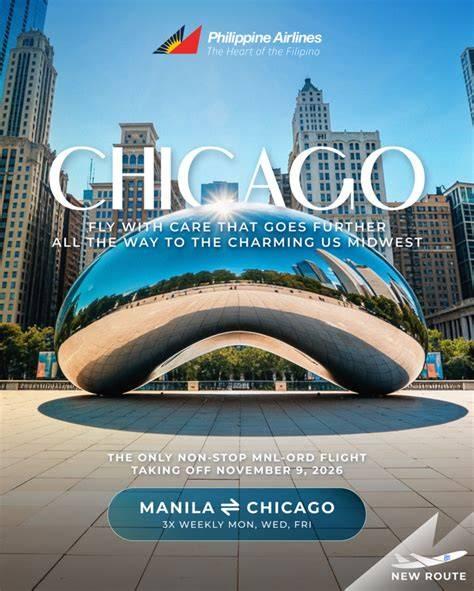
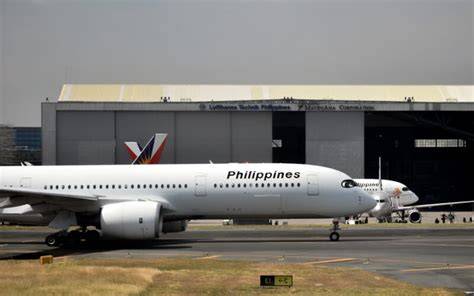
Philippine Airlines will operate its first-ever nonstop passenger flight between Manila and Chicago on Monday, adding the Windy City to a transpacific map that now stretches across eight U.S. destinations and five mainland gateways. The launch of Ninoy Aquino International Airport (MNL) to Chicago O’Hare International Airport (ORD) marks one of the carrier’s most ambitious network moves in years, pushing its long-haul footprint deeper into the American Midwest and giving travelers from Manila a single-seat ride to one of the continent’s busiest aviation hubs. Flights will depart three times each week in both directions, on Mondays, Wednesdays, and Fridays, aboard the airline’s Airbus A350-900 widebody fleet.
For Philippine Airlines, Chicago represents far more than an additional dot on the route map. The carrier has spent months positioning the city as fertile ground not only for end-to-end connectivity to Manila but also for passengers from Chicago looking to reach Philippine domestic markets through the Manila hub. Beyond point-to-point demand, executives believe the route will draw flyers seeking access to other regional markets across Asia, converting O’Hare’s sprawling domestic network into a feeder system for the Philippine flag carrier’s regional connections.
From April Announcement to Monday Launch on the A350
Philippine Airlines first announced plans to link Manila and Chicago on a nonstop basis back in April, laying out a schedule built around three weekly round trips. At the time of the announcement, the airline dangled limited-time round-trip basic economy fares of just $667, available on bookings made until May 31, a promotional push calibrated to seed demand in a market where Philippine Airlines had never flown nonstop. According to scheduling data from Cirium, an aviation analytics company, the thrice-weekly flights are set to operate year-round, with a monthly peak of 14 departures in March 2027.
Richard Nuttall, President of Philippine Airlines, framed the launch in terms of connectivity rather than prestige, saying that “serving the Chicago–Manila corridor will create vital links to key regional destinations and major Philippine domestic markets through our Manila hub.” He also underscored the strategic weight of the destination itself: “Chicago is considered one of the premier hubs in the United States, and our entry into this vibrant city will provide direct connectivity to the Midwest.” The language is telling — Philippine Airlines is not simply chasing Filipino diaspora traffic in Illinois and neighboring states, but betting that O’Hare’s connectivity will pull connecting passengers off rival one-stop itineraries.
Nearly 17 Hours Westbound: Inside PR133’s Marathon Schedule
Transpacific flights from Asia to the United States are long at the best of times, even when flying to the West Coast. With Chicago located far inland, these flights become a genuine marathon in one direction. The eastbound leg, PR132, carries a block time of 14 hours and 15 minutes, departing Manila at 4:40 PM and touching down in the Windy City at 4:55 PM local time, an arrival that trims the calendar back across the International Date Line.
After just under six hours on the ground, the return flight, PR133, leaves O’Hare at 10:45 PM. Facing strong transpacific headwinds on the way back to the Philippines, this leg has a substantially longer block time, with arrival in Manila not until 16 hours and 40 minutes later, at 5:25 AM the next day. That early-morning touchdown is a deliberate scheduling play: it lands passengers in Manila in time for onward connections to domestic islands and regional Asian markets, the very traffic Philippine Airlines hopes to capture.
A 295-Seat A350-900 With 30 Business, 24 Premium Economy and 241 Economy Seats
Cirium data confirms the 295-seat A350-900 as the aircraft of choice on this route. The jet flies in a three-class configuration, with 30 business class seats, 24 premium economy seats, and 241 economy seats arranged nine abreast in a 3-3-3 layout, the standard configuration for the A350-900 and a notable contrast with Philippine Airlines’ larger A350-1000, which packs ten seats per row in a 3-4-3 arrangement. For travelers weighing the long westbound haul, the nine-abreast economy cabin makes the -900 the more comfortable of the carrier’s two A350 variants in the back of the plane.
The aircraft choice also signals how Philippine Airlines reads the market: a mid-size widebody with premium demand strong enough to justify a dedicated business cabin and a premium economy section, but not so large that the airline must discount heavily to fill it three times a week. That balance matters on a route where cargo belly space and seasonal traffic swings between Manila and the American heartland can shift the economics quickly.
Chicago Becomes PAL’s Fifth Mainland U.S. City and Eighth Overall
Chicago’s arrival expands Philippine Airlines’ American network to five destinations on the U.S. mainland, joining Los Angeles International Airport (LAX), John F. Kennedy International Airport (JFK), San Francisco International Airport (SFO), and Seattle-Tacoma International Airport (SEA), routes served by a mix of A350s and Boeing 777s. Beyond the mainland, the carrier also serves three additional American destinations: Antonio B. Won Pat International Airport (GUM) in Guam, Daniel K. Inouye International Airport (HNL) in Honolulu, and Francisco C. Ada International Airport (SPN) in Saipan, the last operated by PAL Express, its regional brand.
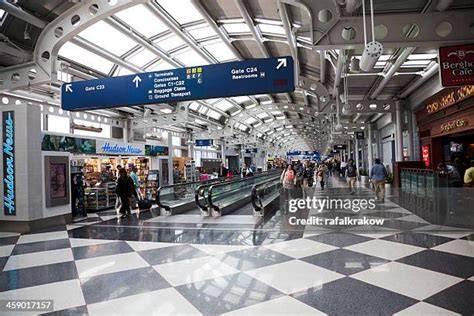
The addition brings the total to eight U.S. destinations and gives the airline a Midwest anchor it previously lacked. Chicago-bound passengers can now reach Manila without a connection through the West Coast or a foreign hub, while travelers heading to Philippine domestic markets can book a single itinerary from the Midwest, arriving in Manila at 5:25 AM with the full day of connections ahead of them. For a carrier competing against Korean, Japanese, and Gulf rivals for transpacific traffic, a nonstop from the third-largest U.S. metropolitan area is a meaningful differentiator, and it positions Philippine Airlines to capture demand that once routed through Seoul, Tokyo, or Taipei.
Months of preparation now culminate in Monday’s inaugural departure, with the A350-900 rolling out of Manila at 4:40 PM and climbing over the Pacific toward O’Hare. For Philippine Airlines, the Chicago launch is a statement: eight U.S. destinations, a year-round transpacific commitment, and a hub-and-spoke strategy built on Manila’s geography and O’Hare’s reach.