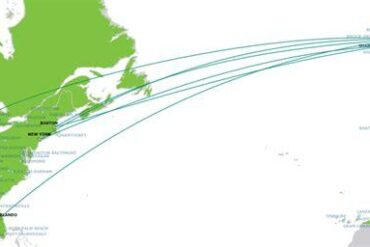
Emirates has built its reputation on a single, relentless idea: funnel the world through Dubai. Yet the Gulf carrier quietly operates a small set of flights that let travelers cross an ocean or a continent without ever touching the United Arab Emirates. These are fifth-freedom routes, and exactly three of them touch the United States. They connect New York to Milan, Newark to Athens, and Miami to Bogotá, and each exists for reasons that have far more to do with aircraft economics, altitude, and political friction than with any simple map of passenger demand.
What Fifth Freedom Rights Actually Let Emirates Do
A fifth-freedom service allows an airline to carry passengers and cargo between two foreign countries as an extension of a flight that begins or ends in its home state. For Emirates, that means a jet that leaves Dubai International Airport (DXB) can stop in one country, pick up local traffic, and continue to a third country while selling standalone tickets on that intermediate segment. The passenger boarding in Milan for New York never sets foot in Dubai, yet the flight is still a Dubai rotation in every operational sense.
That distinction matters commercially. Emirates can fill otherwise marginal widebody capacity with local point-to-point demand that has nothing to do with its Gulf hub, turning a long-haul sector that might otherwise fly half empty into a revenue machine. The rights are negotiated through bilateral air services agreements between governments, which is why the network is shaped as much by diplomacy as by demand modeling. For travelers, the practical result is a rare opportunity to sample Emirates cabins on short regional hops and transatlantic crossings rather than committing to a twelve- to sixteen-and-a-half-hour flight to the Gulf.
The Three Routes Emirates Sells Into the United States
Emirates’ American fifth-freedom footprint consists of New York John F. Kennedy (JFK) to Milan Malpensa (MXP), Newark Liberty (EWR) to Athens (ATH), and Miami (MIA) to Bogotá (BOG). Each pair is built on a different flight structure, and each uses a different slice of the Emirates widebody fleet.
The New York and Newark links are extensions of existing Dubai services, operating as EK205 and EK206 on the JFK–Milan pairing and EK209 and EK210 on the Newark–Athens pairing. These flights are engineered to capture two revenue streams at once: local transatlantic demand between the US East Coast and Southern Europe, and connecting traffic flowing to and from Dubai. The JFK–Milan sector itself covers roughly 3,989 miles (6,413 kilometers), a sector long enough to justify a full widebody cabin but short enough that a stop in Italy does not wreck the overall block time to New York.
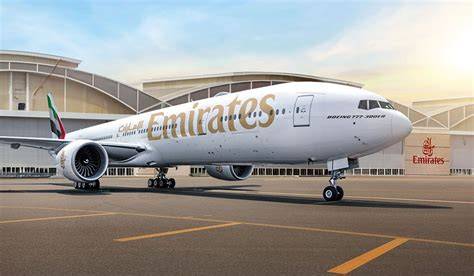
The Miami–Bogotá leg works differently. It operates as EK213 and EK214, an onward tag from Dubai that touches down in South Florida before hopping the 1,513 miles (2,435 kilometers) to Colombia’s capital and returning. There is no European staging point here; Miami itself is the intermediate stop, and the entire Americas sector exists because a Dubai-bound 777 can earn money during what would otherwise be idle daytime ground time.
How the Count Has Shifted Over Time
Emirates’ US fifth-freedom tally has never been frozen at three by design. The EWR–ATH service debuted in March 2017, joining the already established Milan–New York operation. The MIA–BOG tag arrived in 2024, expanding the carrier’s reach into South America. Then came disruption: Middle East airspace closures in 2026 forced temporary schedule adjustments that pulled the Bogotá leg offline before its May 2026 resumption.
That volatility is the honest story of fifth-freedom flying. A route count is a snapshot, not a permanent feature of the timetable. Airspace risk, seasonal demand trims, and aircraft rotations all move the pieces, which is why anyone tracking Emirates’ American network has to watch the schedule rather than assume last year’s map still holds.
Why Bogotá’s Altitude Makes Miami Essential
The Miami–Bogotá route is a masterclass in aircraft performance economics. El Dorado International Airport sits at 8,360 feet (2,548 meters) above sea level, where thinner air and hot-and-high conditions sharply limit takeoff payload. A widebody departing that altitude cannot carry a full load of fuel, cargo, and passengers over an ultra-long sector, which makes a direct Dubai–Bogotá flight commercially painful on most days.
Routing through Miami solves the problem elegantly. The 1,513-mile hop from Florida climbs quickly and lands with fuel to spare, while the long-haul sector stays at sea level where the 777 performs at its best. Miami becomes a pressure-relief valve for both altitude and range, and the stopover pays for itself because the jet is parked in Florida during daylight hours anyway, waiting for its return rotation east.
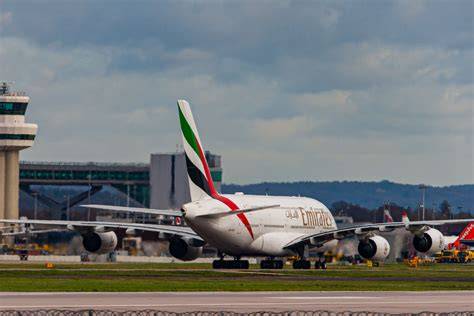
On the European routes, Milan and Athens serve a parallel purpose. They act as stepping stones that let Emirates pair long-haul sectors with local transatlantic traffic without leaving widebody jets idle. The airline balances sector length, point-to-point demand, and through-flight punctuality so that an intermediate stop strengthens the network rather than dragging down reliability. An A380 can leave Dubai, sell the entire Atlantic crossing to passengers who never intended to visit the Gulf, and still deliver a competitive arrival time into New York.
Fleet Utilization and the Widebody Mix
Emirates does not park a jet at a foreign airport for free. Fifth-freedom legs are justified when they squeeze extra block hours out of an airframe that would otherwise sit on the ground. A 777 arriving in Miami from Dubai can complete a quick round trip to Bogotá and be back before its eastbound departure, converting dead ground time into revenue flying.
The aircraft assignments reflect that logic. The JFK–Milan and EWR–Athens links have drawn Airbus A380 capacity in various seasons, while the Miami tag leans on Boeing 777-300ER and 777-200LR variants whose range and payload flexibility suit a high-elevation destination. Each swap between frames changes seat layouts, first class availability, and cabin refurbishment status, so the product a traveler books months out is not always the product that shows up at the gate.
The Political Fight Behind Three Routes Instead of Thirty
Emirates’ American fifth-freedom flights sit inside one of the most contentious debates in modern aviation: Open Skies policy and competitive fairness. American Airlines, Delta Air Lines, and United Airlines have lobbied hard against Gulf carrier expansion through the Partnership for Open & Fair Skies, accusing Emirates and its regional peers of receiving tens of billions of dollars in state support that distorts transatlantic competition.
Emirates and UAE officials have pushed back forcefully, arguing the carrier operates on a commercial footing and pointing to dividend and profit-sharing payouts as evidence. They also note that US carriers have benefited from bankruptcy protections, slot protections, and federal assistance over the years. The dispute has never fully resolved, and it has turned every new fifth-freedom proposal into a closely watched negotiation involving bilateral treaty rights and political pushback in Washington.

The consequence is visible in the network. Even when a city pair looks attractive on paper, adding a US fifth-freedom leg invites immediate scrutiny from domestic rivals and labor unions claiming home-market turf is at stake. Emirates leadership has acknowledged that further US fifth-freedom growth remains tempting when opportunities arise, but the airline has concentrated on sustaining and optimizing its existing three links rather than testing every possible combination.
What Travelers Actually Gain From These Flights
For passengers, the appeal is straightforward: Emirates cabins without the Dubai detour. A traveler flying JFK to Milan experiences the carrier’s service standards, entertainment system, and premium cabins on a transatlantic sector, and the same holds for Newark to Athens. The Miami–Bogotá hop offers something rarer still, a chance to fly a Gulf widebody between two Americas cities on a sector most carriers treat as a narrowbody shuttle.
Redemption value adds another layer. Emirates Skywards awards on the JFK–Europe sectors have been published starting around 17,000 to 17,500 miles one-way in economy, 87,000 miles in business, and 102,000 miles in first, though fees and availability vary by program and cabin. Partner programs such as Aeroplan can offer lower mileage tiers on certain routes alongside different surcharges, which makes comparison worthwhile before booking.

Competing fifth-freedom operators give flyers alternatives. Singapore Airlines runs its own US fifth-freedom links, including JFK to Frankfurt and Los Angeles to Tokyo Narita, with distinct cabin products and loyalty partners. Nonstop US and European carriers usually win on frequency, alliance connections, and lower cash totals when award seats are tight. The three Emirates routes shine specifically when a traveler’s origin and destination line up with New York, Newark, or Miami and the corresponding gateway abroad.
Delays That Begin Thousands of Miles Away
Every one of these flights originates in or routes through Dubai, which means regional airspace disruptions, seasonal schedule trims, and cabin-retrofit rotations can alter how a route operates or pause it altogether. The 2026 Middle East airspace closures that affected MIA–BOG before its May 2026 resumption are the clearest recent example, but frequency and aircraft adjustments ripple through the network continuously.
Practical drawbacks follow. A single-daily or reduced-weekly schedule leaves few same-day rebooking options when something goes wrong, and an inbound jet delayed in the Gulf or Europe can cascade directly into a transatlantic departure. Aircraft swaps between A380 frames and 777 variants can change seat maps between booking and boarding. What looks like a fixed mileage tier or a familiar cabin layout is, on a fifth-freedom flight, a starting point shaped by everything happening upstream along the route.
Will Emirates Add More US Fifth-Freedom Routes?
The three-route benchmark is likely to hold as the core of Emirates’ American fifth-freedom offering for the near term. Ongoing A350-900 deliveries and the airline’s widebody cabin retrofit program will gradually reshape how aircraft and cabins are allocated across the US network, and Emirates continues to evaluate selective growth opportunities as fleet additions arrive.
Any expansion will be governed by the same three filters that produced the current map: geography and aircraft performance, ground-time economics, and political tolerance in Washington. A route that clears all three can join the lineup; one that fails any of them will not, regardless of how attractive the demand forecast looks. For now, travelers seeking a standalone Emirates flight between the United States and another country have exactly three doors to walk through, and each one opens onto a different corner of the carrier’s global strategy.