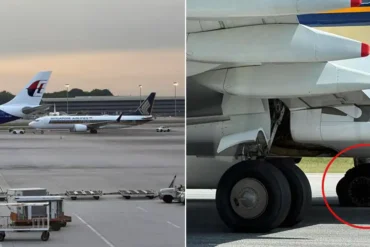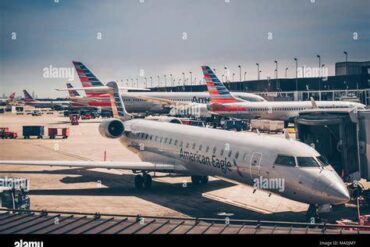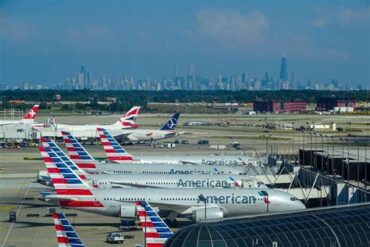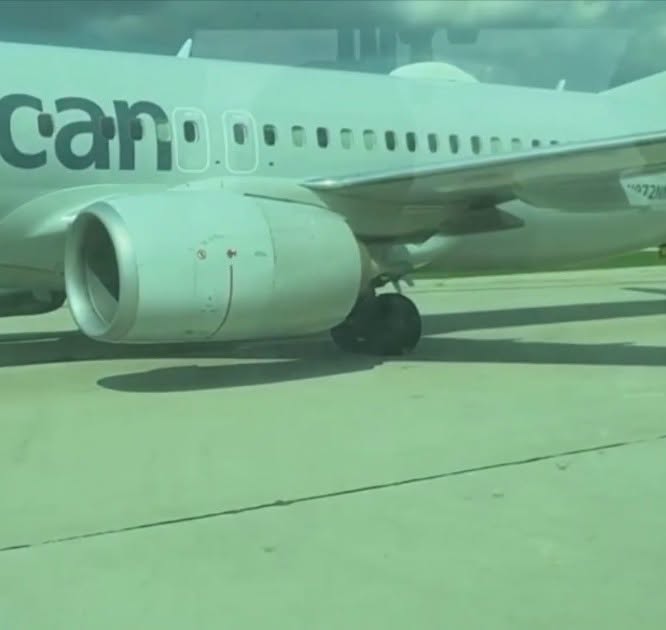
Chicago O’Hare International Airport has recorded its fifth tire-related aircraft incident in just two weeks, adding to a growing sequence of unusual events that has involved both American Airlines and United Airlines. The latest incident occurred on August 26, when an American Airlines Boeing 737 operating flight AA3280 to Charlotte suffered two tire blowouts while taxiing for departure.
The aircraft had pushed back from its gate and was moving toward the runway at approximately 1:35 p.m. local time when the problem occurred. According to air traffic control communications, another aircraft noticed the damaged tires and alerted controllers. The American 737 subsequently became disabled on a taxiway, requiring passengers to leave the aircraft by airstairs before being transported back to the terminal by bus.
There were no reported injuries, but the incident caused a significant operational disruption. Passengers were eventually transferred to a replacement aircraft, with the flight reaching Charlotte Douglas International Airport roughly four hours behind schedule. American Airlines confirmed that flight 3280 had experienced a tire issue shortly after leaving its gate, while the Federal Aviation Administration said it would investigate the event.
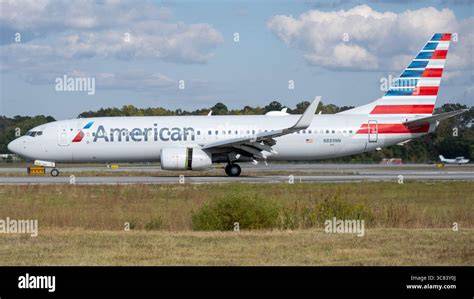
American Airlines 737 Suffers Double Tire Blowout at O’Hare
The most striking aspect of the latest event is that both failed tires were located on the aircraft’s right main landing gear. A tire failure while an aircraft is taxiing is generally less dangerous than one occurring during a high-speed takeoff or landing, because the aircraft is moving considerably more slowly and has greater opportunity to stop safely.
Nevertheless, a disabled narrowbody aircraft can quickly become an airport-wide operational problem at a facility as busy as O’Hare. Taxiway blockages can interfere with aircraft movements, create additional congestion and force airlines to rearrange gates, crews and aircraft. In this case, the passengers had to be removed from the stranded 737 and moved by ground transportation before boarding a replacement aircraft.
The incident is particularly notable because it was the third American Airlines aircraft involved in an O’Hare tire failure since August 13. That frequency has attracted attention from aviation authorities and airport officials, although there is currently no evidence that the events share a common technical cause.
Five Tire Incidents Have Occurred Since August 13
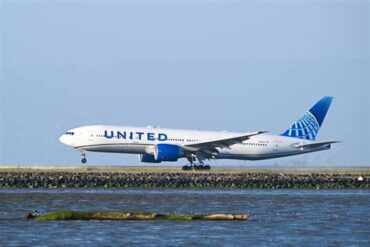
The sequence began on August 13, when United Airlines flight UA455, a Boeing 737-900 bound for Phoenix, suffered a tire failure during takeoff. Pieces of rubber were left on the runway, prompting an operational response at the airport.
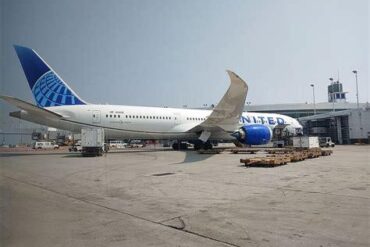
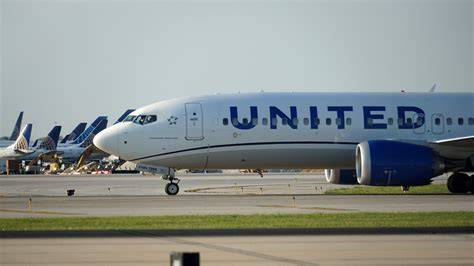
Four days later, O’Hare experienced two separate tire incidents within hours of one another. American Airlines flight AA386, a Boeing 737-800 arriving from New York LaGuardia, experienced two tire failures during landing. Shortly afterward, United Airlines flight UA739, operated by an Airbus A320-200 from Omaha, suffered tire damage while exiting the runway.
The fourth incident occurred on August 21. An American Airlines Boeing 737-800 arriving from Phoenix suffered a tire burst while taxiing toward the gate. Five days later, AA3280 became the latest aircraft affected, bringing the total to five incidents in approximately two weeks.
Multiple Aircraft and Runways Complicate the Investigation
Despite the unusual concentration, investigators have not identified an apparent connection between the five events. The Chicago Department of Aviation has indicated that the incidents occurred in different areas of the airport and involved separate runways and taxiways.
The aircraft involved also weaken the possibility of a single aircraft-type defect. The incidents include Boeing 737-900 and 737-800 aircraft as well as an Airbus A320-200. Both American Airlines and United Airlines have therefore been drawn into the investigation, rather than the events being confined to one carrier or one aircraft family.
The airport has also conducted debris inspections following the earlier incidents. After the August 17 failures, runway and surrounding areas were swept, but officials did not find debris that could clearly explain the tire damage. Investigators are consequently examining a broader range of possibilities, including runway surface conditions, foreign object debris and landing-gear maintenance practices.
What Can Cause an Aircraft Tire to Fail?
Commercial aircraft tires are engineered to withstand substantial loads, high rotational speeds and repeated cycles of takeoff and landing. Even so, they remain consumable components and can fail for a variety of reasons. Low tire pressure, worn casings, excessive braking, heat and foreign object debris are among the potential contributors to a blowout.
Temperature can also influence tire performance. Runway surfaces can become extremely hot during summer conditions, increasing thermal stress on tires during taxiing, landing and braking. However, the presence of several incidents in a short period does not automatically demonstrate that weather or pavement temperature was responsible.
Foreign object debris is another concern because relatively small objects on a runway or taxiway can damage tires. Yet the fact that the five O’Hare incidents occurred in different locations makes a single piece of debris an unlikely explanation unless investigators identify a broader airport-wide source.
Why the Timing of a Tire Failure Matters
A tire failure is not automatically a major aviation emergency. When and where the failure happens can be more important than the failure itself. A blowout during slow taxiing may leave an aircraft stranded but otherwise controllable, while a failure during a high-speed rejected takeoff can create significantly greater risks.
That distinction is important when assessing the O’Hare incidents. Although five tire failures in two weeks are unusual enough to warrant scrutiny, none of the reported events has resulted in injuries or an aircraft accident. The latest American Airlines incident, despite involving two tires, was contained while the aircraft was still taxiing.
For now, the sequence remains an unusual cluster rather than evidence of a confirmed systemic safety problem. The FAA, Chicago Department of Aviation, American Airlines and United Airlines will need to determine whether the incidents are simply a statistical coincidence or whether common environmental, operational or maintenance factors contributed. Until those investigations produce concrete findings, the safest conclusion is that O’Hare has experienced a rare concentration of tire failures that deserves careful examination—but not premature conclusions.