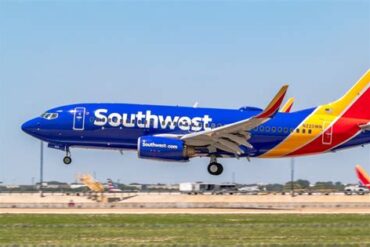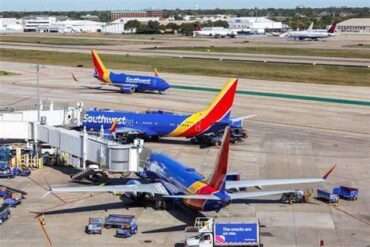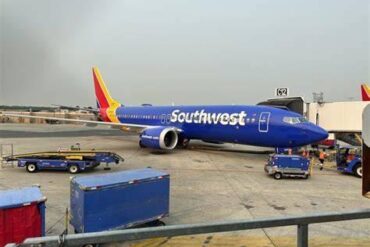
Southwest Airlines, one of the largest carriers in the United States by both fleet size and passengers carried, will introduce five new nonstop routes across its domestic network between January and March, with Nashville, Austin and Houston anchoring the schedule. The airline has continued to pour resources into Nashville International Airport (BNA), where it operates more than 56% of all scheduled flights between June 2025 and May 2026, according to data from The Frequent Flyer. American Airlines sits a distant second at 12.9%, while Delta Air Lines holds 11.5%, underscoring just how dominant Southwest has become in Music City.
Beginning January 6, the carrier adds daily nonstop service from Nashville to Des Moines International Airport (DSM) and five-times-weekly flights to Wichita Dwight D. Eisenhower National Airport (ICT), both planned as year-round operations. The pair slots neatly into an existing footprint of 72 year-round and 18 seasonal routes from BNA. On the Des Moines pairing, Southwest will square off against Allegiant, while the Wichita link faces no direct competition, giving travelers in southern Kansas a fresh one-stop connection to a major leisure and business gateway.
Austin Gains Fort Myers and Palm Springs as Southwest Answers Tech-Driven Demand
At Austin Bergstrom International Airport (AUS), Southwest is adding a seasonal link to Fort Myers (RSW) from March, operating twice weekly on Saturdays as a convenient route to one of Florida’s most popular holiday destinations. Delta will also launch seasonal Fort Myers service from Austin this November, meaning Southwest will become the second carrier on the city pair and will compete head-to-head for winter sun seekers. The airline is simultaneously reintroducing Palm Springs (PSP) to its seasonal map from Austin, flying five times weekly from January 2 aboard its Boeing 737 fleet after previously operating the route in a limited capacity.
Both additions reflect Austin’s transformation into one of the fastest-growing regions in the country, where Tesla, Google and Amazon have established major offices and fueled high-end business and leisure demand. The airport itself is midway through a multi-billion-dollar expansion and upgrade program, positioning the city to absorb even more traffic. Southwest’s timing is deliberate: adding capacity while the region’s corporate base deepens its roots gives the airline a stronger claim on both weekday business travelers and weekend leisure flyers.
Houston Hobby to Amarillo Kicks Off With Daily Nonstop Service
The final piece of the first-quarter expansion is a new Houston Hobby (HOU) to Rick Husband Amarillo International Airport (AMA) route launching January 15 with an initial once-daily schedule. Southwest will face no direct competition on the pairing itself, though United Airlines does fly between Houston George Bush Intercontinental (IAH) and Amarillo, meaning passengers already have an alternative into the Panhandle. The route strengthens Hobby’s role as a low-cost gateway for Texas travelers who would otherwise connect through larger hubs or drive the roughly 600 miles across the state.
Taken together, the five routes illustrate a carrier that is widening its domestic map rather than retreating from it. The Nashville investment captures the city’s booming business and leisure market, the Austin additions respond to a tech-fueled population surge, and the Amarillo link extends Southwest’s Texas network into underserved territory. For travelers across the southern and central United States, the first quarter of 2027 brings more nonstop choices, tighter schedules and fewer connections than ever before.