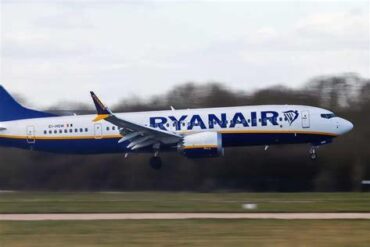
A Boeing 737 MAX 8 generates roughly $200,000 in revenue per day for the airline that flies it, a figure that has climbed from the dark days of the 2019–2020 grounding, when each parked jet was bleeding about $150,000 every single day. That number is the closest thing the industry has to a reliable benchmark, and it emerged not from glossy investor presentations but from the painful arithmetic analysts performed while 387 aircraft sat idle on desert tarmacs. The 737 MAX 8 has since become the workhorse of the narrowbody world, and understanding what it earns — and, more importantly, what it keeps — reveals the entire economics of modern short-haul flying. Revenue is not profit, and the gap between the two determines whether an airline thrives or quietly collapses under fleet costs.
The Grounding Era Loss Estimates That Still Define 737 MAX 8 Revenue
Airlines guard revenue-per-aircraft data more closely than almost any other operational metric, but the 737 MAX crisis created a rare natural experiment. With the global fleet grounded, analysts could calculate exactly what each silenced jet would have been earning, and those estimates remain the best available proxy for 737 MAX 8 daily revenue today. IBA, the aviation consultancy, put total lost earnings at $150,000 per aircraft per day. The Conversation arrived at a strikingly similar conclusion by modeling three round trips per day with an average of 145 tickets sold per flight, then multiplying those sales by the US Department of Transportation average domestic airfare of $343.28 at the time.
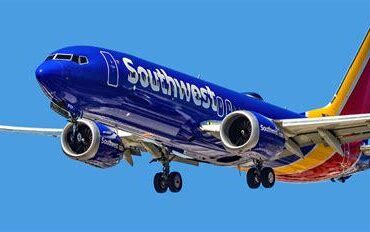
The aggregate numbers exposed the scale of the disaster. Southwest Airlines, which held the largest MAX fleet at the time with 34 aircraft, was losing roughly $5 million in revenue every day. Across the entire global 737 MAX fleet, the losses approached an eye-watering $60 million per day, which is precisely why the crisis became existential for Boeing and why the manufacturer was expected to absorb a substantial share of those costs. IBA also documented the hidden expenses that compounded the revenue loss: leasing at $360,000 a month, staffing for two flight crew and four cabin crew at $5,000 per day, and a cost of $100,000 to reaccommodate every 1,000 disrupted passengers. Those figures matter because they establish that the daily earning power of a 737 MAX 8 was always measured against a dense stack of fixed and variable costs.
Converting 2019 Estimates Into Today’s 737 MAX 8 Daily Revenue
Two independent methods translate the grounding-era figure into contemporary money, and they converge with useful precision. The first uses the US Bureau of Labor Statistics average annual inflation rate of 4.27% from 2019 to 2026, which lifts the original $150,000 to approximately $201,130 per aircraft per day. The second reruns The Conversation’s original model using the current domestic itinerary fare of $445.26 reported by the Bureau of Transportation Statistics for the second quarter of 2026, which produces an estimated $195,000 per day. The roughly $6,000 difference is instructive: it shows that air fares have not perfectly tracked overall inflation, so airlines have not been able to pass the full erosion of the dollar onto passengers.
The reason both methods matter is that they bracket the realistic range of 737 MAX 8 revenue per day between roughly $195,000 and $201,000. That is a remarkably tight band for an industry notorious for volatility, and it gives analysts a defensible central estimate of about $200,000 daily. The aircraft’s technical envelope explains why that figure is achievable at all. In a standard two-class layout the jet seats 160 to 178 passengers, with a maximum seating density of 210, a maximum takeoff weight of 182,200 lb (82,640 kg), a range of 3,300 nautical miles (6,110 km), a length of 138 feet 2 inches (42.1 meters), a wingspan of 117 feet 10 inches (35.9 meters), and two CFM International LEAP-1B engines. Those specifications let airlines chase high-frequency short sectors or thinner long-range missions, and the mission mix is what ultimately determines the revenue.
Why Revenue Is Not Profit: The Real Cost Structure Behind a 737 MAX 8
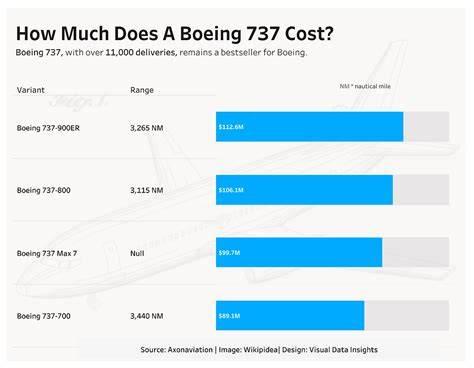
The $200,000 daily revenue figure is a starting point, not an outcome, because every airline must subtract the cost of acquiring and operating the aircraft before booking a single dollar of margin. The largest single cost is the jet itself. Neither Boeing nor Airbus formally publishes list prices anymore, but the market price for a 737 MAX 8 was $55 million in 2025, with leasing at roughly $400,000 per month, both broadly comparable to the Airbus A321XLR. A factory-fresh aircraft costs substantially more than a second-hand example, exactly as with a car, and that acquisition cost is spread across 20 to 30 years of active service rather than loaded into daily operating expenses — though residual depreciation matters enormously when an airline decides to sell.
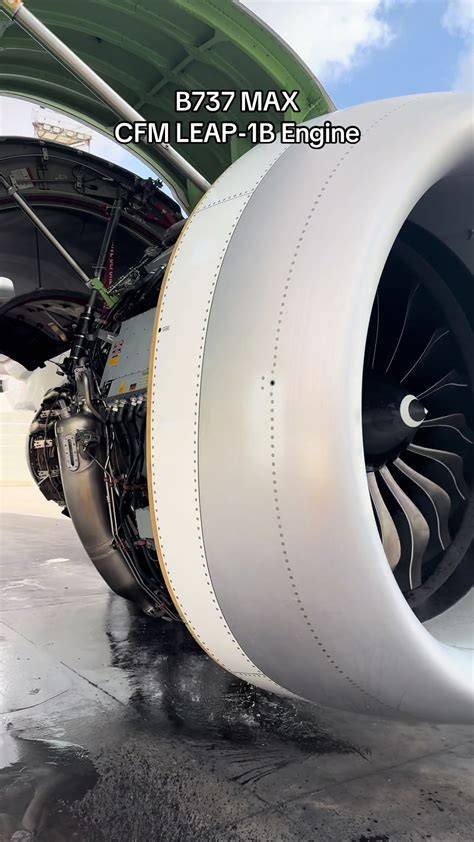
The 737 MAX’s operating economics provide the counterweight. Boeing claims the jet is around 15% to 20% more fuel-efficient than comparable previous-generation narrowbodies, which directly lowers the largest variable cost on every flight. The CFM LEAP-1B engine has also proven exceptionally reliable, trimming maintenance reserves. Its specifications tell the story of that efficiency: 28,000 lbf (124.5 kN) of maximum thrust, a bypass ratio of 8.6:1, an overall pressure ratio of 41:1, a length of 10.3 feet (3.14 meters), a width of 7.9 feet (2.4 meters), a height of 7.4 feet (2.2 meters), and a weight of 6,128 lb (2,800 kg). High bypass ratios and pressure ratios are the mechanical foundation of the fuel burn advantage that makes the daily revenue math work.
Fleet Commonality and Crew Training Determine How Much Airlines Keep
Costs vary dramatically between carriers, and fleet commonality is the variable that separates marginal operators from disciplined ones. An airline introducing the 737 MAX 8 into a fleet with no other Boeing narrowbody aircraft must invest heavily in crew training, simulator capacity, and maintenance infrastructure before the jet earns a single passenger dollar. Southwest Airlines, which operates an entirely 737 fleet of more than 800 aircraft, faced relatively minor excess setup costs when it introduced the MAX. Carriers without that lineage pay far more to reach operational maturity, which compresses their effective daily earnings even when their gross revenue looks identical.
Utilization: The Single Biggest Lever on 737 MAX 8 Daily Earnings
The reason precise daily revenue figures remain so elusive is that utilization varies enormously by operator. Some low-cost airlines achieve turnarounds under 30 minutes and fly their 737s for 10 to 12 hours per day, while legacy carriers are generally less adept at squeezing flight time out of the same airframe. In 2024, Simple Flying’s Lukas Souza illustrated the spread using Southwest’s N8710M as a case study. On November 28, 2024, that jet flew just twice — from Sacramento International Airport (SMF) to Honolulu’s Daniel K. Inouye International Airport (HNL), and onward from HNL to Ellison Onizuka Kona International Airport at Keāhole (KOA).
The previous day was far busier, and the itinerary shows how a single airframe can be worked hard across a continent. N8710M flew from Miami International Airport (MIA) to Denver International Airport (DEN) in 4 hours 13 minutes, from DEN to SMF in 2 hours 14 minutes, from SMF to William P. Hobby Airport (HOU) in 2 hours 57 minutes, from HOU to Los Angeles International Airport (LAX) in 3 hours 15 minutes, and from LAX back to SMF in 1 hour 2 minutes. Five sectors in a single day versus two sectors the next day is the difference between a highly productive asset and an underutilized one, and it explains why two airlines can report wildly different 737 MAX 8 revenue per day while flying identical aircraft.
The MAX’s longer range and greater efficiency also push it toward different missions than older 737 variants. Carriers frequently fly farther but less often, trading frequency for reach. Capacity choices compound the effect. Budget operators pack the jet toward its 210-seat maximum, while legacy carriers sacrifice seat count for premium cabins. United Airlines configures its 737 MAX 8 with 164 or 168 seats, dedicating significant space to premium economy and economy, while Allegiant Air fits 188 to 190 passengers into the same airframe, with one economy-only layout and one carrying a small number of first class seats. Seat Maps data confirms how profoundly configuration changes revenue per flight.
Air Canada’s Longest 737 MAX 8 Route Shows the Jet’s New Mission Profile
Air Canada is preparing to launch its longest 737 MAX 8 flight on December 13, between Vancouver International Airport (YVR) and Liberia International Airport (LIR) in Costa Rica, a route covering 3,425 miles (5,512 km). The scheduled block time is seven hours and 20 minutes outbound and eight hours and 55 minutes for the return, with a frequency of two to three times weekly. The route overtakes Montréal–Trudeau International Airport to Nantes Atlantique Airport (NTE) as the carrier’s previous longest 737 MAX 8 service, and it joins other Air Canada MAX routes exceeding 3,000 miles (4,800 km) to Shannon, Honolulu, Kahului, Brussels, Montego Bay, and Edinburgh.
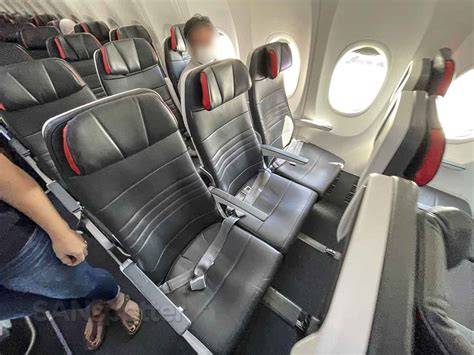
The strategy reflects how far the narrowbody envelope has stretched. Air Canada hopes the new Costa Rica service will cement a strong position in the winter leisure market of Central America, a segment where long, thin routes reward an aircraft with low per-seat costs. “When customers step onto our aircraft, they should instantly feel a sense of comfort, care, and pride,” said COO Mark Nasr. “This renewal program is about delivering that feeling consistently, across every flight. Every update is designed with our customers in mind, as we introduce an entirely new Air Canada Rouge product.” The comment captures the second revenue lever beyond raw utilization: product quality that supports fare premiums on routes where the MAX 8 is the only realistic equipment.
What the 737 MAX 8’s Daily Economics Really Tell Us
A daily $200,000 revenue figure sounds spectacular until it is placed against a $55 million airframe, lease payments near $400,000 a month, crew and maintenance reserves, and the fixed cost of training and infrastructure. The aircraft earns its keep only when it flies long days, turns fast, and carries enough seats to spread those costs across hundreds of fares. The grounding-era estimates of $150,000 per day remain the analytical foundation precisely because they forced the industry to price an idle asset, and inflation-adjusted, they now validate the roughly $195,000 to $201,000 range that operators quietly live with. The 737 MAX 8 is a revenue engine, but the airline that wins with it is the one that keeps it turning from dawn until well after dark.