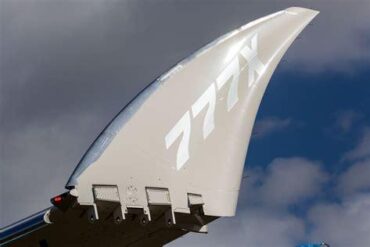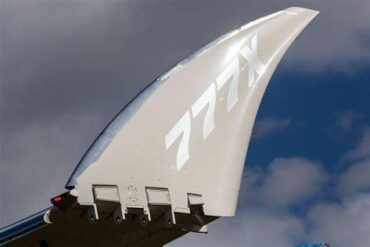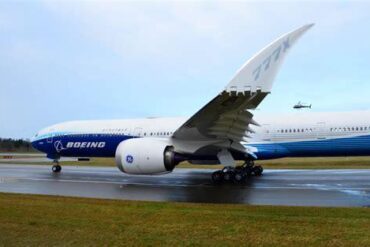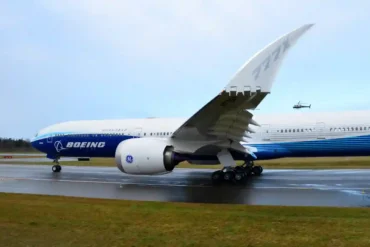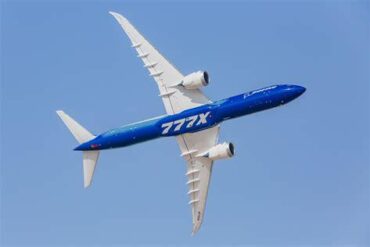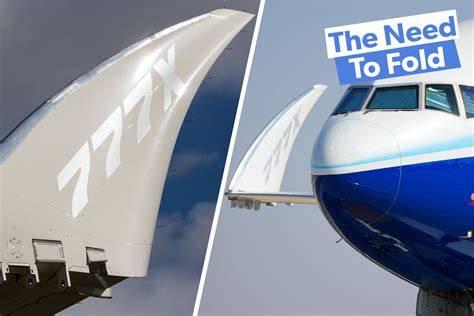
Folded wingtips look like an engineering party trick on paper, yet the Boeing 777X treats them as a hard operational boundary that shapes almost every ground procedure on the aircraft. The flagship twinjet carries a 71.8-metre wingspan, which exceeds the 65-metre limit that the International Civil Aviation Organization sets for Code E airport infrastructure. Rather than force airports to pour concrete and rebuild gates, Boeing hinged the outermost 3.5 metres of each wing so the aircraft can shrink on the ground and stretch in the air. Trouble is, that ingenuity creates a configuration the airframe was never engineered to fly in, and the certification strategy therefore has to make a folded takeoff physically and procedurally impossible rather than merely discouraged. Every warning chime, every electronic checklist item, and every flight control law on the type ultimately exists to keep a pilot from starting a takeoff roll with hinged tips pointing skyward.
What the Liebherr Wingtip Fold Actually Does on the 777X
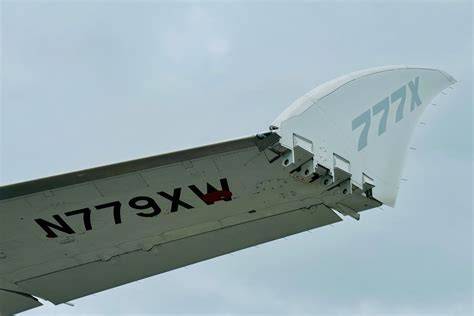
The mechanism itself comes from Liebherr-Aerospace, built at its centre of excellence in Lindenberg, Germany, and represents the first folding wingtip system ever certified for commercial airline service. A hydraulic power drive unit pushes torque into geared rotary actuators that lift each 3.5-metre tip from the horizontal flight position to vertical in roughly 20 seconds. Once upright, the panels rest against the fuselage sides, bringing the effective span down to around 64.8 metres and inside Code E parking limits. Once horizontal again, a chain of latch pins and secondary-lock actuators clamps the joint shut, and in flight a large structural bolt carries the load path while the mechanism is electronically isolated so that even a total loss of hydraulic or electrical power cannot move the tip while airborne.
That architecture explains why folding is not a passive inconvenience. The wingtip joint, the latches, and the surrounding composite structure are sized for the loads a locked, straight wing sees. They were never dimensioned to resist the twisting and bending that an upward-pointing surface would generate at takeoff thrust, rotation and climb-out speeds.
Why the Folded Wing Fails the Aerodynamic Basics of Takeoff
The 777X wing is an efficiency machine built around span. A wider wingspan pushes the tip vortices farther from the fuselage, softening downwash across the chord and allowing the wing to generate more lift for less induced drag. The thinner carbon-fibre reinforced plastic wing also creates a broader, more efficient lifting surface that lets the GE9X engines produce less thrust for a given climb. A folded tip deletes the outer panel from the lift distribution at the exact moment an aircraft needs every newton of lift it can find. Drag rises sharply because the vertical tip acts as a crude, permanent fin and spoiler, while lift falls and the effective aspect ratio shrinks toward the performance of a much smaller wing.
The mathematical consequences land in the certification calculations, not just the test pilot’s intuition. Rotation speeds, takeoff distances, obstacle clearance gradients, engine-out climb performance, and structural limits live and die on the clean, unfolded wing. A folded takeoff would need a longer runway, a steeper throttle setting, and a climb profile the aircraft cannot demonstrate. The reference material puts the efficiency payoff of the unfolded configuration at roughly 10 to 12 per cent against previous generations, with fuel burn about 20 per cent below the legacy 747. Those figures describe a wing that is fully deployed, so a folded takeoff is not a degraded version of normal flight; it is outside the certified aircraft that every performance chart assumes.
The Takeoff Warning System, the Electronic Checklist, and the 50-Knot Trap
Boeing’s answer is an escalating layer of prevention that begins long before the thrust levers move. Federal Aviation Administration and European Union Aviation Safety Agency rules require a takeoff configuration warning that fires an audible alarm if the aircraft is not properly set for flight, and the 777X extends that logic to the hinges. The electronic checklist reports the wingtip position as incomplete until both tips are extended and locked, so a crew running the before-takeoff flow sees an open item rather than discovering the problem on the runway. If a pilot nevertheless adds power with the tips still upright, the warning sounds as part of the standard configuration package.
The most telling detail is what happens after the aircraft starts moving. Once the 777X passes 50 knots on the takeoff roll, the avionics stop flagging the tips as a reason to abort. That design choice reflects the physics of rejected takeoffs more than it reflects leniency: a high-speed abort brings its own catastrophic risks, and below 50 knots a stop is cheap, while above it the system balances risks rather than blindly throwing a warning. The practical effect is a narrow window in which a determined crew could still be warned, and the layered protection above the rolling threshold is the mechanical integrity of the hinge and the certification basis itself, not a chime.
The same 50-knot threshold runs the operation in reverse on arrival. When ground speed drops below that figure after landing, the tips fold automatically, cutting pilot workload compared with the manual, ground-crew-verified folding on carrier jets such as the F/A-18. On the ground the aircraft physically cannot run with tips extended in the general case, because gate clearance depends on them being stowed, and on the runway the opposite lock applies. Automation handles both ends so the crew never has to manage the transition under pressure.
How Naval Aviation Bloodlines Fed the Commercial Hinge
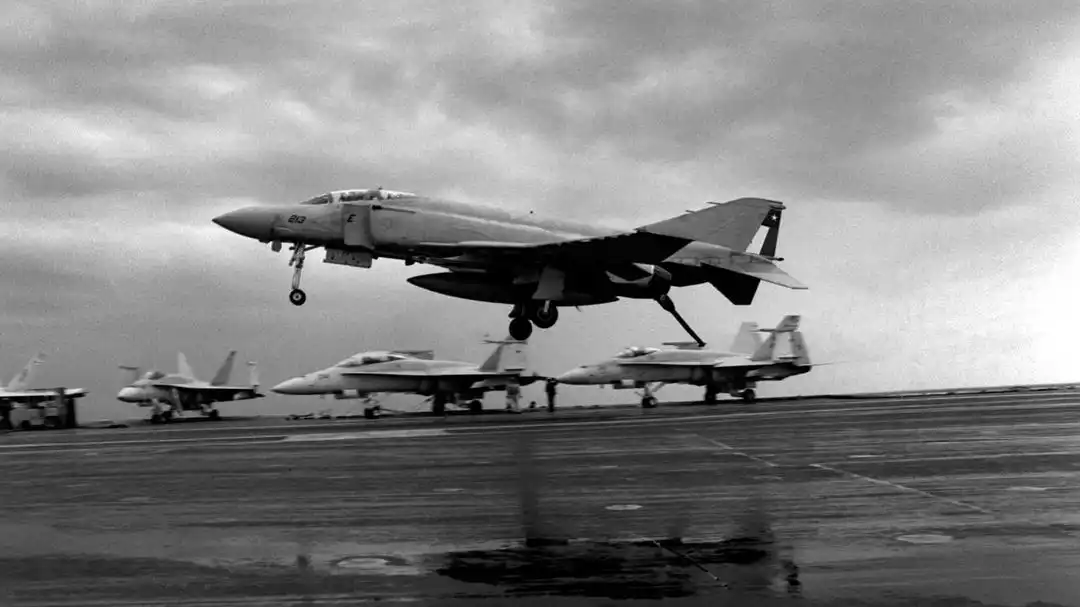
Boeing’s 1997 merger with McDonnell Douglas handed it the F/A-18 Super Hornet programme along with decades of carrier engineering, including the lineage of the F-4 Phantom II, the most heavily produced supersonic naval fighter ever flown. Carrier aircraft live and die by fold reliability, and their designs contributed sensor redundancy and locking-pin philosophies that reappear in the 777X’s tip mechanism. The commercial version differs in scope: the Super Hornet folds a major share of its wing, whereas the 777X folds only the outer 3.5 metres so that the weight penalty stays modest and the hinge sits where bending moments are comparatively gentle rather than at a heavily loaded mid-wing station.
Boeing also had to prove to regulators that the hinged tip could tolerate the same aerodynamic loading as a fixed wing, borrowing testing methods refined across generations of catapult operations. The mock-up sits near the fuselage in silhouette terms only; the real proof is a structural demonstration that a bolted, latched tip behaves as a continuous structural member to the same standard as the rest of the aerofoil.
The 1995 Patent That Was Too Heavy and Too Complex
None of this is new thinking. Boeing patented folding wingtips for the original 777 in 1995, envisaging a hinge closer to the wing root with the outer 21 feet of each panel tilting upward. Airlines rejected the idea because it added structural weight, cut into fuel capacity at the exact volume airlines were paying for, and multiplied maintenance burdens. The trade-offs simply did not close at that point in materials and actuator technology. The modern version moves the joint much farther outboard, trims the folding section to 11 feet, and pairs it with a large-span composite wing that makes the aerodynamic prize worth the hinge’s cost.
The historical contrast also clarifies why the aircraft cannot simply ignore the folded state. The 1995 design was an engineering proposition; today’s hinge is a certified component inside a certified type design, and certification only covers the unfolded configuration. Operating beyond that envelope is not a creative use of the aircraft, it is a departure from approved limits.
What the Folding Tips Buy in Range, Climb and Cabin Comfort
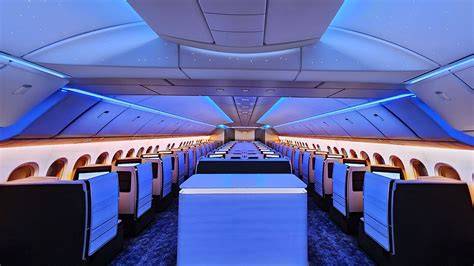
The unfolded wing unlocks the rest of the aircraft’s selling points. Extra span lets the 777X climb faster and cruise higher, where thinner air reduces resistance, a benefit independent of passenger comfort but inseparable from the aerodynamics above. Carbon-fibre construction keeps the big span light enough to avoid a prohibitive weight penalty. Smooth Ride Technology, a fly-by-wire suite descended from the 787, uses hundreds of sensors to detect turbulence and commands the flaperons to damp the vertical motion and pitch passengers feel, while the flexible composite wing absorbs gust loads like a giant shock absorber. A cabin pressure altitude around 6,000 feet, higher humidity, and engines about 40 per cent quieter than their predecessors round out a package aimed at long-haul fatigue as much as at fuel economy.
Certification Delays, the 2025 Dubai Airshow and the 777X’s Future
Reaching service has been slow. The programme was originally slated to debut in 2020 with launch customer Lufthansa, but full-rate production is not expected until 2027, and Boeing chief executive Kelly Ortberg has described a mountain of work still ahead on certification. The fallout from the two fatal 737 MAX crashes in 2018 and 2019, which killed 350 people, drove a company-wide refocus on quality control that inevitably slowed the widebody. The Dubai Airshow in 2025 nonetheless showed customer confidence is intact: Emirates, the world’s largest widebody operator, added 65 more 777X aircraft to its order book, betting that the type is the only credible replacement for ageing jumbo fleets of A380s and legacy 747s.
For all that commercial stakes look enormous, the humblest item on the checklist is the one that keeps the story coherent. The aircraft will not take off with its wings folded because the wing was designed to fly beautifully and the hinge was designed to lock perfectly, and the certification, the alarms, the checklist and the 50-knot logic all exist to ensure that the first configuration is always the one at the runway threshold.