The Federal Aviation Administration lifted its rare nationwide ground stop on Friday evening, but the damage to the US aviation network was only beginning to surface. Hundreds of aircraft had already completed their final flights of the day and thousands of cabin and cockpit crews had finished their duty hours in cities they were never scheduled to lay over in. As the airspace reopened at 8:15 PM, carriers confronted a logistical knot far harder to untangle than the original outage: a fleet and a frontline workforce scattered across the wrong airports, and a flying public spreading across terminals that were never designed to hold them overnight. Airlines for America and federal officials were quick to concede that the effects would outlast the halt itself.
The sequence of events was swift and unusually severe. Trouble was first identified at 3:36 PM, when air traffic control centres around the country detected instability in radar and communication systems. That instability escalated within minutes as the switches and routers carrying critical flight data became overloaded, producing inconsistent information across the network. With controllers unable to trust the displays in front of them, the FAA ordered all aircraft on the ground to remain parked for more than four hours. Tens of thousands of passengers saw their departure times dissolve in real time, and airlines began the painful business of deciding which of their idled jets could realistically be flown again before the night expired.
Thousands of Passengers Face Cancellations and Delays as Displaced Aircraft Squeeze Saturday Schedules
The human cost arrived in dispatches. According to CNN, more than 7,500 flights inside, into, or out of the United States were cancelled across the day, alongside upwards of 10,000 flights that were delayed, some by hours and others by only enough to ruin a connection. The knock-on effect reached immediately into Saturday, when more than 1,500 flights had already been scrubbed before the morning check-in counters opened. Passengers were urged to reconfirm flight status before travelling to the airport and to exercise patience, advice that does little for a family that has already checked out of a hotel or surrendered a rental car.
The underlying mechanism is one the travelling public rarely sees. An aircraft that cannot depart is not merely parked; it is removed from the subsequent rotation it was scheduled to fly, and unless a spare airframe happens to be sitting at the right station, everything downstream of that rotation must be rebuilt, sometimes hours later, often with a different aircraft entirely. Crews add a second layer of constraint. Flight attendants and pilots operate under legally mandated duty and rest limits, so a crew that is held on the ground through the stoppage cannot simply be extended into the night. When their rest window expires, they become unavailable for the very flights the airline needs them to operate when the airspace reopens.
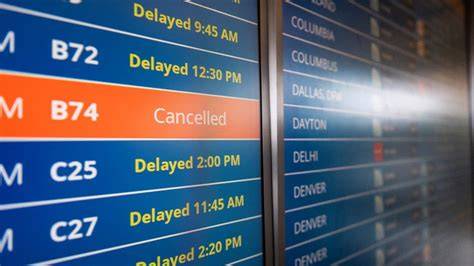
That is why the stranded crews matter more than the grounded jets. Thousands of pilots and flight attendants ended Friday in cities that were not their contractual bases, and each one of them must be ferried back, rested, and reinserted into a legal roster before the operation can stabilise. Chris Sununu, President and Chief Executive Officer of Airlines for America, told NewsNation that the agency had moved quickly to impose the national stop for safety reasons until the affected systems could be restored, and he repeated the central warning: the halt displaced thousands of airline crew members and many aircraft nationwide. Carriers were working around the clock to reposition both, but positioning flights consume aircraft and crews as well, which is precisely why recovery compounds.
Airspace Reopened at 8:15 PM, Yet Slow Restart Keeps Air Traffic Controllers Under Scrutiny
Airspace reopened at 8:15 PM on Friday, and the restrictions that had confined every jet to its stand were formally gone. Recovery, however, is a matter of pace rather than permission. Departures resumed gradually as controllers worked through a congested order book, and Transportation Secretary Sean Duffy acknowledged the obvious in three blunt words: “It’s going to be slow.” Queues built at major hubs where demand had stacked all afternoon, and airlines spaced out their departures to avoid overwhelming a system that had just demonstrated how thin its margins are. The ground stop also rippled outward across the globe, stranding aircraft destined for the US at overseas stations and delaying return legs for passengers who had no idea a communications fault would reshape their itinerary.
The event has intensified scrutiny of the US air traffic control system, long described as overburdened by aging technology, obsolete equipment, and fragile communications links, while simultaneously suffering from a shortage of several thousand air traffic controllers. Not everyone accepts the official account. Some controllers questioned Duffy’s explanation, with journalist Anna Giaritelli telling CNN that such switch work does not normally occur during peak periods: “These types of switches they’re doing that the FAA is doing, they don’t happen during the day. They don’t happen during busy times like a Friday afternoon. They’re doing these midweek, in the middle of the night when there is no air traffic going on.” The remark points to a governance question about maintenance windows, not merely a technical one.
Today’s Ground Stop Was Safe, But Federal Officials Warn More Disruption May Follow
Homeland Security Secretary Markwayne Mullin emphasised that the FAA updates to aging systems drove the decision, and that no threat to the United States was involved; the stoppage was also unconnected to the Thursday Microsoft outage. The distinction matters. A ground stop restricts operations on the ground, so aircraft already airborne continued to their destinations, and thousands of jets landed safely while the halt remained in force; what passengers experienced was a halt to departures, not to flying. The Transportation Secretary has warned that further disruption is possible unless these systems are modernised, a caution that frames the incident as a preview rather than an anomaly.
For the travellers caught inside it, the practical reality is a multi-day rebuild of the aircraft routing and crew scheduling that underpins every ticket. Rebooking options remain thin at hub airports where every seat on every remaining flight is contested, and some passengers will be routed through secondary cities simply to reach their destination within the week. Relief is expected to broaden as displaced crews cycle back through rest and repositioning flights return aircraft to their bases, yet carriers continue to advise travellers to check status repeatedly and to expect schedule changes at short notice. The coming Thanksgiving travel rush in late November is not expected to be affected by this particular event, which is cold comfort to passengers still sleeping in an airport concourse tonight.