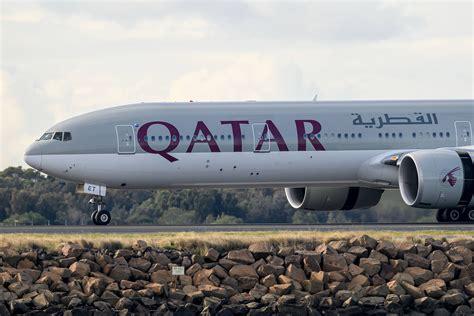
Global aviation networks are built on precision timing, carefully choreographed routes, and predictable airspace access. When one of those elements disappears, the ripple effects spread rapidly across continents. Ten days after the sudden closure of Qatari airspace amid rising geopolitical tensions in the Middle East, Qatar Airways still has 13 passenger aircraft stranded across the United States, creating a rare logistical challenge for one of the world’s most globally connected airlines.
The disruption began on February 28, when multiple Qatar Airways flights landed at American airports shortly before the suspension of normal operations into and out of Doha’s Hamad International Airport (DOH). Once the airspace closure took effect, aircraft that had already reached North America were unable to return to the airline’s hub. As a result, widebody jets that normally operate long-haul rotations between continents have been sitting idle on foreign tarmacs for more than a week.
This unusual situation highlights how dependent global aviation is on stable airspace corridors. When a strategic hub like Doha becomes inaccessible, the airline’s carefully balanced network—spanning Europe, Asia, Africa, and the Americas—suddenly faces operational bottlenecks.
New York JFK Holds the Largest Cluster of Grounded Aircraft
Among all US airports affected, New York’s John F. Kennedy International Airport (JFK) currently hosts the highest number of stranded Qatar Airways jets. Three aircraft arrived within a narrow window on February 28, effectively becoming grounded once the airline halted normal operations.
The first aircraft to touch down was Boeing 777-300ER A7-BEP, which arrived from Doha operating flight QR703, landing at 9:12 a.m. UTC. Only a couple of hours later, an Airbus A350-900 registered A7-AMJ landed at 11:25 a.m. as flight QR706. The sequence concluded later that afternoon when another Boeing 777-300ER, A7-BAI, completed flight QR701 and arrived at 4:23 p.m. UTC.
JFK has long been one of Qatar Airways’ most strategically important destinations in North America. The airport functions as a major gateway to the US East Coast and also acts as a partnership hub with American Airlines, a fellow member of the oneworld alliance. Under normal circumstances, passengers connect seamlessly between the two carriers. With Qatar Airways operations suspended, however, that connection pipeline has effectively paused.
According to the airline, scheduled flights remain temporarily suspended until Qatari aviation authorities declare the airspace safe for full reopening. Until then, the airline continues monitoring the situation while coordinating limited operational adjustments.
Aircraft Scattered Across Major US Aviation Hubs
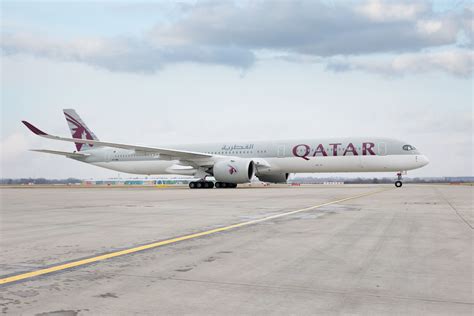
Beyond New York, the grounded fleet is dispersed across several major American aviation hubs, illustrating just how extensive Qatar Airways’ US network has become over the past decade.
Dallas/Fort Worth International Airport (DFW) currently holds two stranded aircraft, both Boeing 777-200ERs. The first, A7-BBC, arrived as flight QR731 at 9:57 a.m. UTC on February 28. The second aircraft, A7-BBA, had actually begun its return journey to Doha as flight QR732 but was forced to divert back to Dallas once the operational restrictions emerged.
Further south, Miami International Airport (MIA) has become another temporary parking location for Qatar Airways widebodies. Two of the airline’s flagship Airbus A350-1000 aircraft, registered A7-ANG and A7-ANR, arrived on the same day and remain grounded there.
Other aircraft are scattered across the country:
- Houston (IAH) hosts A350-1000 A7-ANT
- Los Angeles (LAX) hosts A350-1000 A7-ANC
- San Francisco (SFO) hosts A350-1000 A7-ANA
Each of these aircraft would normally operate ultra-long-haul rotations between the United States and the Middle East, covering distances of more than 7,000 miles per flight. Sitting idle for extended periods disrupts aircraft utilization schedules that airlines normally optimize down to the hour.
West Coast and Midwest Airports Also Holding Stranded Jets
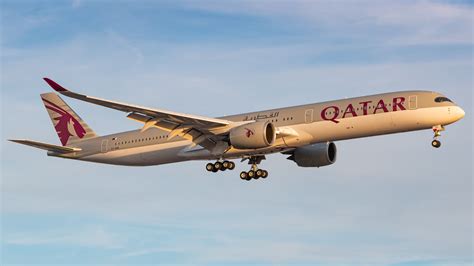
The disruption extends even further across the American aviation landscape. Seattle-Tacoma International Airport (SEA) is currently hosting Boeing 777-300ER A7-BEX, which landed shortly after noon UTC on February 28 and has not departed since.
Two additional 777-300ER aircraft are also parked elsewhere in the United States. One, A7-BEK, remains at Washington Dulles International Airport (IAD), while another, A7-VEW, is grounded at Chicago O’Hare International Airport (ORD).
For airports accustomed to constant aircraft turnover, the presence of idle long-haul jets introduces unusual logistical considerations. Parking positions must be allocated for extended periods, maintenance support must be arranged locally, and airlines must ensure that aircraft remain airworthy despite inactivity.
Although these aircraft are safe and well maintained, their presence highlights how quickly a geopolitical event can reshape airline fleet deployment across an entire continent.
Cargo and Private Aviation Operations Also Affected
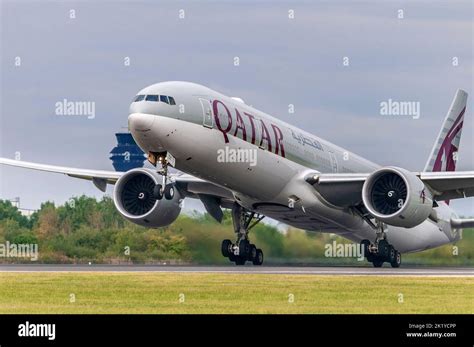
Passenger aircraft are only part of the story. Qatar Airways’ broader aviation ecosystem—including cargo and private aviation divisions—has also been caught in the disruption.
A Qatar Airways Cargo Boeing 777 freighter, registered A7-BFU, recently arrived in Chicago from Liège Airport in Belgium. Although this aircraft did not originate in Doha, it has also remained grounded since landing on March 8. Because its routing does not necessarily require immediate access to Qatari airspace, it may eventually depart sooner than the passenger jets.
Meanwhile, the airline’s luxury charter division, Qatar Executive, has four private aircraft currently positioned in the United States. These include one Gulfstream G700 (A7-CHB) that landed in San Francisco on February 28 and has not flown since.
Three additional Gulfstream G650ER business jets arrived on March 6, touching down in Miami, Washington, and San Francisco respectively. These aircraft normally support government delegations, corporate travel, and high-profile charter missions.

A Network Waiting for Airspace to Reopen
Airlines thrive on movement. Every grounded aircraft represents lost capacity, disrupted schedules, and delayed travel plans for thousands of passengers. For Qatar Airways, whose reputation is built on connecting global cities through Doha, the airspace closure has effectively frozen a slice of its long-haul fleet thousands of miles from home.
For now, the airline is operating limited ad-hoc flights on select corridors, determined by regulatory approvals and operational feasibility. One such temporary service is expected to connect Doha and Dallas/Fort Worth, hinting at the possibility that aircraft could gradually begin returning once safe routing becomes available.
Until authorities fully reopen Qatari airspace, however, the airline’s widebody fleet remains scattered across North America—silent reminders of how quickly the physics of global aviation can collide with the unpredictability of geopolitics. When airspace shuts, even the most meticulously planned airline networks must simply wait for the sky to reopen.