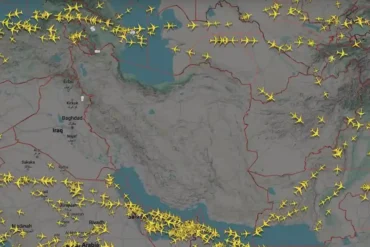
London Heathrow has become an unintended holding bay for the Middle East’s most recognizable long-haul aircraft, as sustained airspace closures across the Gulf region continue to paralyze normal flight operations. Fifteen widebody jets from five carriers remain grounded at the United Kingdom’s busiest airport, transforming routine turnarounds into indefinite stays. The disruption underscores how deeply interwoven global aviation networks are, where instability in one region rapidly cascades across continents.
The current situation is not merely about delayed departures. When airspace shuts down across strategic corridors linking Europe and the Gulf, aircraft cannot simply reroute without severe operational consequences. Crews are displaced, maintenance schedules are disrupted, and aircraft rotation plans—meticulously designed weeks in advance—begin to unravel. Heathrow, as the most-served European airport for Gulf carriers, has absorbed a disproportionate share of the fallout.
February 28 marked the critical inflection point. On that day alone, aircraft from Emirates, Etihad Airways, Qatar Airways, Gulf Air, and Kuwait Airways arrived as scheduled. Ordinarily, these jets—many of them Airbus A380s and Boeing 777-300ERs—would spend only a few hours on the ground before departing back to their Middle Eastern hubs. Instead, they remain parked, occupying valuable apron space and accruing significant parking and handling costs.
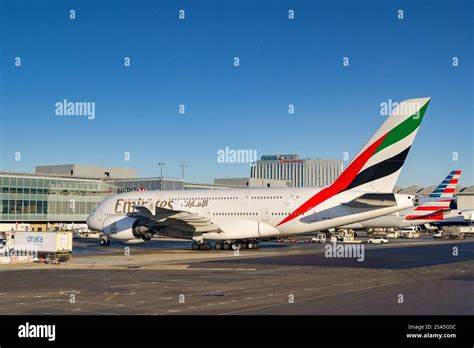
Emirates, Etihad, and Qatar Airways Bear the Brunt
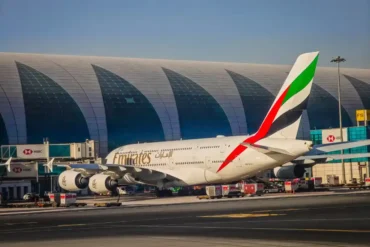
The largest share of stranded aircraft belongs to the Gulf’s aviation heavyweights. Emirates has three Airbus A380s grounded at Heathrow: A6-EEC, A6-EEL, and A6-EEU, the latter wearing the airline’s distinctive “Destination Dubai” livery. These double-deck giants typically symbolize seamless global connectivity. Now, they sit immobile, their departure times tentatively pushed to March 3, subject entirely to geopolitical developments.
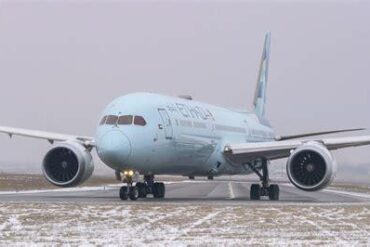
Etihad Airways mirrors that presence with three aircraft of its own. Among them is A6-APH, an Airbus A380, accompanied by two Boeing Dreamliners—A6-BLA, a 787-9, and A6-BMJ, a 787-10. The mix reflects Etihad’s diversified long-haul fleet strategy, yet even modern fleet flexibility offers little defense against closed sovereign airspace.
Qatar Airways faces the most significant exposure at Heathrow, with six aircraft grounded. Its stranded fleet includes Airbus A350 variants—A7-ALZ, an A350-900, and A7-ANH, an A350-1000—alongside an Airbus A380 and three Boeing 777-300ERs. The airline’s higher flight frequency into Heathrow, particularly during early morning arrival banks, explains the larger footprint of parked aircraft.
Smaller Gulf Carriers Feel Outsized Impact
While global attention gravitates toward the region’s aviation giants, Gulf Air and Kuwait Airways face proportionally heavier operational strain. Gulf Air has two aircraft parked at Heathrow—A9C-FD and A9C-FJ. For an airline with a comparatively modest fleet, two widebodies grounded abroad represent a substantial slice of operational capacity.
Kuwait Airways has one Boeing 777-300ER, registration 9K-AOC, currently stranded. Its second scheduled Heathrow-bound flight on February 28 was canceled outright. For smaller carriers, schedule recovery is often more delicate, as limited fleet depth reduces room for substitution or rotation flexibility.
The Case of Qatar’s A350-1000: A Mid-Air Reversal
One aircraft encapsulates the chaos more vividly than the rest. Qatar Airways’ A7-ANH, a seven-year-old Airbus A350-1000, was operating flight QR5 from Heathrow back to Doha. Scheduled to depart at 8:05 am, it lifted off at 8:29 am and proceeded southeast across Europe. According to flight tracking data, the aircraft reached Luxembourg airspace before receiving instructions to return to the United Kingdom.
Such mid-air reversals are operationally complex and financially costly. Fuel burn alone on a partially completed long-haul sector can be immense. Yet returning to a well-equipped hub like Heathrow simplifies passenger handling and aircraft logistics compared to diverting into uncertain airspace conditions closer to the affected region. The A350-1000 remains grounded alongside fourteen other widebodies, emblematic of a network abruptly paused.
Heathrow’s Parking Challenge and Financial Implications
Heathrow is not designed to function as a long-term storage facility for multiple superjumbos. Each Airbus A380 occupies significant stand space, particularly when extended ground time requires additional servicing vehicles and crew accommodation logistics. Parking charges at Heathrow are among the highest in Europe. Multiply that by several days for multiple widebodies, and the financial impact becomes substantial.
Beyond direct fees, the real cost lies in lost utilization. Widebody aircraft are high-value assets intended to generate revenue across intercontinental sectors. Every grounded hour translates into lost seat miles, disrupted cargo capacity, and ripple effects across connecting itineraries in Asia, Africa, and Australia.
A Regional Shutdown with Global Consequences
Airspace closures in the Middle East do not remain regional for long. The Gulf serves as a pivotal crossroads linking Europe, Asia-Pacific, and Africa. Airlines headquartered there rely on synchronized wave systems—banks of arrivals and departures timed to maximize connections. When inbound aircraft cannot depart, outbound banks collapse. Recovery becomes exponentially more complicated with each passing day.
Only one of the fifteen aircraft has attempted departure, and even that effort ended in reversal. The broader question is not merely when airspace will reopen, but how quickly airlines can restore equilibrium. Aircraft and crews must be repositioned. Maintenance intervals must be recalculated. Passenger confidence must be rebuilt.
Heathrow’s apron now tells a visible story of aviation’s interconnected fragility. Gleaming A380 tails and long-range Dreamliners stand motionless, silent evidence that modern air travel—though technologically advanced—remains deeply vulnerable to geopolitical shockwaves. The grounded fleet is more than a logistical inconvenience; it is a snapshot of how swiftly global mobility can stall when a key aviation corridor closes.