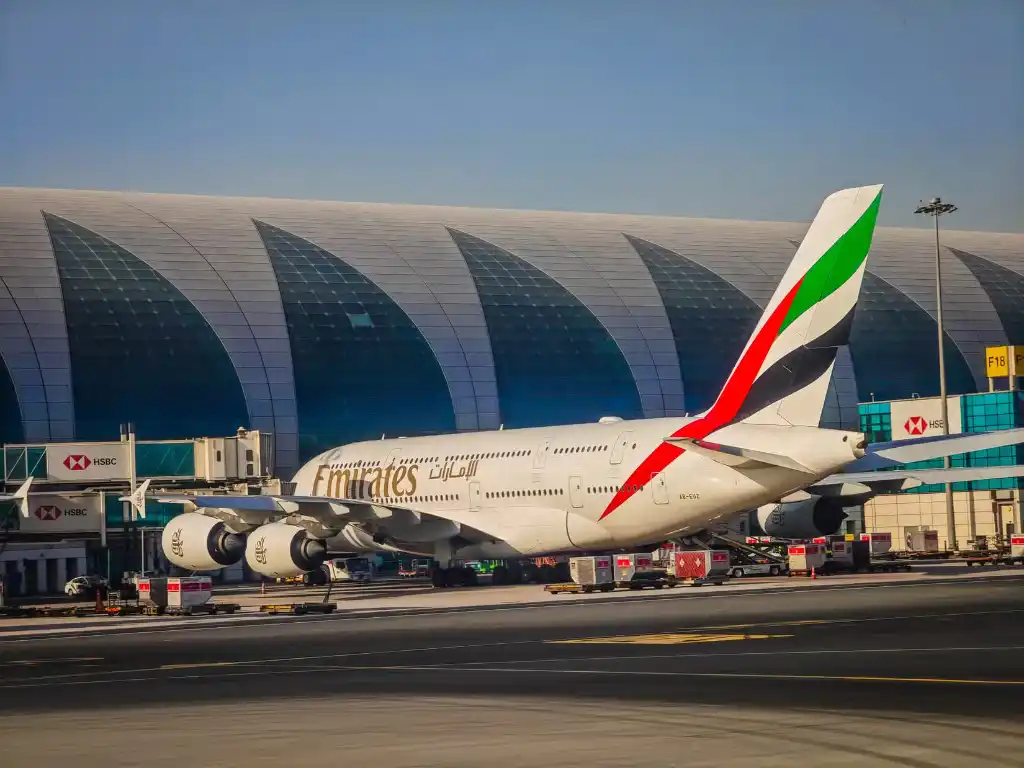
The sudden closure of key Middle Eastern airspace corridors has triggered a systemic breakdown at some of the world’s most critical aviation crossroads, stranding thousands of passengers inside terminals designed for transit—not survival. Following United States and Israeli strikes on Iran and subsequent retaliation, multiple governments moved swiftly to seal their skies. The decision grounded aircraft across Iran, Iraq, Israel, Bahrain, Qatar, and Kuwait, while the United Arab Emirates imposed partial restrictions. What began as a security precaution metastasized into a full-scale collapse of tightly synchronized global flight banks.
Dubai International Airport (DXB), Abu Dhabi International Airport (AUH), and Doha Hamad International Airport (DOH)—three of the most strategically important east–west connecting hubs on Earth—saw departure boards turn into columns of cancellations. These airports collectively process roughly 90,000 connecting passengers daily under normal conditions. When their intricate connection waves disappeared, the ripple effects surged across Europe–Asia routes within hours. Airlines could not simply reroute at scale; aircraft rotations fractured, crew duty limits loomed, and long-haul journeys evaporated mid-network.
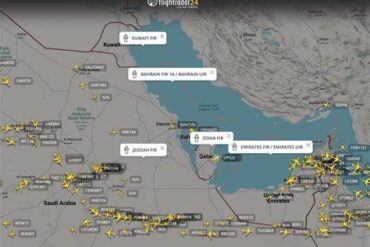
By Sunday morning, flight-tracking maps showed an eerie void across Middle Eastern skies. Where dense streams of long-haul jets typically arc between continents, there was silence. More than 3,400 flights across seven major airports were canceled in a single day, and aviation notices extending Iranian airspace closure underscored that this was not a brief disruption. Damage reports at certain facilities further complicated any immediate restart.
Empty Skies Over Strategic Air Corridors
The Middle East functions as a geographic hinge of global aviation. Gulf carriers built their business models around sixth-freedom traffic—a technical term describing passengers connecting between two foreign countries through an airline’s home hub. That model depends on precise timing. When a hub bank collapses, the entire architecture implodes.
Emirates, Qatar Airways, and Etihad suspended large portions of their schedules and issued rolling restart advisories, but even incremental resumptions cannot instantly restore network equilibrium. Aircraft were stranded out of position. Crews faced legality limits under strict duty-time regulations. Reroutes around closed airspace added hours of flying time, increasing fuel burn and sometimes forcing payload restrictions or technical stops. Flights that once generated predictable margins became economically fragile overnight.
Congestion intensified in the few corridors that remained open, particularly through Saudi airspace. Air traffic flow controls slowed departures, compounding delays even for flights not directly canceled. The result resembled a cardiovascular blockage in global aviation: traffic forced through narrow arteries while major arteries remained sealed.
Terminals Turn Into Temporary Shelters
For passengers, the disruption transcended inconvenience. It exposed the fragility of global mobility. A missed connection at a mega-hub can cascade into legal and logistical complications that few travelers anticipate. Some passengers found themselves stranded without checked baggage, unable to retrieve it because it was interlined to onward destinations. Others faced expiring visas while confined inside transit zones, with no legal right to enter the country of diversion.
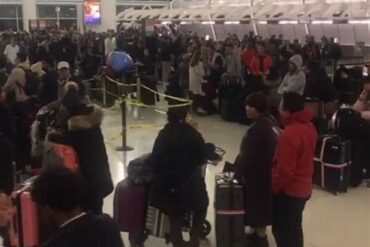
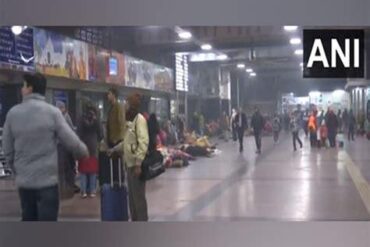
Videos circulating from Dubai and Doha terminals showed travelers sleeping on polished floors beneath departure boards, using backpacks as pillows. Airport seating areas became improvised dormitories. Hotel inventory near major hubs evaporated within hours as airlines scrambled to accommodate disrupted itineraries.
Customer service desks experienced crushing demand. Mobile applications lagged under rebooking surges. Call centers entered saturation mode. Legacy carriers issued rebooking waivers, allowing passengers to reroute through Europe, Turkey, or South Asia. Yet these relief seats vanished rapidly as displaced travelers competed for limited alternatives. The arithmetic was unforgiving: thousands of disrupted itineraries chasing finite capacity.
Travel insurance policies entered the spotlight, particularly clauses addressing war-related disruptions. Many policies contain exclusions tied to armed conflict, leaving passengers uncertain about reimbursement eligibility for meals and lodging. The crisis forced real-time education in aviation fine print.
Cargo Chains Fracture Alongside Passenger Networks
The shutdown did not merely inconvenience vacationers and business travelers. It fractured global cargo flows. The Gulf region functions as a vital transshipment node for high-value freight moving between Asia, Europe, and Africa. When aircraft stop, supply chains stall.
Pharmaceutical shipments, electronics components, and time-sensitive industrial parts faced missed cutoffs. Even modest reroutes can disrupt temperature-controlled logistics, increasing risk for perishable or medical goods. Cargo operators confronted the same airspace closures and fuel penalties as passenger carriers, but without the flexibility of simply rebooking a traveler. Delays ripple through manufacturing systems calibrated to just-in-time delivery.
Operational Whiplash for Airlines
Airlines now confront what can be described as operational whiplash. Aircraft and crews are misaligned with published schedules. Maintenance windows risk compression if aircraft cannot reach base facilities. Crew legality constraints—strict limits on working hours designed to ensure safety—complicate recovery sequencing. Rebuilding a long-haul network resembles solving a three-dimensional puzzle where every piece has shifted.
Financially, Gulf network carriers absorb a disproportionate shock. Their competitive advantage rests on seamless connectivity between continents. When hubs pause, revenue streams tied to transit traffic evaporate instantly. Meanwhile, customer-care liabilities accumulate. Reaccommodation expenses, hotel vouchers, meal compensation, and goodwill gestures all erode margins already strained by volatile fuel prices.
If closures persist, further schedule reductions are likely. Fares on surviving routings may climb as supply tightens. Secondary effects could touch aircraft maintenance planning and fleet utilization rates well beyond the Middle East. Aviation operates as a globally interdependent system; a disruption at its geographic midpoint resonates outward.
The present crisis illustrates a stark reality: modern air travel depends on geopolitical stability as much as engineering precision. Aircraft can cross oceans nonstop, guided by satellites and managed by advanced dispatch systems, yet a single strategic corridor closure can halt the choreography. For now, terminals across the Gulf remain crowded with uncertainty—an uncomfortable reminder that global connectivity, for all its sophistication, rests on fragile foundations.