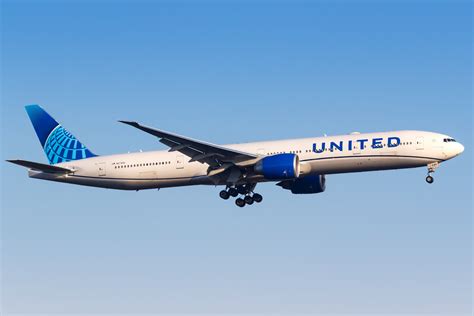
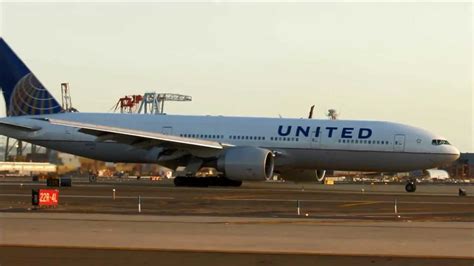
The Boeing 777-300ER is often imagined cruising over oceans, stitching continents together with long-haul precision and premium-heavy cabins. Yet within United Airlines’ network, this massive twinjet also plays a strategic role on a handful of domestic corridors. These routes are not chosen casually. They represent high-yield markets, long-distance sectors, and premium-heavy demand profiles where the aircraft’s sheer size, cabin layout, and range capabilities become commercially potent even without crossing international borders.
At 73.9 meters in length, the 777-300ER is the longest aircraft in United’s fleet, eclipsing other widebody types in physical footprint. However, physical length does not equal passenger density. In fact, United’s 777-200 fleet—configured for domestic high-demand operations—can seat more passengers in certain layouts. The 777-300ER’s comparative lower seat count reflects its luxury-biased cabin design, built for revenue optimization rather than brute-force capacity.
This article examines the precise domestic routes served by United Airlines’ 777-300ER fleet, explores the strategic logic behind their deployment, and dissects the onboard product that makes these aircraft uniquely suited for premium domestic missions.
United’s Boeing 777-300ER: The Largest Jet in the Domestic Toolbox
The 777-300ER occupies a special niche within United’s widebody portfolio. It is engineered for ultra-long-haul operations but frequently repurposed for domestic sectors where premium traffic density and operational flexibility justify its deployment. These aircraft typically operate international missions, but schedule optimization, fleet balancing, and hub connectivity requirements bring them onto select domestic routes.
United schedules approximately 166 domestic flights on the 777-300ER compared to more than 500 international operations. This ratio highlights how exceptional domestic deployment is—each route selected must meet strict revenue and operational criteria.
A Map of United’s Domestic 777-300ER Routes
United currently assigns the 777-300ER to three domestic corridors, spanning the continental U.S. and Pacific territories. These routes are geographically diverse and commercially distinct, but each showcases a strategic rationale rooted in demand, distance, and premium yield.
Guam to Honolulu: A Trans-Pacific Domestic Marathon
The longest domestic 777-300ER route in United’s network links Guam (GUM) and Honolulu (HNL). Despite being a domestic flight, this corridor spans 3,801 miles (6,117 km), rivaling transcontinental and even some transatlantic distances. Block times typically range between seven and eight hours, making it one of the longest domestic sectors operated by any U.S. airline.
This route exists in a unique geopolitical and operational context. Guam is a U.S. territory in the Western Pacific, positioned across the International Date Line from Hawaii. United uses widebody aircraft here due to military traffic, government travel, tourism demand, and limited competition, all of which create sustained high-capacity needs.
United has also signaled investment in Guam’s infrastructure, refreshing airport facilities to enhance the premium passenger experience. This aligns perfectly with the 777-300ER’s premium cabin architecture, turning a domestic flight into a long-haul-like experience.
Honolulu to San Francisco: Pacific Hub-to-Hub Power Corridor
The second domestic route for United’s largest widebody connects Honolulu (HNL) and San Francisco International Airport (SFO). This West Coast link is one of United’s most strategically important Pacific corridors, connecting Hawaii with one of its primary mainland hubs.
Flight times typically range between five and six hours, long enough to justify widebody service. United operates multiple daily frequencies on this route, mixing aircraft types such as the 737 MAX 9, 757-300, and 777-200. The 777-300ER stands out as the premium flagship option, catering to high-yield leisure travelers, elite frequent flyers, and corporate passengers.
San Francisco’s role as a gateway to Asia and the Pacific makes this route particularly valuable for connecting itineraries. Widebody deployment ensures consistent product standards for connecting passengers transitioning between domestic and international legs.
San Francisco to Newark: The Premium Transcontinental Battleground
The only domestic 777-300ER route fully within the continental United States is the San Francisco (SFO) to Newark (EWR) transcontinental sector. This route sits at the epicenter of the U.S. premium aviation market, connecting Silicon Valley and Wall Street.
United deploys the 777-300ER here to maximize premium cabin revenue, offering a Polaris-equipped aircraft on a route dominated by business travelers, technology executives, finance professionals, and high-value corporate contracts. This corridor competes fiercely with American Airlines and Delta Air Lines, making aircraft quality a strategic differentiator.
Widebody service on this route also ensures cargo capacity and schedule resilience, particularly during peak business travel periods.
Inside the Cabin: Why the 777-300ER Fits Premium Domestic Missions
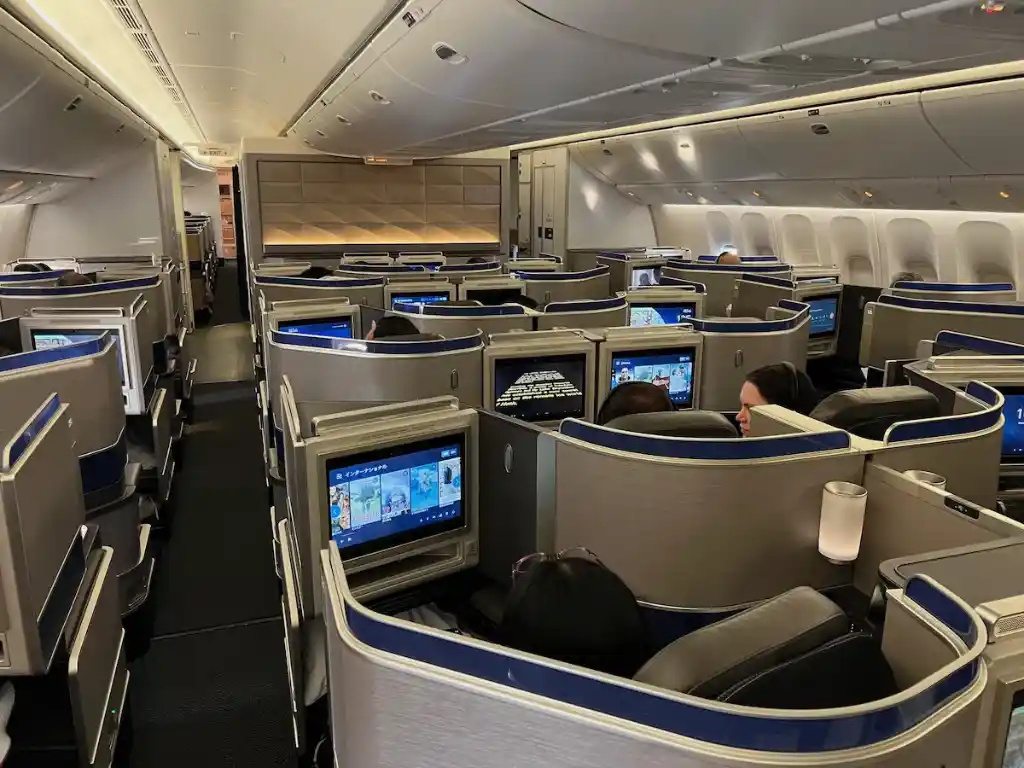
United’s 777-300ER cabin is configured with 350 seats, deliberately skewed toward premium products. Roughly 24% of passengers sit outside economy, a high ratio for a U.S. airline. This premium-heavy configuration is the core reason the aircraft appears on these domestic routes.
Business class features the United Polaris product in a 1-2-1 layout, giving every passenger direct aisle access. This is crucial for long domestic sectors where productivity and comfort drive ticket pricing. Polaris seats transform a five-hour domestic flight into a mobile office or private sleeping environment.
Premium Economy seats are arranged in a 2-4-2 layout, bridging the gap between economy and Polaris with enhanced recline, upgraded dining, and increased legroom. Economy class uses a 3-4-3 layout, typical for high-density widebodies, but still benefits from modern inflight entertainment and connectivity.
The aircraft’s cabin architecture allows United to monetize domestic flights at international-style fare levels, especially on premium-heavy corridors.
Strategic Logic: Why Use a Long-Haul Jet Domestically?
Deploying a 777-300ER on domestic routes may seem excessive, but the logic is ruthlessly economic. These aircraft are used domestically when:
- Demand is premium-heavy and business travelers are willing to pay for Polaris and Premium Plus products.
- Distance is long enough to justify widebody operating economics and passenger comfort.
- Fleet scheduling requires repositioning aircraft between international rotations.
- Cargo capacity is needed, especially on transcontinental and Pacific routes.
United also benefits from operational consistency, allowing crews, maintenance teams, and passengers to experience a uniform product across global and domestic segments.
The Hidden Economics of Domestic Widebody Flying
Widebody domestic flying is not about spectacle; it is about yield management. A 777-300ER filled with high-fare business travelers can outperform multiple narrowbody flights in revenue per departure. Additionally, using a single large aircraft reduces congestion at slot-constrained airports like Newark and San Francisco.
The 777-300ER also provides significant belly cargo capacity, enabling United to transport high-value freight alongside passengers. This cargo revenue can materially influence route profitability, especially on transcontinental sectors.
United’s Domestic Widebody Strategy in Context
United is not alone in deploying widebodies domestically, but its strategy is notably focused. Delta and American use widebodies on select domestic routes, but United’s reliance on the 777-300ER highlights its hub-centric premium strategy, especially between SFO, EWR, and HNL.
These deployments also reflect broader fleet realities. As United modernizes its fleet and balances international demand cycles, domestic widebody flying becomes a flexible lever for capacity optimization.
What This Means for Passengers and the Market
For passengers, the presence of the 777-300ER on domestic routes is a rare opportunity to experience long-haul luxury on a domestic ticket. Polaris lounges, lie-flat seats, and enhanced catering redefine the domestic flight experience on these corridors.
For competitors, these deployments raise the stakes in premium domestic markets, forcing rivals to upgrade products or risk losing high-value customers. For United, the strategy cements its reputation as a premium-first network carrier, particularly on long-distance domestic routes.
The Future of Domestic Widebody Flying at United
As demand patterns evolve, the domestic role of the 777-300ER may expand or contract. However, the underlying logic remains timeless: deploy the biggest, most luxurious aircraft where customers will pay for it. Guam, Honolulu, San Francisco, and Newark represent precisely that intersection of distance, demand, and revenue potential.
The 777-300ER’s domestic missions are not anomalies; they are strategic chess moves in a network optimization game measured in billions of dollars. In that sense, these routes offer a fascinating window into how modern airlines treat aircraft not as mere machines, but as precision tools for revenue engineering.
In the theater of domestic aviation, United’s largest widebody is not overkill—it is calculated dominance.