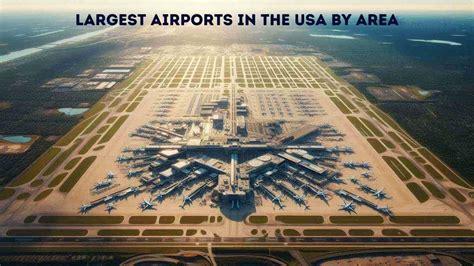
The United States is one of the most heavily networked air travel ecosystems on Earth, powered by immense airports that serve as global gateways, economic engines, military adjacencies, and logistical superhubs. We explore the 10 largest U.S. airports in active operation, measured strictly by land area, and dive far deeper than surface numbers. Scale shapes capability, and capability shapes the way a nation moves—financially, socially, and geographically. These airports are built not just for passengers, but for resilience, expansion, international commerce, and the evolving aviation fleet of tomorrow.
Airports are not monoliths of concrete and runway paint. They are cities with power lines, fire departments, highways, customs agencies, wastewater processing, and a workforce equivalent to small towns. Their physical footprint reflects decades of planning, political negotiation, federal investment, airline ambition, and commercial realities. Size grants breathing room, and breathing room enables future-proofing in an industry where demand escalates cyclically yet relentlessly.
Detroit Metropolitan Wayne County Airport (7.3 sq mi)
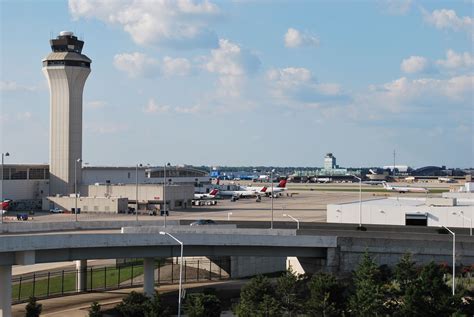
Detroit Metropolitan Wayne County Airport—commonly branded as DTW—anchors southeastern Michigan and ranks 10th in the U.S. by land mass. Stretching 7.3 square miles, this field once formed the core of Northwest Airlines’ global hub system before its consolidation into Delta Air Lines. Today, it remains a dual-hub megastation powering both Delta Air Lines and Spirit Airlines, making it one of America’s most strategically placed northern trans-lakeside aviation bridges.
Detroit’s airfield hosts six runways, each designed to accommodate widebody frames. Aircraft as significant as the Boeing 747-400 once called DTW home, and while fleet shifts have replaced the Queen of the Skies with the Airbus A350, DTW’s geometry remains capable of future-generation long-haul hardware.
Two passenger terminals anchor the traveler experience. The Edward H. McNamara Terminal, a colossal tri-concourse design, holds 121 gates, including one of the world’s longest continuous concourses. The parallel Evans Terminal, slightly smaller, contributes another fleet of gates—bringing the collective total to 150. Detroit is built for flow: strong runway separation, streamlined taxi corridors, and a layout planned for irregular-operations recovery. Future expansion remains possible as land banks and operational spacing continue to support incremental development cycles.
John F. Kennedy International Airport (8 sq mi)
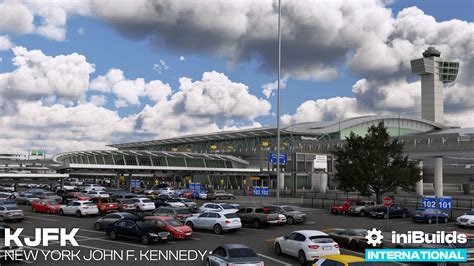
New York-JFK functions as America’s eastern front door to the world, situated across 8 square miles in Queens. Its footprint enables volume unmatched in New York airspace, dwarfing LaGuardia and Newark in physical scale and operational runway flexibility. This is the airport where international passengers step onto U.S. soil, and its terminals pulse with long-haul metal from every continent except Antarctica.
Runway 13R/31L spans 14,511 feet, ranking as the third-longest runway in the United States and a former alternate landing path for the Space Shuttle. Four runways serve as the arterial skeleton, balancing immense outbound traffic heading to London, Doha, São Paulo, and beyond.
Five passenger terminals—with 130 gates in combined circulation—house global airlines including American Airlines, Delta Air Lines, JetBlue, Atlas Air, and Kalitta Air cargo operations. Plans for terminal modernization indicate New York’s determination to remain globally relevant. JFK operates like a cultural marketplace as much as an airfield: languages blend, airline liveries mosaic, and global freight crosses oceans hourly. It is not just an airport—it is a gateway that introduces America to the world.
San Francisco International Airport (8.1 sq mi)
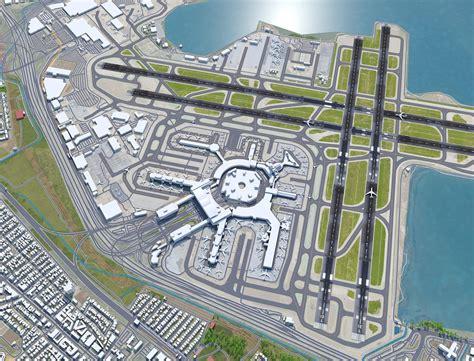
SFO’s 8.1 square-mile span positions it as the largest airport in California by land area, overtaking Los Angeles in raw footprint. More importantly, it serves as the West Coast’s prime aviation hinge to Asia, powered largely by a massive United Airlines hub supplemented by Alaska Airlines growth and strong international demand into East Asia and Southeast Asia.
Four intersecting runways define SFO’s grid. The airfield can run simultaneous approaches during clear weather, stunning for spotters when two heavies glide in side by side like synchronized whales of aluminum. Fog is SFO’s persistent adversary, throttling capacity during low visibility, exposing the tension between landmass scale and coastal geography.
Gate distribution spans four terminals, numbered structurally rather than chronologically. The International Terminal, a dual-wing design, hosts long-haul widebody fleets from Japan Airlines, Air India, Singapore Airlines, and dozens more. United maintains a massive maintenance campus here, servicing its fleet and contract clients worldwide. SFO is both a launchpad and a workshop—hardware lands here weary from oceanic flight and departs reborn after deep technical care.
Chicago O’Hare International Airport (11.9 sq mi)
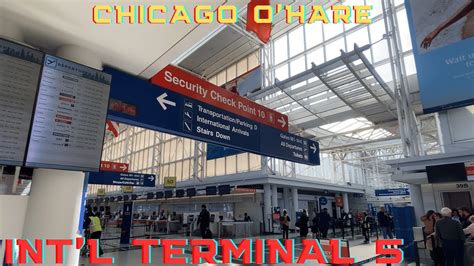
Chicago’s O’Hare International Airport, spanning 11.9 square miles, serves as one of the world’s busiest multilateral transfer hubs. It is the beating heart of the U.S. Midwest, unmatched in connectivity and capable of projecting passenger traffic in virtually every compass direction.
With eight runways—more than any other airport on Earth—O’Hare can machine-gun departures without pause when traffic spacing permits. Its geometry enables remarkable throughput, supporting American Airlines, United Airlines, Frontier, and Spirit simultaneously. O’Hare represents engineering scale with metropolitan efficiency.
Four terminals house 216 gates, exceeding every other global airport. Terminal 1, United’s fortress hub, channels international and domestic networks seamlessly. Terminal 3 pulses with American Airlines metal, a counterweight to United’s dominance. Terminal 5, a modernized international interface, expands Chicago’s global reach with new gate additions and aerodynamic passenger circulation redesigns. O’Hare plays chess while others play checkers.
Salt Lake City International Airport (11.96 sq mi)
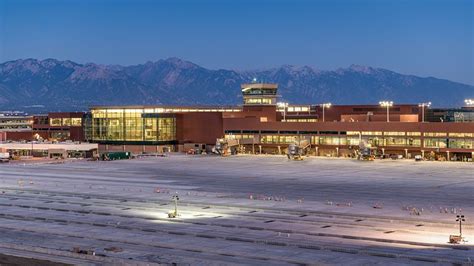
Salt Lake City’s footprint—11.96 square miles—barely edges out Chicago. What makes SLC fascinating is that unlike older coastal airports, its scale is new by global standards, built with open expansion capability that airports like JFK and SFO lost decades ago.
Four runways anchor the site, two extending past 12,000 feet for heavy long-haul operations. A third runway at nearly 9,600 feet supplements mid-widebody operations, while a fourth shorter strip serves general aviation and light craft.
One modern, contiguous terminal replaces the fractured legacy building footprint. Concourse A supports 47 gates, while Concourse B houses 36—with 11 additional gates expected by late 2026. Delta Air Lines dominates Salt Lake City’s long-haul operations, leveraging altitude and airspace flexibility to route western-U.S. through traffic. GA density remains higher than expected for an airport this size, reinforcing the idea that large western airports serve multi-role logistics, not just passenger transit.
George Bush Intercontinental Airport (15.4 sq mi)
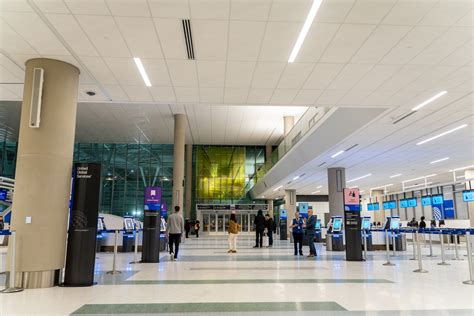
Houston’s intercontinental gateway—IAH, spanning 15.4 square miles—stands as Texas’ second-largest airport. United Airlines uses Houston as a Latin-America gateway while Spirit maintains operational volume linking domestic, Caribbean, and Central American destinations.
Five runways lace the expanse, parallel alignments engineered for high-frequency operations. Terminal complexity forms Houston’s identity: five passenger terminals totaling 121 gates. Terminal A for domestic flow, Terminal B for regional turbofan arteries, Terminal C as mainline core, Terminal D for international movement, and Terminal E handling intercontinental long-haul heavy metal. Houston is structured like a vascular system—arteries feeding into chambers, chambers feeding into outflow.
IAH embodies heat, humidity, and hub efficiency. It is southern air travel incarnate: international, bilingual, economically diverse, and ready for growth as Texas expands beyond energy dominance into technology and spaceflight.
Washington Dulles International Airport (20 sq mi)
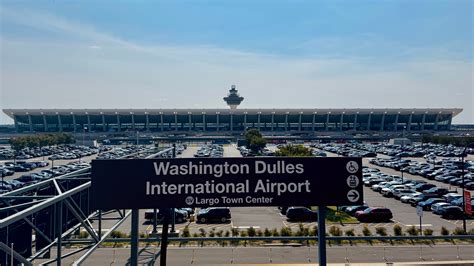
Dulles International (IAD) sprawls across 20 square miles, larger than Washington, D.C. itself. Its vastness reflects ambition—built to be the East Coast’s long-haul capital. For decades, United Airlines used Dulles as its premier transatlantic hub, until market gravity shifted power toward Newark. Yet IAD remains an elegant behemoth.
Four runways currently operate, with a fifth runway already planned, ensuring future redundancy. Midfield concourses A/B and C/D hold 135 gates, supplemented by the iconic Saarinen terminal architecture. Travelers approach by AeroTrain rather than compact terminal walks, a reminder that this airport was designed for sprawl, not density.
Dulles is enormous by intent. Land banks buffer expansion space exceeding most American peers. Despite this size, Reagan National Airport often out-competes it due to proximity to Capitol Hill. Yet when widebodies launch toward Frankfurt or Doha, they launch from Dulles—the capital’s long-range lung.
Orlando International Airport (20.8 sq mi)
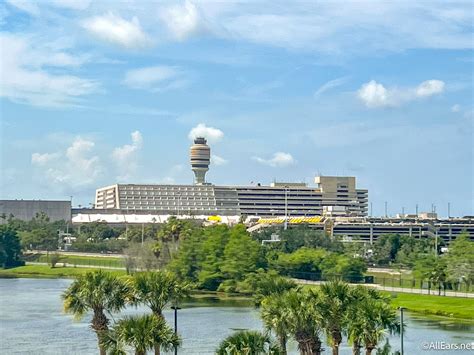
Orlando’s 20.8-square-mile airport stands as Florida’s largest aviation hub by footprint and by passenger traffic. Unlike legacy hubs, Orlando thrives on leisure volume. Budget carriers, theme park travelers, families with souvenir-stuffed suitcases—this is an airport built for vacation movement.
Four parallel runways establish symmetry. Terminals A and B operate two airsides each, totaling 118 gates, while the newer Terminal C adds 16. Orlando is efficient because it must handle surges. Seasonal spikes can be violent—holidays, spring breaks, international tour influxes—and MCO’s runway parallelization distributes flow.
Unlike corporate-centric hubs such as Dallas or Chicago, Orlando’s traveler base skews low-yield, but high-quantity. Airlines like Frontier, Spirit, Southwest, JetBlue, and Breeze thrive here. Orlando is aviation tourism distilled, and its scale reflects decades of amusement-industry momentum.
Dallas/Fort Worth International Airport (26.6 sq mi)
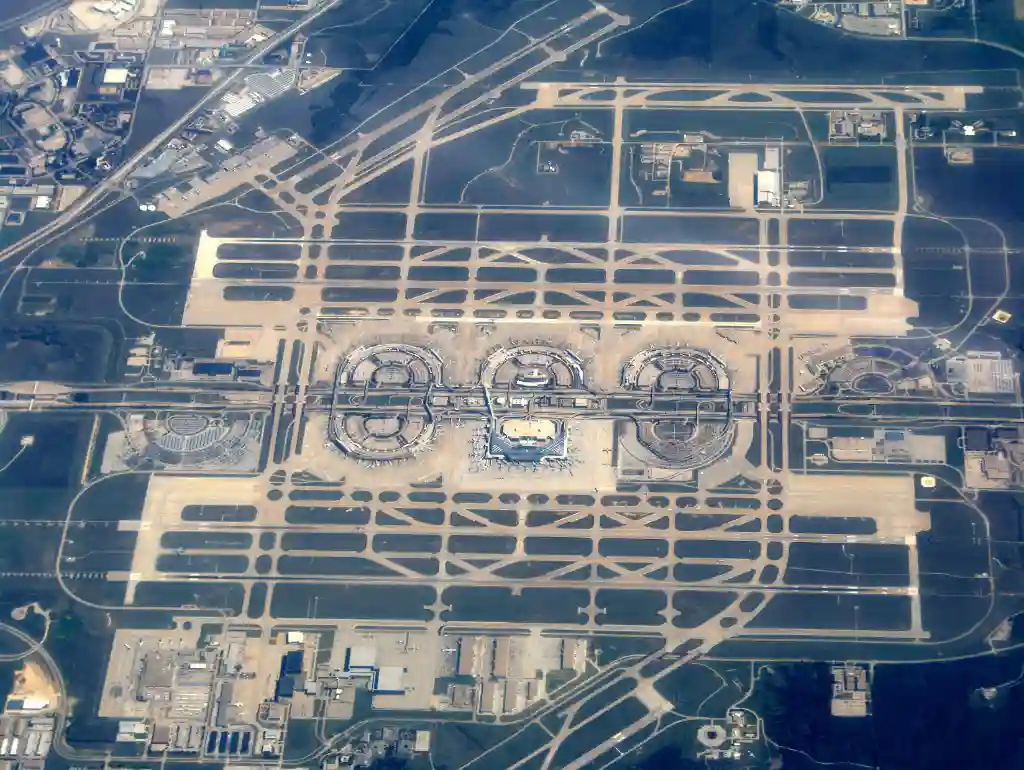
Spread across 26.6 square miles, DFW operates like a self-contained municipality. It even has its own postal designation. With seven runways, six terminals, and global airline patronage, the Texan super-airport forms the operational epicenter of American Airlines’ network—the second-largest hub in the United States.
Terminals A through E currently host 193 gates, soon to expand to 224 after Terminal F opens. Dallas-Fort Worth is a oneworld alliance magnet, receiving aircraft from Tokyo, Sydney, Doha, Seoul, Santiago, London, and beyond. Between Europe, Asia, South America, and domestic traffic, few airports match the transactional diversity of DFW.
DFW is engineered for expansion. Taxiways are spaced like arterial highways, parking stands accommodate A380-scale wings, and terminal distance is measured in miles, not minutes. Size here is not a statistic—it is a utility.
Denver International Airport (52 sq mi)
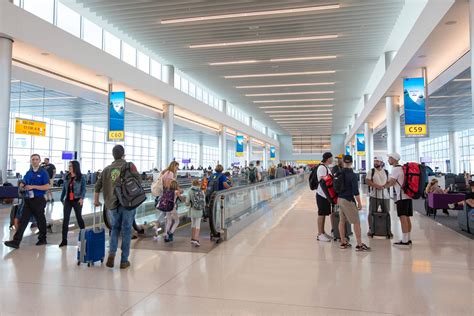
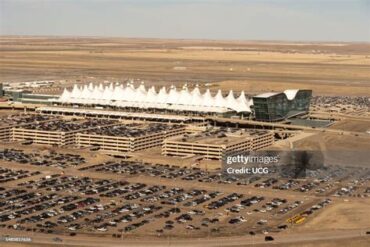
Finally, there is Denver International Airport, an unmatched 52-square-mile colossus—more than double the size of DFW and nearly the size of San Francisco city limits. Denver is America’s largest airport by land area by an enormous margin. Scale here is not gradual—it is planetary.
Six runways in a pinwheel configuration minimize crossing traffic and accelerate movement like a rotating turbine. One terminal—Jeppesen Terminal—feeds three midfield concourses A, B, and C with a combined 169 gates. The airport is widely regarded as a modern engineering model: fast turnarounds, efficient taxi separation, relentless expansion optionality.
United Airlines’ hub here has grown so large that it occasionally out-performs O’Hare in daily departures. Denver is also the highest-elevation megahub in the continental U.S., which affects takeoff roll, fuel calculus, engine thrust output—and runway length requirements. Long taxi lines carve across flat plains beneath the Rocky Mountain horizon like asphalt rivers.
Denver represents future runway philosophy: land first, build later. The space exists for more concourses, more aprons, more cargo pads, more everything. It is the American airport of tomorrow already standing in today.
Across these ten giants, size is not vanity—it is velocity. Runways map trade routes. Terminals frame cultural exchange. Gate counts illustrate national mobility. These airports form the metal bloodstream of a continent-scale republic, ensuring that people, goods, and ideas move without friction. Their landmass enables that future. Expansion is not just possibility—it is inevitability.
Airports shape nations more quietly than politics and more tangibly than policy. America’s largest airports prove this with every departure roll and every arrival flare, day after day, decade after decade.