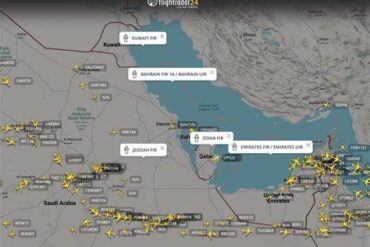
The rapidly escalating security situation across parts of the Middle East has forced several international airlines to rethink how they move passengers across the region. With airspace restrictions, airport closures, and safety concerns disrupting normal flight operations, major carriers have begun improvising new routes and temporary hubs. Among the most notable responses is the decision by British Airways and Qatar Airways to pivot operations toward Muscat International Airport (MCT) in Oman, transforming the airport into a strategic airlift point for stranded travelers.
For thousands of passengers caught in the operational chaos, the shift to Muscat represents one of the few viable pathways out of the region. Airlines are now coordinating aircraft relocations, crew redeployments, and passenger ground transfers to keep international travel moving despite widespread disruptions.
Qatar Airways Establishes Temporary Muscat Hub
Qatar Airways has been particularly affected by the regional instability. With Hamad International Airport (DOH) in Doha facing operational shutdowns due to its proximity to the Iran-related conflict zone, the airline has suspended most passenger flights since last weekend. The halt stranded travelers across multiple continents and left many passengers unable to depart Qatar.
To restore limited connectivity, the airline is establishing a temporary “mini hub” at Muscat International Airport. The strategy involves repositioning aircraft and flight crews from several European gateways where Qatar Airways aircraft had been grounded or displaced.
Aircraft are reportedly being moved from cities including:
- London Heathrow
- Berlin
- Copenhagen
- Madrid Barajas
- Rome
- Amsterdam Schiphol
Once relocated to Oman, these aircraft will operate a reduced network of international evacuation and repositioning flights. The goal is simple: create a stable launch point outside the conflict zone while maintaining global connectivity for passengers attempting to leave the Gulf region.
The choice of Muscat is not accidental. Oman sits geographically close to Qatar and the United Arab Emirates while remaining outside the most heavily restricted airspace corridors. In aviation strategy terms, it functions as a safe operational perimeter—close enough to reach displaced passengers but far enough to allow uninterrupted international departures.
British Airways Adds Muscat Flights for Stranded Travelers
While British Airways does not normally operate scheduled service to Muscat, the airline has temporarily expanded flights to the Omani capital to support repatriation efforts. The carrier has added a fourth special service between Muscat and London Heathrow, scheduled to depart in the early hours of March 8.
This flight is specifically designed to transport passengers stranded in Dubai, Abu Dhabi, and other Gulf cities who are unable to access their original departure airports due to airspace closures.
Passengers cannot simply appear at Muscat Airport expecting transport. British Airways has instructed travelers that only confirmed reservations arranged through its call centers will be accepted. This precaution prevents overcrowding at the airport and ensures aircraft capacity is allocated to verified passengers first.
The airline’s strategy highlights how traditional route networks can quickly transform during crises. Airports that normally play secondary roles can suddenly become critical logistical bridges when geopolitical realities redraw aviation maps overnight.
Long Road Journeys to Reach Oman
Reaching Muscat is often the most challenging part of the journey for displaced travelers. With regional airspace limitations blocking short-haul flights between Gulf states, many passengers must travel hundreds of miles by road before reaching the evacuation flights.
Travelers departing from Qatar must cross two international borders, typically transiting through Saudi Arabia and the United Arab Emirates before entering Oman. Meanwhile, passengers located in the UAE face shorter journeys but still must cross the Oman land border.
Typical travel distances include:
- Dubai to Muscat: 281 miles (453 km)
- Abu Dhabi to Muscat: 309 miles (498 km)
- Sharjah to Muscat: 275 miles (443 km)
- Doha to Muscat: 643 miles (1,036 km)
These journeys often require organized transport convoys, visa coordination, and extended border processing times. For many passengers, the trip to Muscat becomes an overnight expedition before they even reach an airport terminal.
Oman Air Expands Capacity as Regional Aviation Lifeline
Oman’s own national carrier, Oman Air, has also stepped in to support the sudden surge in demand. Aircraft originally assigned to regional Gulf routes have been redeployed toward long-haul international services, particularly flights linking Muscat to Europe and Asia.
This rapid reallocation of capacity has allowed Muscat to function as a temporary aviation relief valve for the wider region. Airlines that cannot safely operate from their home bases can still maintain some connectivity by leveraging Oman’s relatively stable airspace.
Muscat International Airport Becomes a Strategic Gateway
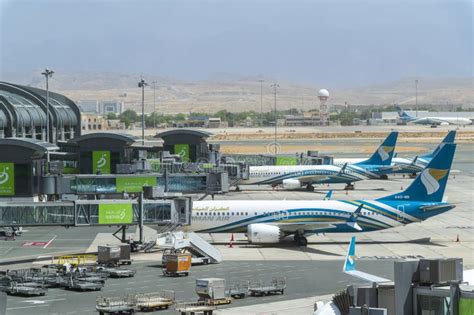
Muscat International Airport is well equipped to absorb the sudden operational surge. Located approximately 20 miles (32 km) from Oman’s capital, the airport already serves as the primary hub for both Oman Air and SalamAir, the country’s low-cost carrier.
The airport features two long asphalt runways capable of handling widebody aircraft:
- Runway 08R/26L: 13,385 feet (4,080 meters)
- Runway 08L/26R: 13,123 feet (4,000 meters)
In 2024 alone, Muscat handled nearly 13 million passengers and recorded more than 96,000 aircraft movements, according to Oman’s National Centre of Statistics and Information. Twenty-six airlines operate scheduled flights there throughout the year, connecting the airport with destinations across Africa, Europe, and Asia.

As geopolitical tensions reshape aviation routes across the Middle East, Muscat has quickly emerged as one of the region’s most important contingency gateways. Airlines that once treated the airport as a secondary stop are now relying on it as a crucial staging point for moving passengers across continents. In aviation, geography often dictates strategy—and in moments of crisis, a single well-placed airport can suddenly become the center of the global network.