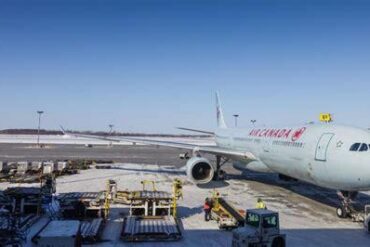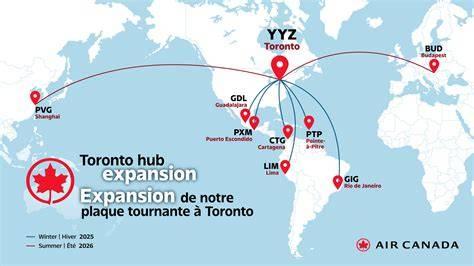
Air Canada has quietly redrawn parts of its international map since mid-year, removing three routes that once carried real strategic weight: the only nonstop link between Canada and Singapore, a pair of New York-JFK rotations from Toronto and Montreal, and the seasonal Toronto–Charleston service that never found its footing. For a carrier operating more than 240 aircraft across hubs in Vancouver, Toronto and Montreal, these are small numbers on a network chart, yet each cut signals a different calculation — a long-haul experiment that fell short, a consolidation into cheaper airports, and a leisure route that lost its seasonal demand.
Vancouver–Singapore: The Longest Flight That Could Not Sustain Itself
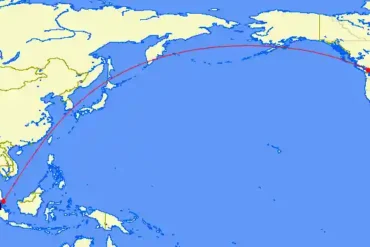
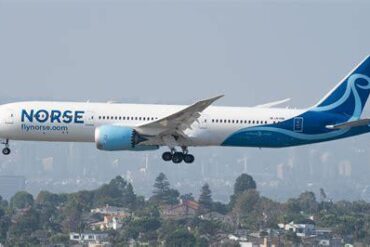
Air Canada made aviation history in April 2024 when it became the only North American airline flying to Singapore Changi Airport (SIN), launching a four-times-weekly service from Vancouver International Airport (YVR) aboard the Boeing 787-9 Dreamliner. The route was the airline’s longest, and for three years it stood as the sole nonstop connection between Canada and the Lion City. That chapter closes on January 24, when the final flight pushes back from Vancouver, with the return leg departing Singapore on January 26. The airline has signalled that the route failed to meet commercial sustainability targets, a candid admission that a prestige flagship can still bleed money when yields fall short of the fuel and aircraft-time it consumes. The withdrawal leaves Canada with no nonstop route to Singapore at all, and the only remaining nonstop operators between North America and Singapore are Singapore Airlines and United Airlines, both flying from the mainland United States. Calgary and Montreal travellers who once connected through Vancouver will now route through US gateways or Asian hubs, adding hours to a journey that briefly promised a single boarding pass from Canadian soil to Southeast Asia.

New York-JFK: Consolidation Over Four Daily Rotations
Air Canada ended its nonstop service to John F. Kennedy International Airport on June 1, removing up to four daily rotations — two from Toronto Pearson International Airport (YYZ) and two from Montréal–Trudeau International Airport (YUL), both flown with the Embraer E175. The math was stark: roughly 480 seats per day disappeared from JFK’s Canadian arrivals board. The Star Alliance carrier framed the exit as consolidation, shifting its New York capacity to LaGuardia Airport (LGA) and Newark Liberty International Airport (EWR), where it now serves six Canadian cities with 34 daily departures. Jet fuel economics sharpened the decision; the severe spike in fuel costs following the US–Iran conflict and the blocking of the Strait of Hormuz made thin, slot-constrained operations harder to defend. For passengers, New York remains well covered, but the move confirms that Air Canada will trade airport prestige for operating efficiency when the numbers demand it.
Toronto–Charleston: A Seasonal Route That Never Grew
Charleston International Airport (CHS) lost its seasonal nonstop link to Canada on September 6, ending a service launched from Toronto in March 2024 with ambitions of up to 200 annual departures. Instead, the schedule shrank to 92 flights, or up to six weekly departures aboard the Embraer E175, before the route was axed entirely. The cut forms part of a five-route reduction for the 2027 summer season that also touches Toronto Billy Bishop Airport (YTZ) to Boston, Montreal to Seattle, Vancouver to Nashville, and Vancouver to Raleigh. Charleston now counts just one international destination on its route map, Cancun, served seasonally by Breeze Airways — a reminder of how quickly a secondary US airport’s international connectivity can evaporate when a single carrier rebalances its network.
What These Three Cuts Reveal About Air Canada’s Network Strategy
Read together, the three withdrawals describe a disciplined, yield-first approach. The Singapore route tested whether a Canadian carrier could profit from ultra-long-haul without a partner hub to feed it, and the answer was no. The JFK exit shows a willingness to surrender slot-constrained prestige flying in favour of airports where frequency and connections work better. Charleston demonstrates that seasonal leisure routes face ruthless scrutiny when aircraft are scarce and fuel is expensive. Air Canada retains its global reach through partners and its three hubs, but the pattern is clear: routes must earn their place every season, and sentimentality carries no weight in the scheduling department. Travellers holding bookings on the affected services should expect rebooking through alternative gateways, and anyone planning Southeast Asia itineraries from Canada now needs to build a US or Asian connection into the plan.