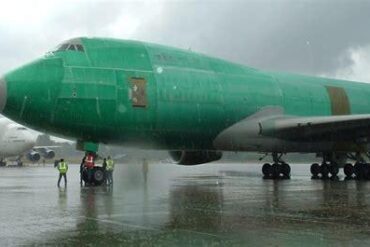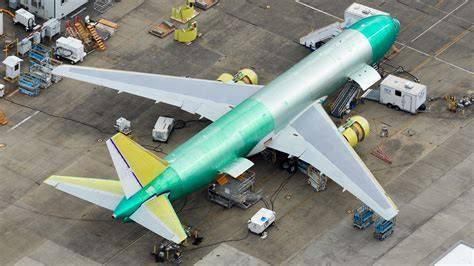
The first time most people see a factory-fresh Boeing 737, it is not in an airline’s colors. It is a startling, almost luminous emerald green, rolling along a rail spur in the Pacific Northwest or parked nose-to-tail outside the Renton plant. Search for images of a new Airbus A320 in Toulouse and the scene looks entirely different: a chalky, matte patchwork of pale yellow, olive, and tan that could almost pass for weathered primer on an old machine. The two planemakers build aircraft that do the same job, to broadly the same airworthiness standards, yet their unfinished products leave the factory looking as if they came from different eras. That contrast has fueled a durable aviation myth — that Boeing has a special “green” process or that Airbus skips corrosion protection altogether. The truth is more interesting than the myth, and it runs through chemistry, supply chains, European regulation, and the simple reality of when each manufacturer’s aircraft happens to be photographed.
The green surface on a Boeing airliner is not paint in any decorative sense, and it is not a single coating either. Boeing is primarily an assembler of aluminum aircraft, and aluminum skin on a modern airliner is thin, expensive, and unforgiving. A scratch during transport or a ding during assembly can demand inspection, rework, and costly delays. To prevent that, Boeing applies two distinct protective layers before the aircraft ever reaches its final livery: a corrosion-inhibiting primer applied directly to prepared aluminum, and over it a Temporary Protective Coating (TPC), widely known by the trade name “Spraylat”. The primer is the true undercoat; the TPC is a peelable film designed to take the abuse of weather, railcars, and ground handling, then be stripped away cleanly before final paint. What looks like one glossy green skin is actually these two coatings working in tandem, and neither is the decorative topcoat that will eventually carry an airline’s brand.
Watching a 737 fuselage leave Wichita makes the point vividly. Spirit AeroSystems builds the airframe there, coats it, and loads it onto an open railcar for a journey of roughly 2,000 miles (3,200 km) across the American interior to Renton. The train passes through Nebraska, Wyoming, Montana, and eastern Washington, mostly on BNSF Railway track, a journey that takes ten to twelve days with three or four fuselages per train. For more than a week, that aluminum sits exposed to sun, rain, grit, and the occasional hailstorm. No bare primer could shrug that off without damage, which is precisely why the strippable film exists.
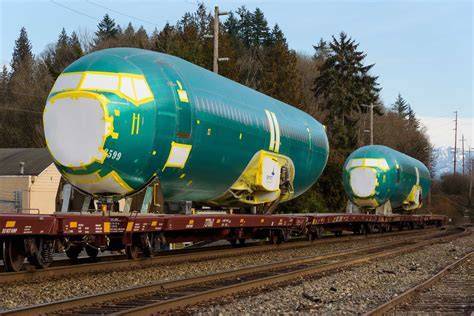
Boeing’s reliance on this technology is not a matter of style but of geography. Its supply chain spans a continent, and the rail route is the cheapest way to move integrated fuselages that already have wiring, insulation blankets, and systems installed. Removing the TPC restores a pale, matte structure beneath, but that stage is rarely photographed because by then the aircraft is inside a paint hangar, stripped of its protective cocoon and being prepared for the customer’s colors. The green images that circulate online capture the aircraft at its most exposed, not its most refined.
Why Airbus aluminum jets show a patchwork of shades
Airbus aircraft carry protective coatings too, and the chemistry is more advanced than Boeing’s. What differs is the appearance that chemistry produces. Airbus applies chromate-free exterior primers to its aluminum structures, and the company’s regulatory environment has pushed it faster in that direction than its American rival. The European Union’s REACH chemical framework has been tightening restrictions on hexavalent chromium (Cr(VI)), a known carcinogen long used in aerospace primers for its superb corrosion inhibition. In 2025, the European Chemicals Agency proposed sweeping restrictions on Cr(VI) substances across the EU, and Airbus began introducing chromate-free exterior primers on the A380 in 2016, only a few years after the Superjumbo entered service.
Chromate-free primers tend to appear tan, beige, or pale yellow-green rather than vivid emerald, and that alone explains much of the visual gap. Boeing still works under the more permissive US regulatory regime, where chromate chemistry remains viable for longer, so its primers and protective films retain the signature green tint that the industry associates with the manufacturer. Neither company is cutting corners; both are meeting the corrosion protection standards of their market, just along different timelines dictated by different chemical laws.
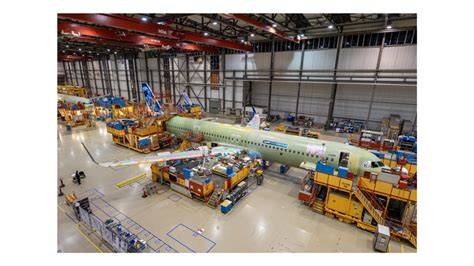
The second reason Airbus fuselages look like an unfinished quilt is structural and political at once. Boeing is an essentially national enterprise with concentrated assembly. Airbus is a multinational consortium with four home nations — the United Kingdom, France, Germany, and Spain — and its components are fabricated, anodized, and primed at facilities scattered across that footprint. Each plant applies its own corrosion-inhibiting primer, and each primer formulation has a slightly different chemistry. When the barrels, wings, and tails converge for final assembly, the aircraft emerges as a mosaic: a matte gray or tan composite radome, a pale yellow-green nose section, a slightly darker olive center fuselage, a tan belly, light gray wings over green primer, and an olive or beige aft. Those variations are the fingerprint of a distributed industrial model.
Contractors deepen the effect. GKN Aerospace, which absorbed Fokker Aerostructures in the UK and Netherlands, supplies large structures; Latecoere in France and Spirit AeroSystems contribute sections, each with its own primer tone. Airbus also transports major assemblies in BelugaXL freighters, a climate-controlled air bridge that spares components the punishment of open rail. No peelable film is needed for the journey, so the structural primer is what the world sees when a BelugaXL disgorges a wing set at Toulouse or Hamburg.
Composite airliners break the green rule entirely
The entire green discussion applies only to aluminum structures, a qualification that is frequently forgotten. Carbon-fiber-reinforced polymer (CFRP) does not corrode, exhibits no galvanic reaction with metal fasteners, and requires no chromate-based protection. Boeing’s 787 Dreamliner, the company’s only true clean-sheet design built around composites, rolls out of production in white, light gray, or beige, coated with conductive and ultraviolet-protective primers rather than corrosion inhibitors. Its European counterpart, the Airbus A350, shows up in similar tan and beige tones. Photographs of either aircraft in “primer” are really photographs of a different protective philosophy.
The contrast is sharpest on the Boeing 777X, which carries a 1990s-era aluminum fuselage under modern composite wings. Its fuselage leaves the factory in the glossy emerald green TPC, while its wings emerge white or light gray. Some early 777-9 test airframes have sat outdoors for years awaiting certification, and Boeing has applied a strippable green film to those stored aircraft to shield their skins from the elements. An airline could survey the same aircraft and see its composite and metal halves as two different colors of message.
The comparison is also a trick of timing and lighting
Much of the perceived gap comes from when each manufacturer’s aircraft gets its picture taken. Boeing’s green jets are typically captured on railcars or parked on the flight line before paint, deep in the manufacturing process. Airbus jets are frequently photographed emerging from the final assembly line, being unloaded from a BelugaXL, or conducting customer acceptance flights — stages where the structural primer is bare, uniform, and matte. Fans are comparing a film-wrapped fuselage in transit with a finished airframe freshly primed.
Lighting does the rest. Washington State’s overcast skies flatten green surfaces into dull khaki, while Toulouse’s Mediterranean sunlight warms primer tones toward honey and beige. Camera software often shifts the tones further; when a planespotter fills the frame with green fuselage, auto white balance can push the image toward magenta and artificially intensify the color. None of this changes the aircraft, only the impression.
What the paint stages actually mean
Airliners pass through three coating stages that are easy to conflate: structural primer, then an intermediate coating, then decorative topcoats bearing airline livery. Boeing’s green is the first two stages only. Airbus’s patchwork is its primer made visible by chromate-free chemistry and distributed manufacturing. Embraer takes yet another route, with bare bright silver or pale yellow-green aluminum on its aircraft, and COMAC and ATR apply their own variants of the same protective logic.
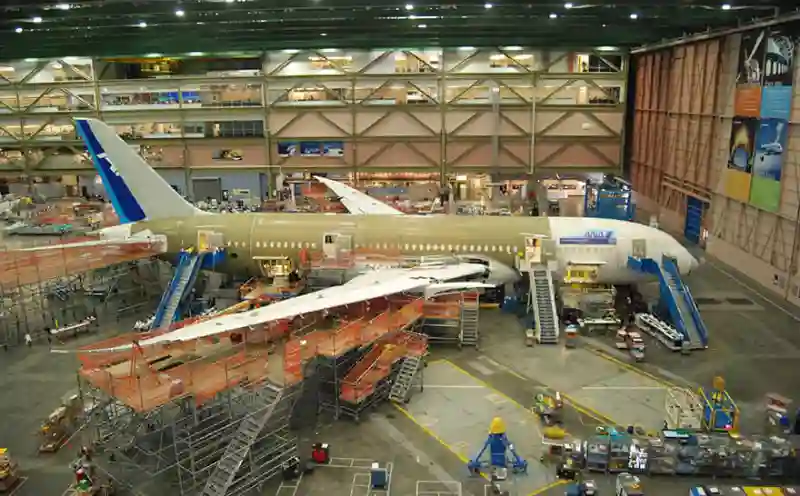
So the myth dissolves into a chain of causes: regulatory timing on chromium chemistry, a strippable film designed for a 2,000-mile rail journey, the color of chromate-free primers, a multinational assembly network, and the accidents of where photographers stand. Boeing planes are greener not because Airbus neglects them, but because Boeing’s aluminum aircraft spend their most photogenic early days wrapped in a protective film that is designed to be seen and then discarded. Airbus aircraft shed their earlier skins before most cameras arrive. Both practices produce safe airliners; only one produces an emerald icon.