When a fully loaded widebody touches down in torrential rain, the margin between a routine stop and a runway excursion is measured in fractions of a second and metres of asphalt. Runway grooves, the narrow parallel cuts machined or formed into runway surfaces, exist for precisely that moment. They are one of the least visible and most consequential pieces of wet-weather safety infrastructure in commercial aviation, giving rainwater a route out from beneath spinning tyres so that braking friction can survive contact with a flooded surface.
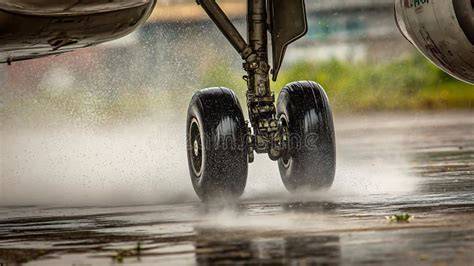
The core problem they solve is hydroplaning: at sufficient speed on a wet runway, the tyre footprint can lift off the pavement and ride on a film of water, severing the physical connection between rubber and asphalt. Once that connection is lost, anti-skid braking, ground spoilers, thrust reversers and autobrakes all operate on a surface that is no longer transmitting usable friction. A 1997 FAA Advisory Circular titled Measurement, Construction, and Maintenance of Skid-Resistant Airport Pavement Surfaces framed the issue bluntly, noting that with the arrival of turbojet aircraft, braking performance on pavement had become more critical, and that under certain conditions hydroplaning or an unacceptable loss of traction could occur, producing poor braking and possible loss of directional control. Grooving is the FAA’s proven answer to that failure mode.
What Transverse Runway Grooves Are and the FAA Specifications Behind Them
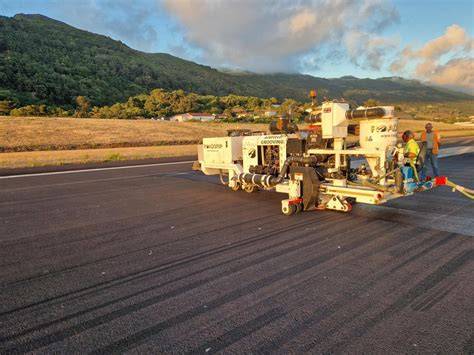
Grooves are cut or formed across the runway, typically running perpendicular to the centreline in the transverse configuration that dominates in the United States. Their geometry is deliberately specific. FAA specifications call for transverse grooves approximately 1/4 inch (6.4 mm) in width, approximately 1/4 inch (6.4 mm) in depth, and spaced 1.5 inches (38 mm) apart, centre to centre. The dimensions matter collectively: too shallow and they cannot vent water quickly enough under a heavy tyre load; too tight and the pavement loses texture; too deep and they become rubber traps that erode the very friction they were cut to provide. Grooves can be saw-cut into existing or newly laid hot-mix asphalt (HMA), or formed while portland cement concrete (PCC) is still plastic, which is why runway grooving is as much a construction sequencing decision as a maintenance one.
The engineering history behind those numbers is unusually well documented. The United States pioneered runway grooving to improve aircraft traction and water drainage, and NASA’s Wallops research runway carried out almost 200 braking tests using a McDonnell Douglas F-4D Phantom II fighter and a four-engine Convair 990 airliner. The finding was decisive: grooves substantially increase the braking capability of heavy jet-powered aircraft on wet, flooded and slushy surfaces. Over the decades, aviation experimented with a variety of cuts, including square grooves, V-shaped grooves and trapezoidal grooves, before the FAA settled on the straight-line grooves now standard at airports today. NASA, the FAA, the USAF and several foreign governments pooled research into two areas — high skid-resistant pavement, and proper maintenance techniques and procedures — and both strands converged on grooving as effective and proven.
Why the FAA Treated Grooving as a Priority for Every Turbojet Runway
The 1997 advisory circular did not merely recommend grooving; it set an expectation. All runways serving, or expected to serve, turbojet aircraft were considered a high priority for grooving, and existing runways without grooves were to be modified as soon as practical. The paper acknowledged that some existing pavements might not be immediately suitable for sawing, and recommended studies to determine whether they could be overlaid or rehabilitated to allow grooving. For runways that did not serve turbojets, the requirement was not automatic and depended on circumstances — a distinction that would later matter enormously in the case of military airfields used by commercial airlines. This strong federal position explains why grooving is especially common at commercial airports in the United States, even though it is not fully universal worldwide, including among some major international airports.
How Grooving Spread Internationally and Where It Remains Optional
In Europe and beyond, grooving is generally less common than in the United States. ICAO’s international standards are less prescriptive than the FAA’s: ICAO recognises grooving as a means of improving wet-runway braking but stops short of making conventional grooving universally mandatory. EASA treats grooving as one possible method to improve runway friction and surface texture, while Canada’s Transportation Safety Board has stated that grooving reduces the potential for both dynamic and viscous hydroplaning by providing a place where water can escape from beneath tyres. Yet the Board is explicit that runway grooving is not a requirement for new or existing runway pavement in Canada. Even in a country as frequently wet as Canada, it wasn’t until 2013 that Ottawa International Airport became the first Canadian airport to groove its runway. Some jurisdictions prefer alternatives: China favours stone mastic asphalt and other textured pavement surfaces, and France uses specialised asphalt surfacing. A 2010 Canadian safety investigation nonetheless found grooving present at almost all major airports in the US, UK, continental Europe, Australia and Japan.
When Grooving Is Not the Right Answer: General Aviation Airports
At most small general aviation airports, runways are ungrooved, and the reasons are practical rather than negligent. Light aircraft land at lower weights and speeds than commercial airliners and are therefore less susceptible to hydroplaning; low traffic volumes may not justify grooving costs; and many airfields are built with pavement characteristics that already deliver adequate friction and drainage. Operators can also achieve sufficient wet-weather friction through porous friction course overlays, concrete texturing finished by wire combing or tining, careful surface aggregate selection and favourable runway gradients. The irony is that light aircraft are genuinely vulnerable to skidding, since many lack anti-skid braking systems, operate from shorter and less frequently maintained runways and use relatively small tyres. Without anti-skid protection, excessive braking on a slippery surface can lock the wheels, and a locked wheel both loses braking effectiveness and makes directional control harder in crosswinds.
Maintenance Burdens, Climate Trade-offs and the Case Against Grooving
Grooving carries real costs. Rubber accumulation in the grooves, concentrated in touchdown zones, gradually reduces effectiveness and adds another layer of airport maintenance. Beyond construction expense, grooves can damage pavement, generate foreign object debris as rubber builds up, and slightly increase tyre noise. Climate is the sharpest dividing line: grooved runways suit persistently wet regions such as the US Pacific Northwest and Northern Europe, but deliver little benefit at dry airports in Saudi Arabia, Egypt or Arizona, where flash flooding may make them momentarily useful while desert sand actively contaminates the grooves. In colder climates, grooves retain anti-icing and de-icing chemicals and help drain melted snow and ice, a residual benefit that partially offsets the maintenance burden.
How Ungrooved Runways Contributed to Documented Overruns
The accident record shows what is at stake. On Miami Air International flight 293 in 2019, a Boeing 737 overran the wet, ungrooved runway at Jacksonville and ended up in the St. Johns River with no serious injuries. Because the airfield was a US Navy facility rather than Jacksonville International, it fell outside the 1997 FAA grooving framework, and the NTSB determined that probable cause included extreme loss of braking friction due to heavy rain and the water depth on the ungrooved runway, which resulted in viscous hydroplaning. A United Express Embraer overran the wet, ungrooved runway at Ottawa in 2010, three years before that airport grooved its surface. Parallel cases include American Airlines flight 331 at Kingston in 2009 and Southwest Airlines flight 1919 in Chicago in 2011, while Virgin Australia experienced a similar event on New Zealand’s then-ungrooved Christchurch runway in 2015, where the Australian Transport Safety Bureau found that company policy treated damp runways as dry, distorting landing performance calculations amid high crew workload on a revised approach.
Why Grooved Runways Will Keep Spreading in the 2020s
Despite uneven regulation, the worldwide trend across the 2010s and 2020s has been for grooved runways to become more common, even if the total is difficult to quantify. Grooving is not the only route to traction — its value waxes and wanes with climate, traffic and maintenance — but the physics of hydroplaning do not change with jurisdiction. For any airport handling heavy jet traffic in heavy rain, transverse grooves remain the most reliable way to keep a tyre in contact with the pavement, and the evidence from Wallops onward suggests that the investment pays off in the fraction of a second when braking matters most.