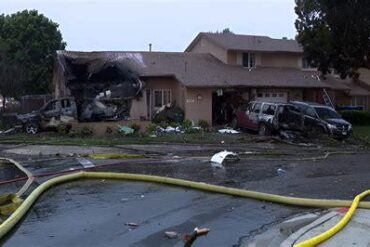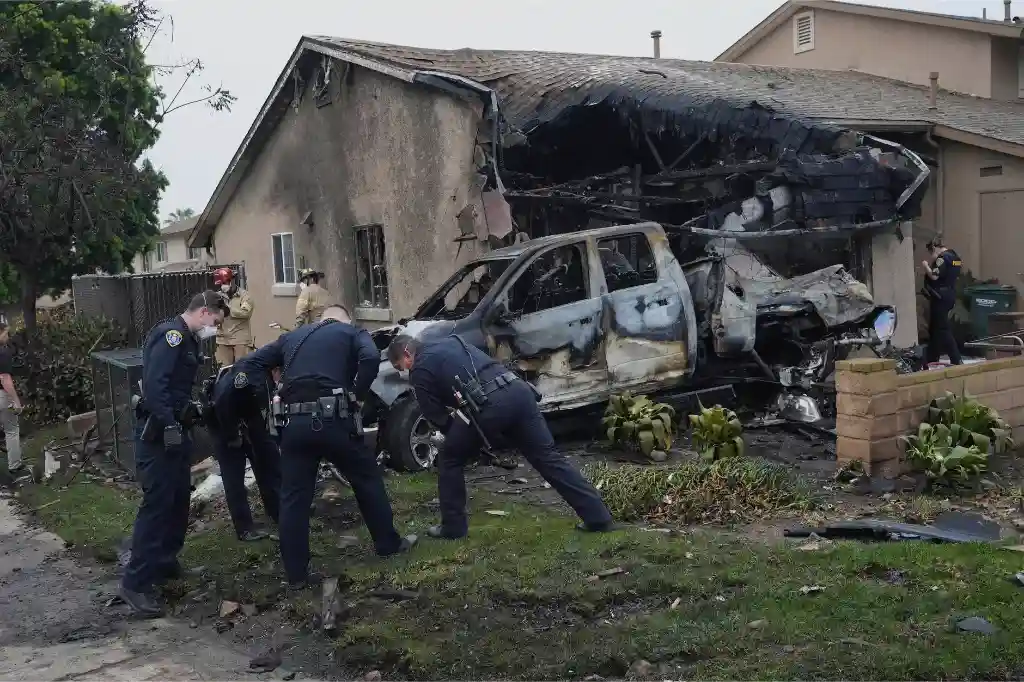
In the early morning hours of a quiet San Diego neighborhood, a tragedy in the skies became a personal catastrophe on the ground. The crash of a Cessna 550 into a residential area in Murphy Canyon not only claimed six lives aboard the aircraft but also left residents grappling with the devastating fallout. Among the most affected is the Crone family, whose primary vehicle was destroyed in the inferno that followed — not by direct impact, but by a torrent of burning jet fuel that surged through the gutters and ignited everything in its path.
The chaos unfolded around 4 a.m. when Nichole Crone, a mother of three and the wife of a U.S. Navy service member, was jolted awake. Not by the impact of the crash, but by the sound of tires exploding outside her home. Their son, who sleeps with his window open, was the first to detect the danger. The sharp pops of the tires, a haunting prelude to the blaze that consumed their Kia Soul, echoed through the dark.
The Ring security footage would later confirm the horror. A deluge of flames poured through the gutter system, igniting vehicles in its path. “A lot of people were panicking, telling us to get out, to leave, because they thought the car was going to explode,” Nichole recalled. Her voice, steady despite the trauma, underscored the surreal terror of that moment — the realization that even though the aircraft did not strike her home directly, the consequences found their way to her family’s doorstep.
Wrong Place, Wrong Time: How Trash Day Changed Everything
In a cruel twist of fate, the family’s vehicle was not even parked where it usually sits. Crone explained that their Kia Soul typically remains in front of their house — safely away from the corner where the fuel eventually pooled. But because it was trash day, the car had been relocated to the other side of the street to make room for bins.
“It’s just one of those random things you never expect,” she said. “We didn’t park there by choice. We just wanted to make sure the trash got picked up.”
That decision, seemingly insignificant at the time, would cost them dearly. The fire obliterated their car — their financial investment, their logistical lifeline, and their daily transportation solution — in seconds. But the flames didn’t just take property. They scorched peace of mind, financial stability, and the sense of safety that a family should feel in their own neighborhood.
Insurance Nightmare Adds to the Burden
Just days after the crash, the Crone family found themselves confronting yet another crisis: insurance denial of full compensation. According to Nichole, their provider, USAA, has offered $15,885 for the totaled vehicle. After deducting the $1,000 deductible, the payout leaves the family with a significant gap — nearly $3,000 short of what they still owe on the car.
“It wasn’t even two months old for us,” she said. “We were still making payments. We still owe $19,000.”
The timing could not have been worse. The family had just added the second vehicle to help ease the strain of their demanding schedule. Nichole uses the car not only to generate income through Instacart deliveries, but also to drive one of her children, who is on the autism spectrum, to multiple therapy appointments each week. Their other car is required for her husband’s daily commute to Naval Base Coronado.
“We’re already struggling with both car payments, and now we lost a vehicle and still have to make payments on it,” she added. Her frustration is compounded by the fact that the loss was entirely out of their control.
Emotional and Logistical Fallout of a Neighborhood Disaster
The emotional toll is hard to quantify. Crone, who has chosen not to show her face publicly for privacy reasons, speaks with a quiet urgency — the tone of someone trying to hold everything together while each new development adds weight to the burden.
Despite the trauma, the family continues to negotiate with USAA, hoping that the exceptional nature of the accident — caused by a rare aviation disaster — might prompt a reconsideration. “This wasn’t our fault,” she said. “We didn’t ask for this to happen. We just want what’s fair.”
Her point resonates with many in the community. When a vehicle is destroyed by a negligent driver, fault can be determined, and recovery may be more straightforward. But when it’s burned to ashes by aviation fuel in a freak accident, the lines of liability become obscured, and residents are left clinging to hope rather than protected by policy.
Community Fundraiser Brings Rays of Hope
Recognizing the family’s dire situation, a friend has stepped in to organize an online fundraiser. The GoFundMe campaign is intended to help cover the gap left by the insurance shortfall and assist the family in securing a new vehicle. Crone has expressed gratitude for the outpouring of support and hopes the campaign can at least cushion the financial blow until a more permanent solution is found.
Even with this assistance, the situation remains precarious. Families in military communities often face unique financial strains, and the Crones are no exception. While many Americans live paycheck to paycheck, this family now faces a situation in which a necessary piece of their livelihood — a car used for both caregiving and income — was destroyed in an event that defies logic.
Broader Implications for Disaster Coverage and Urban Aviation Safety
This incident also raises questions about the scope of insurance coverage in rare but catastrophic events. Should policies be revised to include such disasters? How should insurance providers assess the value of a car lost in a situation that cannot be reasonably anticipated or avoided? These are the unanswered questions looming in the background, not just for the Crones, but for any family living under flight paths or near small airport zones.
The crash has highlighted a growing concern in densely populated urban areas: the risk of small aircraft accidents in residential zones. As more cities expand outward and infill development brings more homes closer to older airfields, residents face risks they may not have fully considered when they bought or rented.
Conclusion: When the Skies Fall, Who Pays the Price?
As investigators sift through the wreckage to determine what went wrong aboard the ill-fated Cessna 550, families like the Crones are left to pick up the pieces. The jet fuel that tore through their street didn’t just destroy metal — it tore open a financial wound that may take years to heal.
Crone’s story is a powerful reminder that the victims of such disasters are not always the names in the flight manifest. Sometimes, they are the quiet families watching flames engulf a vehicle parked where it never usually is, woken up not by fire alarms but by the sound of tires bursting in the dark.
And sometimes, they’re left asking a single, gut-wrenching question: “If it wasn’t our fault, why are we still the ones paying for it?”