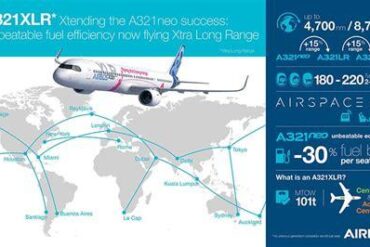
The Airbus A321XLR has quietly rewritten one of commercial aviation’s oldest assumptions: that crossing an ocean requires a twin-aisle aircraft. With a published range of up to 4,700 nautical miles (8,704 kilometers), the type lets airlines fly long, thin routes that once demanded an Airbus A330 or a Boeing 787, but with far fewer seats to fill. That difference sounds modest on a spec sheet and radical on a balance sheet. Instead of committing 250-plus seats to a city pair that can support only 180 on a Tuesday in February, carriers can keep the nonstop link alive, add frequencies, and protect premium cabins from discounting. The routes below show the transition in practice, and each one substitutes widebody capacity in a different way, from full replacement to seasonal shuffling and range-limited compromises.
Madrid to Boston: The First Commercial A321XLR Long-Haul Flight
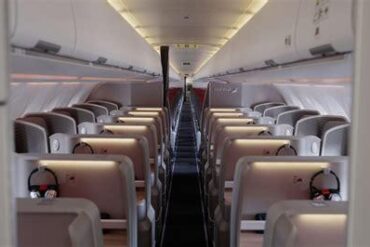
Iberia made aviation history on November 14, 2024, when it flew the world’s first commercial long-haul A321XLR service from Madrid to Boston. The Spanish flag carrier had served the market with widebodies, including the Airbus A330, but the route carried a structural problem: Boston is an important transatlantic destination yet not a major connecting hub for a oneworld partner, so Iberia had fewer opportunities to top up a large aircraft with transfer passengers. Outside peak periods, the A330 flew with seats nobody needed. The XLR solved that arithmetic directly. Iberia configured its aircraft with 182 seats, comprising 14 business-class seats that convert into fully flat beds and 168 economy seats, a substantial reduction against a typical long-haul A330. The premium cabin also offers direct aisle access for every business-class passenger, a detail that matters for corporate contracts: the airline can sell a genuine long-haul product on a single-aisle jet without apologizing for it.
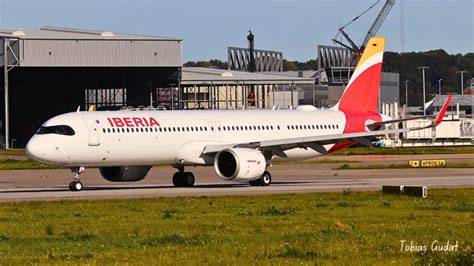
The schedule has since demonstrated the type’s flexibility rather than a one-off experiment. Iberia said in November 2025 that Boston had grown from one daily flight to two, with the XLR supporting the additional frequency. Crucially, that growth did not mean every Boston departure permanently abandoned widebodies. The A330 remains useful when demand rises, so the airline can allocate capacity by season and timetable, offering more frequent service without filling a twin-aisle jet on every flight. Boston became the proof of concept that made the case for deploying the XLR elsewhere across the North Atlantic.
Madrid to New York-JFK: Preserving Frequency While Changing Gauge
Iberia expanded its A321XLR operation to New York JFK on October 26, 2025, when the aircraft replaced an A330 on one of the airline’s two daily flights. The move was notable precisely because New York is a far larger market than Boston, supporting heavy premium demand and a dense web of connections. Rather than withdrawing widebody service, Iberia used the XLR to diversify the capacity offered across its schedule: one daily frequency flew with the smaller aircraft while the second retained a larger gauge. The purpose was to redistribute capacity across the day, not to signal that demand between Madrid and New York had weakened. A major city pair can justify several daily departures without justifying a widebody on each one, and a smaller aircraft makes off-peak flights viable while freeing an A330 for routes where its seats earn more.
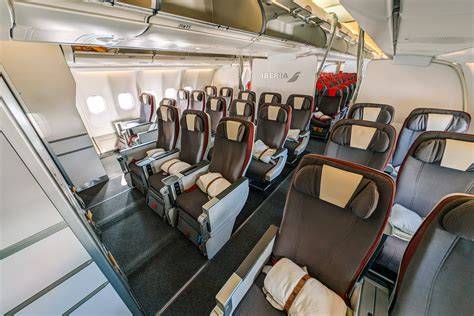
The deployment has varied by season and schedule. The initial winter 2025/26 plan assigned the A321XLR to one of two daily JFK flights, with an A330 continuing on the other, and later timetable filings showed further changes in aircraft assignments, including A350 and A330 operations. This is a partial widebody replacement, not a permanent conversion of Madrid to JFK to narrowbody service. Aircraft type can change by date, so passengers who care about cabin layout or aircraft size should verify the operating schedule before booking. AeroRoutes documented the original change and its planned frequency.
Madrid to Washington Dulles: Year-Round Service With Mixed Equipment
Washington was among Iberia’s first A321XLR destinations after Boston, and it illustrates how the aircraft sustains a route beyond the peak season. Iberia had previously operated Madrid to Washington seasonally, a direct reflection of uneven year-round demand. The XLR made the route viable in the quiet months by giving the airline a smaller aircraft for departures that could not support a widebody. The substitution is partial rather than absolute. Iberia’s schedule has included narrowbody operations on most weekly flights, with the A330 retained for selected departures; published timetable data has shown five weekly narrowbody flights alongside two weekly A330 services in some periods, though the exact split shifts with seasonal demand and schedule revisions. Some schedule databases identify the aircraft only as an A320-family narrowbody, so the specific variant should be verified for the date in question rather than assuming every narrowbody departure is an XLR.
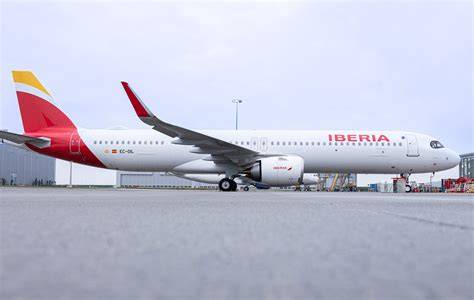
Washington rewards this approach because the market serves government and corporate travel alongside leisure passengers and onward connections. Iberia can maintain a nonstop link to the US capital while limiting the number of seats it must sell on quieter days, and the A330 stays available when additional capacity is justified. The result is a schedule in which aircraft size follows demand rather than a fixed fleet plan, which is exactly how Iberia has described the XLR’s role in turning Washington into a year-round destination.
Montreal to Berlin: Lower Capacity for a Developing Market
Air Canada introduced Montreal to Berlin in July 2026, initially operating the route with a Boeing 787-8 before switching to the A321XLR on July 19. The route is a clean example of a widebody replaced within weeks of a launch, and the capacity gap is significant: the 787-8 carries substantially more seats than Air Canada’s 182-seat XLR, so the narrowbody cuts capacity on every departure while preserving the nonstop connection. Montreal is Air Canada’s principal hub in Quebec, where passengers connect across Canada and the United States, while Berlin is a major European market with far less transatlantic connectivity than Frankfurt, London, or Paris. A three-times-weekly service lets the airline test demand without committing a larger aircraft to every flight, and Air Canada has announced plans to resume the route in summer 2027, growing it to as many as four weekly departures during the season.

The cabin design supports the strategy. Air Canada’s XLR carries 14 lie-flat Signature Class seats in a 1-1 layout and 168 economy seats, so despite the single aisle, every premium passenger keeps direct aisle access. That arrangement lets the airline position the aircraft as a long-haul product rather than a high-density narrowbody, and it underpins the broader goal of connecting secondary markets directly to the Montreal hub. Montreal to Berlin is therefore not merely a capacity reduction from the 787-8 but a test of whether a smaller aircraft can make a thinner transatlantic market sustainable.
Mumbai to Amsterdam: Replacing a Leased Dreamliner at the Edge of Range
IndiGo switched its Mumbai to Amsterdam service from a Boeing 787-9 to the Airbus A321XLR on October 25, 2026, ending its widebody operation with Norse Atlantic Airways. The earlier arrangement had allowed IndiGo to launch long-haul flying using leased Dreamliners while supplying its own cabin crew, but rising operational pressures, including airspace restrictions and fuel costs, pushed the airline toward a different model. The XLR now operates the roughly 11-hour westbound flight, making Mumbai to Amsterdam the world’s longest scheduled A321XLR route by block time. Restrictions on Russian, Ukrainian, and Iranian airspace force aircraft onto longer routings, adding strain to a sector already close to the type’s practical range limits.
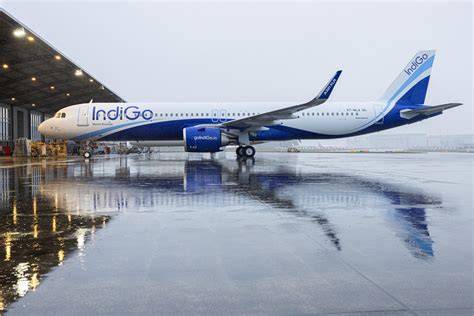
Those constraints initially prompted IndiGo to consider trimming capacity. The airline planned to cut the service from daily to three weekly flights and limit bookings to fewer than 140 passengers on its 195-seat aircraft, reducing payload so the aircraft could carry the fuel needed for the long nonstop journey. IndiGo subsequently reversed the frequency reduction, restoring daily service for winter 2026/27, so the three-weekly plan did not become the final operating arrangement. The proposed passenger cap remains instructive all the same, showing the compromises involved in running a densely configured narrowbody on a sector this long. The XLR offers fewer seats than the leased 787-9, yet it preserves IndiGo’s Amsterdam connection without the Norse partnership, and the airline’s own Airbus A350-900s from 2027 are expected to supply the longer-term widebody answer.
What These 5 Routes Reveal About the A321XLR Transition
Read together, these routes show that the A321XLR is less a universal widebody killer than a capacity-matching instrument. Boston shows a route that gained frequencies once the gauge fell. New York shows a major market where the smaller aircraft absorbs off-peak demand while widebodies keep the peak. Washington shows a seasonal route turned year-round through a mixed fleet. Montreal shows a brand-new market launched on a 787 and quickly right-sized. Mumbai shows the outer boundary of the concept, where range, payload, and geopolitics all press on the economics at once. In every case, the common thread is that airlines can now keep a nonstop link, or a preferred frequency, without flying excess seats, and that is precisely the advantage that made the XLR one of the most consequential aircraft of this decade.