Africa’s aviation landscape is entering a period of transformative momentum, shaped by surging demographics, expanding urban centers, and a growing middle-income population with increasing mobility needs. Boeing’s newest Commercial Market Outlook for 2025 positions the continent as one of the most dynamic growth regions worldwide, anticipating a sustained climb in passenger demand over the next two decades. This projection aligns with ongoing investments in airport modernization, regional connectivity initiatives, and the steady rise of low-cost carriers capable of unlocking underserved markets.
The continent’s economic trajectory provides the foundation for this expansion. As household incomes rise and infrastructure strengthens, air travel is shifting from a premium option into a more accessible mode of transportation across domestic, regional, and international routes. These structural changes underpin Boeing’s prediction that Africa is on the brink of a prolonged aviation upcycle.
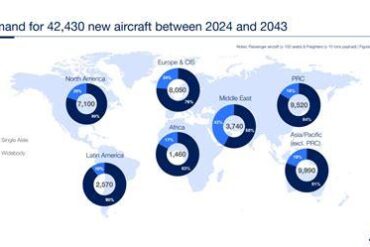
Boeing’s 2025 outlook projects passenger traffic in Africa to grow at an average annual rate of 6% through 2044, placing the continent near the top of global aviation growth rankings. To support this surge, the African commercial fleet is expected to more than double—from about 744 aircraft today to approximately 1,680 by 2044.
The forecast includes deliveries of 1,205 new aircraft to African operators between 2025 and 2044. A remarkable 865 of these will be single-aisle jets, signaling that the continent’s growth engine will primarily come from short-haul and medium-haul markets. These narrow-body aircraft will feed regional and domestic networks that continue to benefit from population growth and evolving travel patterns.
Wide-body demand remains present but more modest, with 240 units expected, complemented by 90 regional jets and 10 dedicated freighters. This distribution illustrates a continental aviation market prioritizing frequency, operational flexibility, and cost efficiency—qualities central to single-aisle models such as the Boeing 737 MAX family.
Economic Transformation And Connectivity Driving Demand
Africa’s growth fundamentals extend beyond aircraft numbers. Boeing anticipates $130 billion in demand for aviation services—covering maintenance, repair, training, and operational support—over the next two decades. The continent will also require up to 74,000 new aviation professionals, including pilots, engineers, and cabin crew, to support an expanding fleet.
Underlying these projections is a set of powerful socioeconomic shifts. Rapid urbanization, swelling population centers, and the emergence of a more affluent middle class are collectively increasing the appetite for fast, reliable mobility. As modern airports come online and regional policies improve, more travelers will shift from long-distance road transport to air travel. Low-cost carriers, in particular, are positioned to reshape continental travel by offering fares that open aviation access to millions of new passengers.
Improved regulatory frameworks, increased airspace liberalization, and strengthened safety oversight are also assumed in Boeing’s long-term forecast. These elements, if fully realized, will enable airlines to operate more efficiently while unlocking aviation-driven economic opportunities such as tourism, trade, and investment flows.
Risks, Constraints, And Policy Hurdles
Africa’s aviation ascent is not without challenges. Regulatory fragmentation remains a persistent obstacle, with inconsistent policies and slow adoption of open-skies agreements limiting the ability of airlines to expand cross-border networks. Without cohesive market liberalization, significant portions of the projected demand risk going unmet.
Economic volatility—particularly currency instability and exposure to commodity cycles—may affect traveler purchasing power and elevate airline operating costs. Environmental pressures are also intensifying. As global sustainability standards tighten, airlines will need to invest in cleaner technologies and potentially costlier sustainable aviation fuels. These measures are essential to ensuring African carriers remain competitive on the international stage.
Despite these uncertainties, the long-term potential remains clear. With strategic investment, stronger policy frameworks, and a sustained commitment to modernization, Africa is positioned to become one of the world’s most important single-aisle aircraft markets. The coming two decades will reveal whether the continent’s infrastructure and regulatory environment can keep pace with the ambitious trajectory outlined in Boeing’s forecast.