A single fiber optic cable no thicker than a garden hose carries more financial traffic in one hour than most nations move through their banking systems in a month. Hundreds of thousands of miles of these cables lie on the seabed, quietly carrying 99% of intercontinental internet data, entirely owned in large part by private companies rather than governments. Global banking, energy trading, and every transaction processed between continents pass through that submerged lattice, which means the decision by the U.K. Ministry of Defence to fund a $120 million robotic submarine-hunting network is not techno-optimist theater but a response to a specific adversary doctrine. Announced on November 10, 2026, and named Atlantic Net, the framework puts acoustic sensors on uncrewed surface vessels and underwater robotic drones built to patrol the North Atlantic and detect Russian submarines long before they can lie quietly above cable infrastructure.
Why Russian Submarines Mapping Underwater Cables Changes the Naval Equation
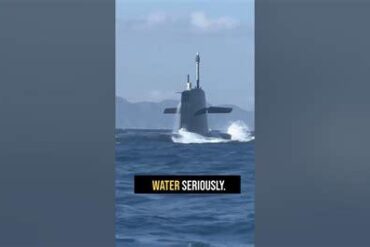
British intelligence has tracked specialist Russian submarines spending prolonged periods loitering directly over Atlantic cable infrastructure, and the Ministry of Defence is blunt about what that behavior represents: peacetime mapping conducted to identify the precise positions, acoustic signatures, and vulnerable access points that would be targeted during wartime. Two Russian vessels — including the Yantar, a known cable-mapping ship — were reported operating near undersea cables in the North Sea, a pattern that intelligence analysts read as preparation rather than routine navigation. The MoD specifically names GUGI, Russia’s Main Directorate of Deep-Sea Research, as the organization responsible for dispatching those vessels, a unit whose entire purpose is deep-water reconnaissance, salvage, and sabotage.
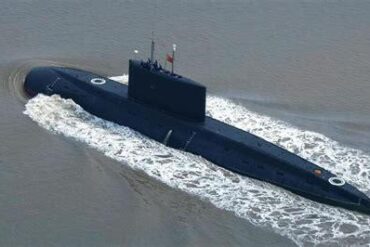
In April 2026, Defence Secretary John Healey disclosed one particularly telling operation: three submarines deployed to the North Atlantic, comprising an Akula-class attack submarine and two GUGI deep-sea units. The GUGI submarines loitered over infrastructure for more than a month while the Akula-class boat appeared to function as a decoy, drawing surveillance attention away from the intelligence and mapping work happening below. Experts cited in reporting on the operation noted that GUGI submarines are equipped to place wiretaps on cables, meaning the threat reaches beyond severing links to intercepting their contents. That combination — sustained loitering, quiet reconnaissance, and apparent deception — explains why legacy coastal monitoring no longer delivers the situational awareness Britain believes it needs.
How Atlantic Net Uses AI-Powered Sensor Drones to Listen for Hostile Submarines
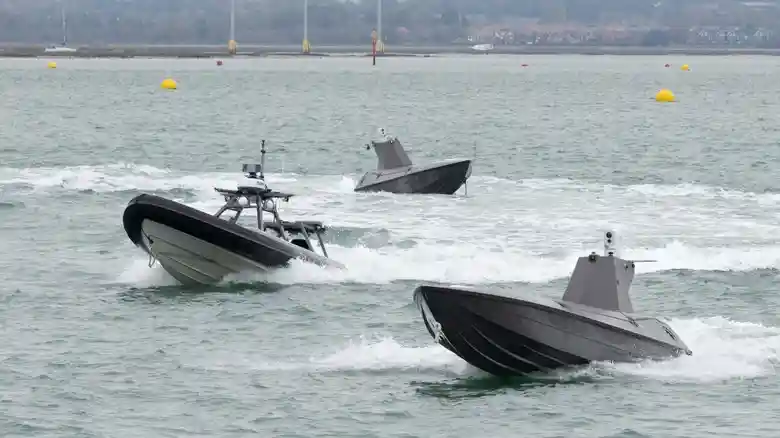
Atlantic Net will be developed by Ocean Infinity, a Hampshire-based marine robotics company that has spent years proving its autonomy stack in commercial survey work, and the technical architecture is deliberately simple in concept. Sensors mounted on uncrewed vessels and underwater drones record actual sound, which AI software sorts and classifies as acoustic data before relaying findings to the Royal Navy’s remote operations center. There, trained staff review flagged contacts and, once a track is confirmed as something hostile, task Astute-class submarines and anti-submarine warfare vessels to intercept and identify the target. The result is a detection layer that should shorten the time between a Russian boat entering the monitored box and a response being ordered.
The Contractor-Run Model That Keeps Royal Navy Warships Free
What distinguishes Atlantic Net from a conventional procurement program is not the hardware but the contractual structure. The Royal Navy will neither own the systems nor operate them directly; instead it rents the capability as a service, with Ocean Infinity carrying responsibility for fielding, maintaining, and sustaining the drone fleet under government oversight. According to the Navy, that arrangement moves the operational burden onto the contractor, leaving naval assets available for warfighting and other deployments rather than tied to persistent patrol duties. Beyond cable protection, the MoD has confirmed that Atlantic Net will support protection of the U.K.’s nuclear deterrent, extending the network’s remit beyond commercial infrastructure into the territory of national strategic survival.
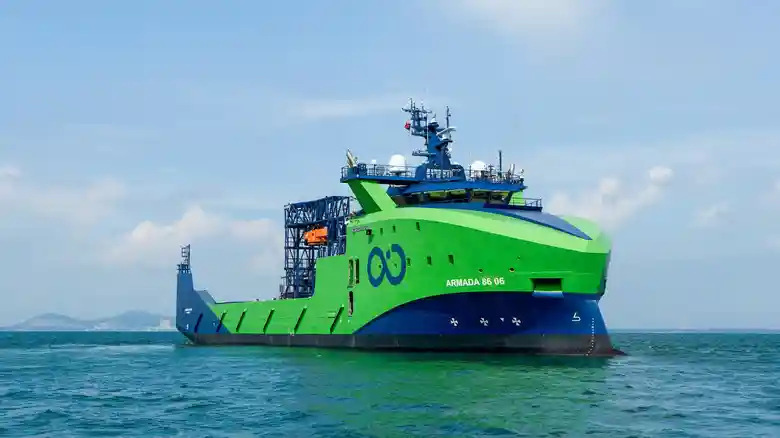
The commercial credentials behind the award are substantial. In December 2025, Ocean Infinity completed construction of its own purpose-built fleet of 14 vessels — the Armada — designed originally as survey ships for offshore energy clients mapping the seabed. Those same autonomous, sensors-first hulls are now being re-tasked for defense, a transition that gave the company demonstrable experience in operating uncrewed platforms at sea at scale while competitors were still assembling proposals.
The Cold War Precedent: Hydrophones, Quieter Submarines, and Why Mobility Matters
The underlying concept is far from novel. During the Cold War, the U.S. Navy operated huge hydrophone networks attached to cables running across the seafloor to shore stations, producing audio that analysts used to track Soviet submarines. That system worked admirably for decades, but it carried two structural weaknesses. First, Soviet submarines became progressively quieter, and by the late Cold War the network’s detection performance had diminished significantly. Second, modern diesel-electric submarines running on battery power generate even less acoustic signature, deepening the challenge. Fixed seabed hydrophones can listen only where they are wired, so a quiet boat slipping along the corridor between arrays might go unheard entirely.
Atlantic Net’s answer is mobility. Uncrewed drones can be repositioned to cover chokepoints, adapt to shifting intelligence priorities, and provide detection in areas fixed arrays never covered. The service is expected to go live in 2027, but the MoD has framed it frankly as a stopgap: the Royal Navy intends to take over the mission with its own purpose-built vessels by 2030. Britain is not buying the future of undersea surveillance outright — it is renting a bridge to it, backed by an investment unlocking roughly £90 million, while a real maritime security capability quietly becomes the private sector’s job.