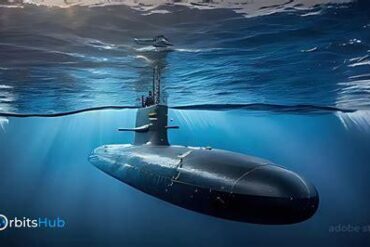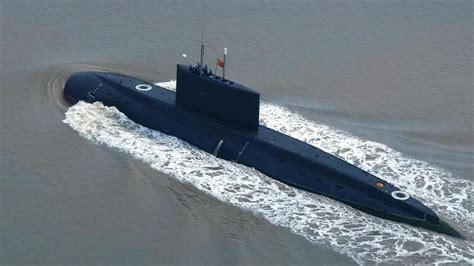
Japan’s undersea fleet has become an increasingly decisive factor in the balance of naval power in the Western Pacific. While China’s People’s Liberation Army Navy has surged past every global competitor in sheer numbers, Tokyo’s 24 high-technology submarines remain a formidable strategic counterweight. Their blend of acoustic stealth, advanced propulsion, and increasingly sophisticated weapons systems grants Japan a quiet but potent influence beneath contested waters.
Japan’s Submarine Power in a Region Dominated by Numbers
China fields over 370 active battle force platforms, a figure expected to climb to 395 ships by 2025 and 435 by 2030. Several of these ships are modern nuclear submarines with long-range patrol capabilities. Yet Japan’s relatively modest fleet leverages a completely different kind of superiority—low acoustic signatures, high endurance, and unparalleled operational reliability. These strengths allow Japan to influence critical chokepoints across the First Island Chain, particularly the Miyako Strait and waters near Taiwan.
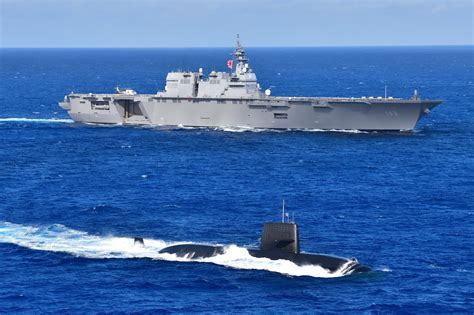
Unlike China’s increasingly diversified fleet of nuclear and diesel-electric boats, Japan’s undersea forces rely on exceptionally refined conventional designs. These submarines are optimized for quiet operation in littoral environments, where PLAN vessels must approach exposed passages to break into the Pacific. In these tight corridors, stealth counts for more than raw numbers.
Sōryū-Class: The Backbone of Tokyo’s Silent Deterrent
Japan’s Sōryū-class submarines, introduced in 2009, represent one of the most advanced diesel-electric submarine designs in service today. Built jointly by Mitsubishi Heavy Industries and Kawasaki Heavy Industries, the class is distinguished by its X-shaped stern—a geometry chosen to maximize maneuverability in shallow and acoustically complex waters. These boats are among the world’s largest conventional submarines, stretching 84 meters with a submerged displacement of roughly 4,200 tons.
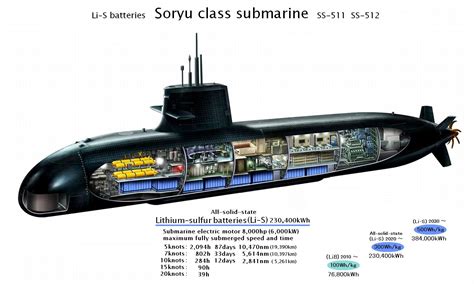
More than one-third of Japan’s submarine fleet uses air-independent propulsion (AIP). The Sōryū-class employs Swedish-designed Stirling engines licensed to Kawasaki, enabling weeks of fully submerged operation. This reduces the need to snorkel—one of the biggest risks for diesel-electric submarines—and significantly lowers the acoustic footprint during patrols.
Even more striking are the final two Sōryū-class vessels, which replaced AIP with next-generation lithium-ion batteries. This pioneering move has delivered exceptionally high energy density, faster recharge cycles, superior endurance, and fewer mechanical components. Japan remains the only nation operating submarines of this type at scale.
Taigei-Class: A Leap Into the Future of Stealth Warfare
Japan’s latest Taigei-class submarines build upon the lithium-ion revolution. Four boats are already operational, with three more planned. These vessels abandon AIP entirely yet manage over a month of submerged endurance in low-power mode, relying solely on battery technology that remains unmatched globally.
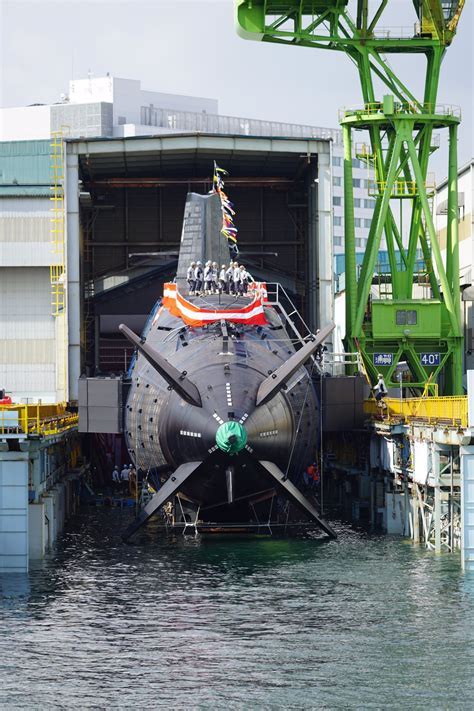
For Japan, the advantages are direct: deeper patrol durations, quicker acceleration, reduced maintenance, and ultra-low noise signatures. For China, the challenge becomes more complex. A silent submarine that can remain underwater far longer than expected is a tactical wildcard—one capable of disrupting amphibious movements, carrier group transit, or missile submarine patrol patterns.
The PLAN’s Struggle Against Undersea Ambiguity
Although China’s submarine program has expanded rapidly, not all boats are equal. Roughly 48 of its 60 submarines are diesel-electric, and only 12 use AIP. Its nuclear-powered attack submarines are improving but still struggle with noise reduction compared to U.S. or Japanese standards.
More critically, PLAN submarines must exit the South or East China Sea to access blue-water environments. This forces them through predictable chokepoints, many of which fall within the surveillance and engagement zones of Japan’s Maritime Self-Defense Force.
Japanese submarines positioned at these bottlenecks—silent, patient, and technologically advantaged—can impose immense risk on even the most modern PLAN vessels.
JMSDF Surface Power: A Force Multiplier Beneath the Waves
Japan’s undersea fleet does not operate in isolation. Its efforts are strengthened by one of the world’s most sophisticated surface combatant forces. The Maya-class Aegis destroyers, displacing 8,200 tons, integrate advanced radar, missile defense networks, and long-range strike capabilities.
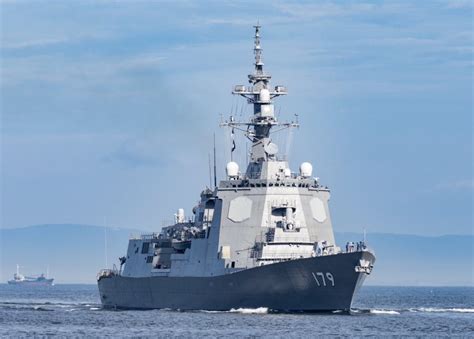
Japan’s acquisition of 400 Tomahawk cruise missiles further extends its strategic reach to 1,500 kilometers. Additionally, Tokyo’s helicopter carriers—capable of launching F-35B stealth fighters—serve as critical nodes for anti-submarine warfare and maritime domain awareness.
Japan’s Hypersonic Railgun: A Disruptive New Threat
One of the most consequential developments is Japan’s ship-mounted hypersonic railgun, tested successfully at sea in 2025. Firing projectiles exceeding Mach 6 with a deep virtual magazine and low cost per shot, the system undermines China’s reliance on expensive missile saturation tactics.
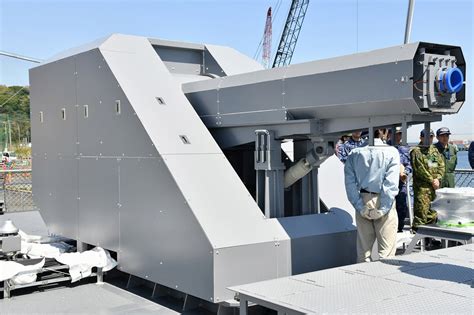
A destroyer equipped with such a weapon can remain in the fight far longer than a missile-dependent vessel. With hundreds of potential rounds and strong rate-of-fire durability, a railgun alters PLAN risk calculations across every contested theater of East Asia.
A Submarine Force Built to Counter a Giant
China’s navy may be the largest in the world, but Japan’s submarine force is precisely engineered for the region where the two powers would meet. Every advantage Japan holds—quiet propulsion, advanced batteries, superior sonar, and highly trained crews—works to neutralize PLAN numerical superiority.
Beyond raw capability, these submarines carry strategic weight. They can complicate any Chinese operation around Taiwan, slow carrier group movements, protect U.S. and Japanese supply lines, and impose chronic uncertainty on Chinese planners.
In a conflict where silence and invisibility can decide the fate of fleets, Japan’s undersea force remains one of the most potent tools shaping the Pacific’s future.