The Net Takeoff Flight Path (NTOFP) outlines the vertical trajectory of an aircraft after it has taken off. This profile indicates the minimum altitude the aircraft should reach while following the Aircraft Flight Manual (AFM) guidelines, especially if the most critical power unit fails. Before takeoff, it’s essential to calculate the aircraft’s performance to ensure it can clear significant obstacles by at least 35 feet.
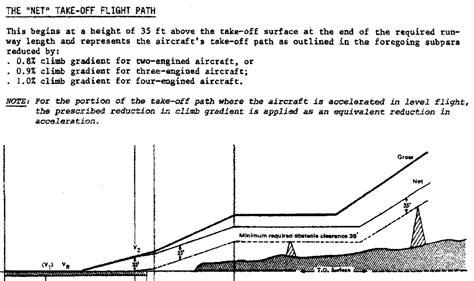
The NTOFP is influenced by various factors, including weather conditions, wind, and engine performance that may not meet expectations. Figure 1 illustrates a typical NTOFP, which consists of four distinct segments. In the first segment, the landing gear is raised, and the aircraft accelerates to the required speed. During the second segment, the aircraft climbs to a height suitable for flap retraction, which must be no less than 400 feet.
In the third segment, the flaps are retracted as the aircraft accelerates to the climb speed for the fourth segment. Finally, in the fourth segment, the aircraft continues its ascent to 1500 feet or until it safely clears any significant obstacles. In this scenario, the two obstacles must be cleared by a minimum of 35 feet. If the aircraft cannot achieve this clearance, it may be necessary to reduce the takeoff weight. While there are alternative solutions, they will not be explored in this article.
Figure 2 depicts the Obstacle Domain, which ensures that an aircraft operating per the AFM will avoid encountering significant obstacles. Calculations for this domain consider potential deviations from the runway centerline, accounting for factors like weather, wind, and possible pilot performance issues.