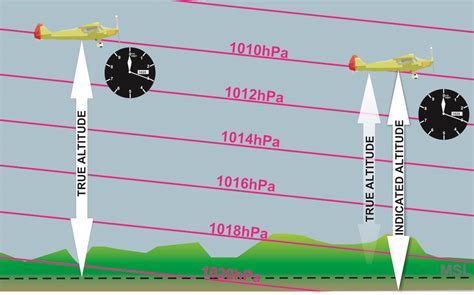
Altimeters, which are essential for determining an aircraft’s altitude, don’t directly measure height in relation to the Earth’s surface. Instead, they rely on atmospheric pressure. As a plane climbs or descends, the surrounding pressure changes, and pilots (or autopilots) adjust their altitude based on these variations. Pressure altitude, the altitude that corresponds to the atmospheric pressure measured by the altimeter, is typically kept constant during flight.
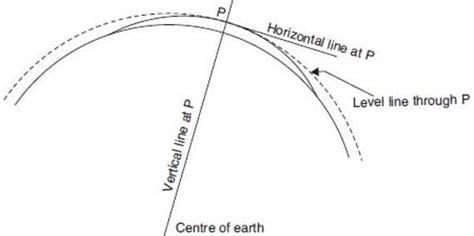
- The atmospheric pressure is closely tied to the Earth’s shape and curvature, meaning that as the aircraft flies, it naturally follows the Earth’s curvature.
- Pilots do not need to make manual adjustments to compensate for the Earth’s curvature. As the atmosphere is attached to the Earth, maintaining a constant pressure altitude inherently ensures that the aircraft is flying along the curved surface of the planet.
Gravity and Atmospheric Attachment
The Earth’s atmosphere is not a stationary layer that we simply fly through; it is firmly attached to the Earth and co-rotates with it. Gravity plays a pivotal role here, acting toward the center of the Earth. This gravitational pull aligns perfectly with the plane’s lift, which always acts perpendicular to the aircraft. As a result, the aircraft’s flight path continuously adjusts, aligning with the local down vector.
- In level flight, this means the aircraft will follow the curve of the Earth naturally.
- This phenomenon is subtly illustrated when you imagine suspending a model airplane on a string and carrying it around the Earth: the airplane remains level throughout the journey without needing any manual corrections.
This effect is so subtle that the aircraft’s nose will be imperceptibly pointed downward by approximately 0.007°, or about 8 inches per mile, to match the Earth’s curvature. However, this adjustment is not something the pilot actively calculates or adjusts for in real time; it happens automatically due to the forces acting on the aircraft.
Frame of Reference and Thrust
The aircraft’s speed is measured in relation to the surrounding atmosphere, not an inertial, fixed point like the Earth’s surface. As a result, pilots do not need to adjust for the Earth’s rotation when flying, as the atmosphere moves along with the planet. The engines produce thrust by accelerating air backward, and this thrust is relative to the atmosphere itself.
- The atmosphere’s rotation is synchronized with the Earth’s, meaning that any adjustments to the aircraft’s velocity are made relative to the atmosphere, not the ground.
- This eliminates the need for any compensatory actions for Earth’s rotation.
The aircraft’s movement is in sync with the rotating atmosphere, and while wind drift adjustments may be needed to account for local air currents, no correction is made for the Earth’s rotational speed.
Orbital Mechanics Example
To understand why airplanes don’t need to worry about Earth’s curvature in the way we might initially think, it’s helpful to look at the speeds involved. The orbital speed of an object is calculated using the formula: v₀ = √(GM/r), where G is the gravitational constant, M is the Earth’s mass, and r is the radius from the center of the Earth.
- For an object in low Earth orbit, this speed is approximately 7.9×10³ m/s, or around 18,000 mph.
- An airliner traveling at 600 mph is much slower than this speed and is nowhere near fast enough to leave Earth’s atmosphere.
Despite the airplane traveling at high speeds, it remains well within the atmosphere and follows the Earth’s curvature naturally due to the forces already at play, like gravity and pressure altitude.
Isobaric Surfaces and Autopilot Trim
Aircraft autopilots are designed to maintain an aircraft’s flight on a constant isobaric surface. These are levels of constant atmospheric pressure, which, like pressure altitude, follow the curvature of the Earth. By targeting isobaric surfaces, autopilot systems keep the aircraft level relative to atmospheric pressure, ensuring the flight path follows the Earth’s curvature.
- For instance, an aircraft flying at FL300 (30,000 feet) will typically reference 1013.25 hPa as the standard pressure level, and small adjustments are made to account for pressure changes due to weather systems.
- These adjustments are automatic, and recalibrations from Air Traffic Control (ATC) ensure the aircraft remains on its intended flight path.
Attitude Indicators and Continuous Alignment
Modern aircraft are equipped with sophisticated attitude indicators that help pilots determine the aircraft’s orientation relative to the Earth’s surface. These devices rely on gyroscopic systems to provide a local down reference, which realigns the horizon display to the Earth’s curvature during flight.
- As the aircraft moves, the attitude indicator ensures the pilot can continually monitor the aircraft’s position relative to the Earth.
- These systems automatically adjust for the aircraft’s curved flight path, ensuring that pilots do not need to make manual corrections for curvature during flight.
Great-Circle Navigation: The True Path Across the Earth
When flying from one point to another, aircraft typically follow great-circle routes. These routes represent the shortest distance between two points on the surface of a sphere and naturally account for the Earth’s curvature.
- For example, a flight from New York to London would follow a 51.4° course, and the return journey would follow a 288° course. This is because the Earth is a sphere, and straight lines on a flat map do not represent true distances across the globe.
- The New York-London-Tenerife triangle sums to 191.5° on the surface of the sphere, further illustrating the reality of curved flight paths.
Conclusion
In conclusion, the curvature of the Earth is inherently accounted for in aviation without requiring pilots to make explicit corrections. The pressure altitude system, combined with the forces of gravity and the atmosphere’s rotation, ensures that the aircraft naturally follows the Earth’s curvature. The use of autopilot systems, attitude indicators, and great-circle navigation all contribute to this seamless alignment. Pilots do not need to perform any complex calculations to adjust for the Earth’s rotation or curvature; these factors are already integrated into the flight systems, ensuring a smooth and accurate flight path from takeoff to landing.