In the vast theater of the cosmos, Earth has always seemed modestly adorned when it comes to natural satellites. Unlike Jupiter and Saturn, which flaunt dozens to hundreds of moons, Earth has historically stood with a singular, faithful companion: the Moon. Yet, in a surprising twist of orbital intrigue, astronomers recently identified an asteroidal visitor—a quasi-satellite named 2025 PN7—which has sparked sensational claims of Earth having a ‘second moon.’ This narrative, though captivating, is scientifically nuanced and demands a closer, informed examination.
The Discovery of 2025 PN7: A Celestial Introduction
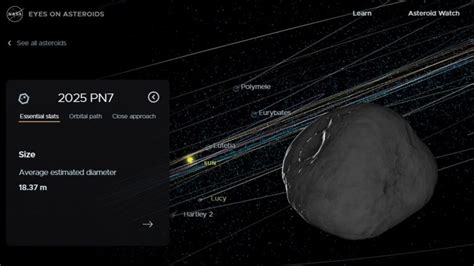
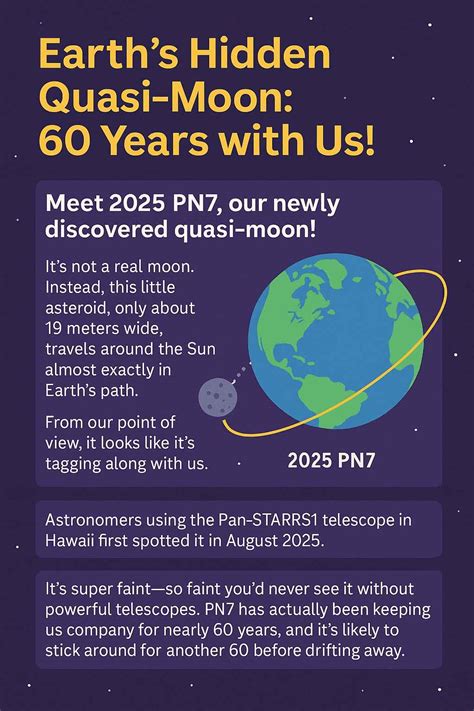
In August 2025, astronomers from the University of Hawaii detected a faint but persistent object following Earth in its orbital path around the Sun. This object, now cataloged as 2025 PN7, is estimated to be approximately 118 feet (36 meters) across—a cosmic pebble in contrast to the Moon’s commanding radius of over 1,000 miles (1,737 km).
Despite the disparity in size, 2025 PN7 is intriguing because of its quasi-orbital relationship with Earth. It has remained within Earth’s gravitational sphere of influence for around 60 years, unnoticed until now. But unlike the Moon, this object is not gravitationally tethered to Earth in a permanent orbit.
What Is a Quasi-Satellite?
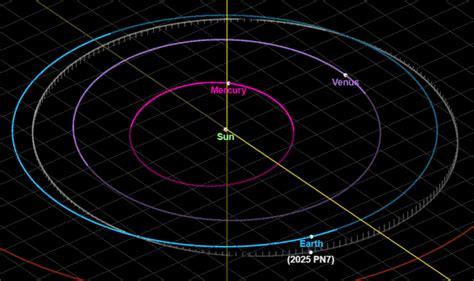
To understand why 2025 PN7 is not Earth’s second moon, we must grasp the concept of a quasi-satellite. A quasi-satellite is a celestial body that follows a similar orbit to a planet around the Sun and stays relatively close to the planet for an extended period. However, it is not bound by the planet’s gravity like a true satellite.
Unlike our Moon, which is caught in a continuous gravitational ballet with Earth, a quasi-satellite like 2025 PN7 is only gravitationally flirting with our planet. It maintains an orbit around the Sun that mimics Earth’s own path. From our perspective, it appears to trace an odd spiral around Earth over time, but it is not orbiting Earth directly—a critical distinction.
A Modest Companion With No Lunar Title
Despite some headlines sensationalizing the presence of a “second moon,” 2025 PN7 is not a moon in the traditional sense. The definition of a moon—a natural satellite in constant, gravitational orbit around a planet—is not satisfied in this case. Instead, 2025 PN7 is classified as a temporary quasi-satellite.
Astrophysicist Jonathan Blazek from Northeastern University succinctly explained that quasi-moons eventually drift away because their orbits lack long-term stability. Earth’s gravitational pull is not enough to capture such objects permanently. Indeed, Blazek estimates that the asteroid will remain in this pseudo-companionship with Earth until around 2083.
Why Didn’t We Detect It Earlier?
The cosmic silence around 2025 PN7’s presence over the last six decades is not entirely surprising. The immensity of space means even relatively close objects can remain hidden from our telescopes for extended periods. Space is littered with rocks, ice, and metallic debris of varying sizes, and even the most sophisticated Earth-bound observatories struggle to detect small, non-reflective objects unless they enter specific observable trajectories.
The discovery of 2025 PN7 highlights a growing capability in observational astronomy. With improved sky surveys, higher-resolution sensors, and advanced orbital modeling software, we’re now unearthing previously unknown visitors that have been near us for decades.
How 2025 PN7 Compares to the Moon
While it may be tempting to romanticize 2025 PN7 as a junior sibling to our Moon, the differences are astronomically stark. Consider:
- Size: The Moon’s diameter is about 2,159 miles, whereas 2025 PN7 is barely over 100 feet across.
- Mass: The Moon’s mass is roughly 7.3 x 10^22 kg, while 2025 PN7’s mass is negligible in comparison.
- Gravitational Influence: The Moon significantly affects Earth’s tides, axial tilt, and even stabilizes our climate. 2025 PN7, by contrast, has zero measurable impact on Earth’s gravitational system.
Blazek estimates that the asteroid is roughly a quadrillion times less massive than the Moon, meaning its influence is entirely negligible for all terrestrial and orbital systems.
Other Quasi-Satellites: We Are Not Alone
Interestingly, 2025 PN7 is not the first quasi-satellite Earth has hosted. Scientists have identified at least six other quasi-moons that have orbited Earth temporarily in recent decades. Among them:
- 2006 RH120, a small asteroid that orbited Earth for a brief period from 2006 to 2007.
- 2016 HO3, another quasi-satellite which has remained near Earth since at least 2016 and is expected to stay for centuries.
Each of these objects highlights the complexity of orbital dynamics in the near-Earth environment. Their paths are influenced by the gravitational interplay of Earth, the Moon, and the Sun—creating a delicate and transient balancing act.
When Will 2025 PN7 Leave Earth’s Vicinity?
Astronomers predict that by 2083, the orbital paths of Earth and 2025 PN7 will diverge enough for the asteroid to permanently leave Earth’s vicinity. The drifting is the result of gravitational nudges and orbital resonances that accumulate over time. Once the Earth and PN7 part ways, the asteroid will continue its lonely path around the Sun, no longer shadowing our planet.
Its exit won’t be dramatic. There will be no sky-splitting farewell. Instead, it will quietly fade from Earth’s neighborhood—just as it quietly entered it.
Why These Visitors Matter
While 2025 PN7 poses no threat to Earth, its presence is still profoundly valuable. Studying objects like these enhances our understanding of:
- Orbital Mechanics: Quasi-satellites provide natural laboratories for testing gravitational theories.
- Planetary Defense: Understanding how such objects move could be vital if we ever need to deflect a dangerous asteroid.
- Near-Earth Environment: It helps us catalog and track bodies that might interact with Earth’s gravity in the future.
Moreover, the detection of 2025 PN7 is a triumph of modern astronomy, proving that even the smallest celestial bodies can no longer evade our watchful gaze.
Will Earth Ever Have Another Moon?
Although 2025 PN7 does not qualify as a true moon, the prospect of a new moon is not entirely outlandish. Earth’s gravitational influence could, in rare cases, permanently capture an asteroid. However, such captures are astronomically improbable. The most likely scenarios involve temporary satellites—just like PN7—that arrive, loiter, and depart.
Given this, Earth’s solitary lunar status remains intact, and our Moon continues to be a singular guardian, shaping the rhythm of tides, stabilizing Earth’s axial tilt, and illuminating our skies through every phase.
Final Thoughts: A Cosmic Dance With a Fleeting Partner
2025 PN7 is not Earth’s second moon, nor is it likely to become one. Yet, its quiet presence in our neighborhood is a humbling reminder of how dynamic and populated our solar system truly is. These quasi-satellites are ghostly companions, following our path yet destined to diverge. They pose no danger, yet they offer immense insight.
Their stories are brief, but each adds a chapter to our evolving understanding of space. For now, 2025 PN7 shares our celestial path—a visitor without a visa, orbiting the Sun on a parallel journey with Earth. Come 2083, it will be gone. But its discovery ensures that we’ll be watching the skies with ever greater clarity and curiosity.