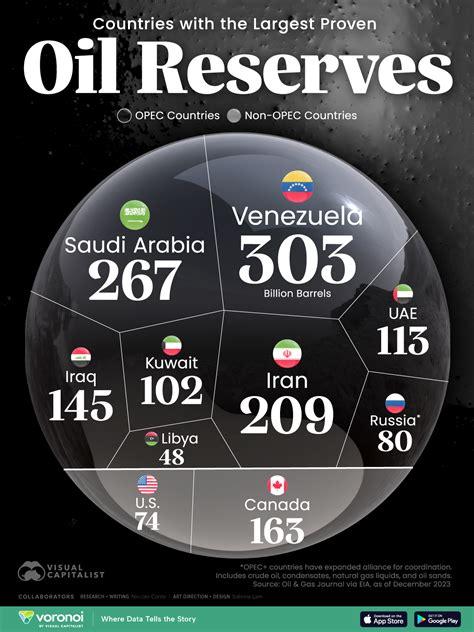
Vast oil reserves shape geopolitics, energy markets, and industrial power, but the global leader in proven crude holdings is not where many expect. While Saudi Arabia often dominates popular imagination, the largest officially recognized oil reserve belongs to Venezuela, a nation whose energy wealth contrasts sharply with its economic struggles and political isolation.
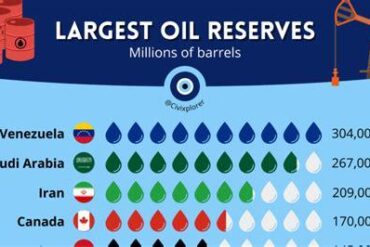
Located just south of the Caribbean, Venezuela sits closer to the United States than most Middle Eastern producers. According to data from the U.S. Energy Information Administration, the country holds more than 303 billion barrels of proven oil reserves, a figure that places it firmly at the top of the global ranking as of 2025. This staggering volume exceeds Saudi Arabia’s reserves by tens of billions of barrels, reshaping assumptions about where the planet’s deepest petroleum wealth truly lies.
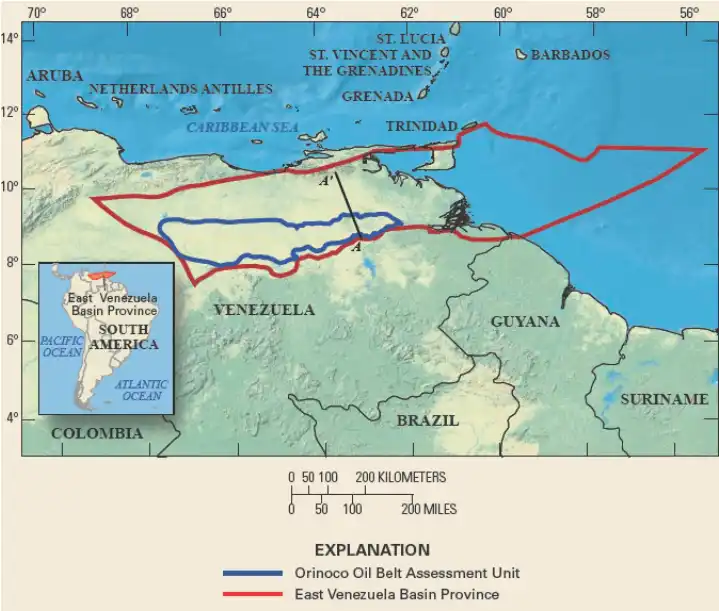
The overwhelming majority of this oil is concentrated in the Orinoco Belt, a massive geological formation stretching across northern Venezuela. The scale of this region is difficult to overstate, covering tens of thousands of square miles and containing hydrocarbons accumulated over millions of years. Yet abundance alone does not equal easy wealth, and the nature of Venezuela’s oil presents significant obstacles.
Unlike the light, sweet crude found in Texas or the Arabian Peninsula, Venezuelan oil is predominantly heavy and sour, meaning it contains high levels of sulfur and has a thick, tar-like consistency. This makes extraction slower, refining more expensive, and transportation more corrosive to pipelines and equipment. Processing such crude requires specialized refineries, many of which Venezuela lacks or can no longer operate at full capacity.
Heavy Oil, Heavy Costs
Producing oil from the Orinoco Belt is not only technically demanding but also environmentally costly. Energy-intensive extraction methods generate higher carbon emissions per barrel, prompting experts to describe Venezuelan crude as among the most carbon-intensive oils in the world. These realities reduce its attractiveness in an era increasingly shaped by climate policy and cleaner energy transitions.
Infrastructure, Sanctions, and Decline
Decades of underinvestment, mismanagement, and state seizures of private assets have left Venezuela’s oil infrastructure in severe disrepair. Refineries, pipelines, and export terminals require massive capital injections to function reliably. Compounding these issues are U.S. sanctions, which restrict Venezuela’s access to global markets, financing, and advanced technology, sharply limiting its ability to monetize its reserves.
How Venezuela Compares to Other Oil Giants
Several nations trail Venezuela with formidable reserves of their own. Saudi Arabia holds approximately 267 billion barrels, followed by Iran, Iraq, and the United Arab Emirates. The United States, propelled by technological innovation rather than conventional fields, ranks within the top ten with roughly 45 billion barrels in proven reserves.
Technology and the Future of Oil Rankings
The global oil hierarchy is not frozen in time. Advances such as hydraulic fracturing have already transformed the United States into a dominant producer by unlocking oil trapped in dense rock formations. New discoveries, including a major 2026 find in Texas, continue to shift reserve estimates and production potential.
Venezuela’s position as the world’s largest oil reserve holder remains intact, but its ability to leverage that status depends on political reform, infrastructure renewal, and global demand trends. The oil is there, immense and undeniable. Turning it into prosperity is the far harder task.