When the world’s busiest airport ran out of room in the middle of a mountain and a sea, aviation in the Pearl River Delta had a problem that could not be solved with better terminals or longer taxiways. The solution had always been near one place. Here are five airports born on land that humanity created, from Osaka Bay to the Black Sea.
5. Airports Built On Artificial Islands: The Greatness of Kansai International Airport (KIX)
The most ambitious project in modern civil engineering opened in 1994 and it still swallows up the imagination as it did on the first day of operations. Designed by the Pritzker Prize-winning architect Renzo Piano, the airport sits entirely on a reclaimed artificial island in the middle of Osaka Bay, which was chosen because a city as dense as Osaka had no flat space left to give. The hub was built to ease pressure on the city’s older airport, and from the very beginning it was clear that this was not just a terminal: it was a self-contained piece of land in the middle of the water.
The real challenge was never the island itself, but what lies beneath it. The seabed consists of soft, waterlogged clay, and the sheer weight of the airport has continued to press down on it, squeezing out water and causing the surface to sink. To speed up this inevitable settlement, engineers drove approximately one million sand columns into the seabed, giving the trapped water a route to escape and breaking the clay down more quickly so the ground could stabilize sooner. Even so, the subsidence that occurred during the construction phase was deeper than predicted. This meant that when the KIX island first opened, it was already lower than the original plans had allowed for.
The overall subsidence figure sounds like the entire island is falling into the sea, but that number needs context. Of the total drop of about 45 feet (13.66 meters), the vast majority occurred during the initial construction phase and in the early decades. The passenger terminal and runway structures themselves have sunk about 13 feet (3.84 meters) since the day the airport opened. The rate of sinking has now slowed to a near standstill, with the island settling only about two inches (5 cm) in 2024, which indicates that the consolidation phase is finally coming to an end.
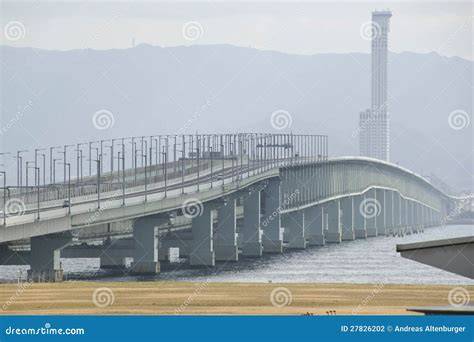
Even with this engineering, KIX proved vulnerable to the sea. On September 4, 2018, Typhoon Jebi drove storm surge into the main runway and a terminal building, and the storm also caused the anchor of a fuel tanker to give way; the ship, pushed by 110 mph winds, then crashed into the bridge that links KIX to the mainland, cutting the airport’s only road and rail link and leaving around 8,000 passengers and staff stranded on the island. It took three weeks for full passenger service to resume. The typhoon raises a difficult question that operators have yet to fully answer: how high do the sea walls need to be, and for how long will they hold against both subsidence and rising sea levels?
4. Macau International Airport: A Surgical Approach to Land Reclamation
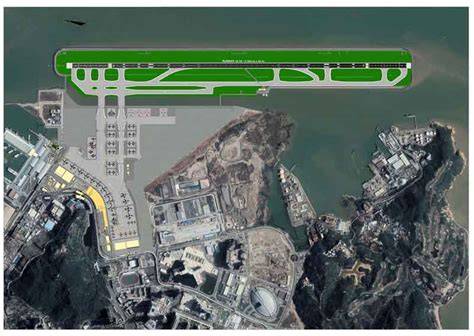
Built in 1995 by engineers working in the Pearl River Estuary, Macau International Airport (MFM) took a different approach. Instead of moving the entire airport onto a single huge island, Macau’s team focused only on what truly had to sit in the water: the runway. The passenger terminal and all supporting buildings were constructed on Taipa Island, leaving room to build an impressive 11,024-foot (3,360-meter) runway without having to raise the capital required for an entire offshore land mass.
This split-island method saved a great deal of money at the time, but the trade-off became clear quickly. Because there is no room for aircraft to park and only limited flexibility during the busiest hours, the airport reached its capacity sooner than expected. In response, the Macau International Airport Company launched an expansion covering 129 hectares (319 acres), starting construction in 2026 and running through 2028. With reclamation complete in 2030, the airport’s total usable area will grow to 325 hectares and its annual capacity will increase from ten million to 13 million passengers.
3. Ordu-Giresun Airport: Carving an Airfield Out of the Pontic Mountains
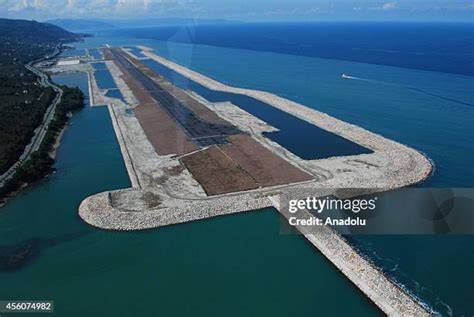
The Turkish Black Sea coast offered almost no flat ground, so engineers built the island themselves. Ordu-Giresun Airport (OGU) was completed in 2015 after about 35 million tons of rock were dumped into the sea; trucks made roughly 950,000 trips, each carrying between 30 and 36 million tons of heavy stone, to raise the island’s foundation above the ocean bed. It features a single asphalt runway measuring 9,842 feet (3,000 meters) long and 45 meters wide, built on compacted rock fill that rests on a firmer coastal shelf, and the operator reports zero structural settlement issues at the site.
The Black Sea’s unpredictable swells are handled by a 7,435-meter (4.6-mile) breakwater that wraps around the perimeter of the island. Ordu-Giresun welcomed a modest 221,000 passengers during its true maiden year of 2015, but by 2016 that figure had grown by more than 250%, to about 777,000 annual passengers. The airport has never had to close because of a severe ocean storm, and it now handles well over 1.1 million passengers every year.
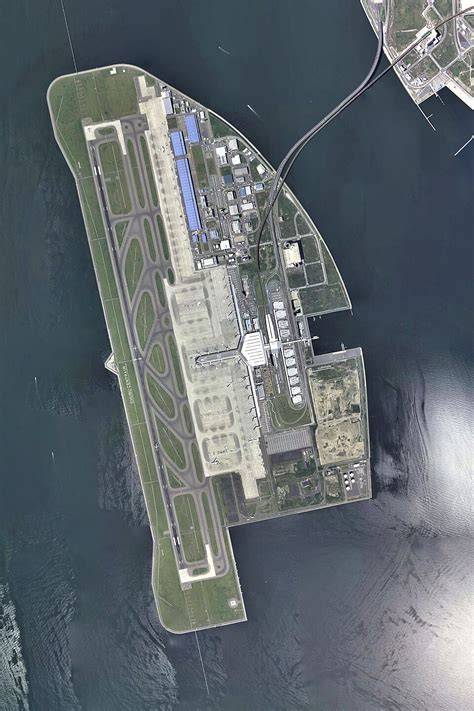
2. Chubu Centrair International Airport: An Island Shaped Like a D
Opened on February 17, 2005, Chubu Centrair International Airport sits on a reclaimed island in Ise Bay and has become the main international gateway to the industrial heart of Japan around Nagoya. Its layout reflects environmental thinking: the shoreline was built in a curved D-shape with rounded corners rather than as a sharp rectangle, so that the prevailing bay currents flow around the island without resistance, and a wildlife sanctuary was placed inside the island’s footprint to protect the nesting sites of the Little Tern, a vulnerable bird.
Rather than an unyielding line of vertical concrete walls, the sloped shoreline banks were covered with natural stones that mimic a rocky shore, encouraging seaweed to grow and giving local fish and crabs a place to breed. The airport proved its purpose almost immediately. Before Centrair opened, roughly half of Nagoya’s travelers heading to major destinations in the United States or Europe had to first take a domestic flight or a bullet train to Narita Airport near Tokyo. The project was accelerated so that it could serve as the international gateway to the 2005 Aichi World Exposition, bringing a wave of foreign visitors and dignitaries directly into the region.
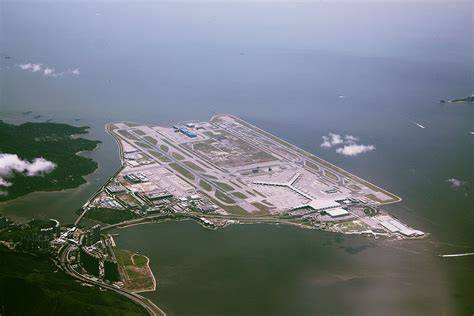
1. Hong Kong International Airport: Turning a Mountain Into a Mega-Island
The jewel of the Airport Core Program, the largest infrastructure project in Hong Kong’s history, opened in 1998 on a site once dominated by the congested and geographically trapped Kai Tak Airport. To build Hong Kong International Airport (HKG) at Chek Lap Kok, crews used explosives to reduce a rocky mountain from a peak of 328 feet (100 meters) to a uniform 23 feet (seven meters) above sea level, recycling the blasted rock to fill the channels between two islands. The 9.5-square-kilometer reclamation joined the two landmasses into a single flat mega-island that added a full 1% to Hong Kong’s total land area.
The move from Kai Tak was an event of remarkable precision. On the night of July 5, 1998, the main roads of Kowloon were closed as a convoy of heavy ground support equipment, baggage loaders and thousands of airport vehicles crossed the newly built suspension bridges. Meanwhile, around 30 commercial aircraft departed Kai Tak one after another, making short, low-altitude flights to the new site. Once the last plane had left, Kai Tak’s runway lights were permanently switched off, and at exactly 6:27 AM on July 6, 1998, Cathay Pacific Flight CX887 landed at Chek Lap Kok, beginning a new era for the airport.
Hong Kong’s airport has never stopped evolving. A third runway opened in 2022, and a major terminal expansion is planned for 2030, continuing its transformation from an isolated reclamation project into a true city-within-a-city.
| Airport | Opening Date | Longest Runway | Artificial Land Area | Annual Passengers |
|---|---|---|---|---|
| Kansai International (KIX) | September 4, 1994 | 13,123 ft (4,000 m) | 4.07 sq mi (10.55 sq km) | ~33.5 million |
| Macau International (MFM) | November 9, 1995 | 11,024 ft (3,360 m) | 0.76 sq mi (1.96 sq km) | ~7.6 million |
| Hong Kong International (HKG) | July 6, 1998 | 12,467 ft (3,800 m) | 4.82 sq mi (12.48 sq km) | ~53.0 million |
| Chubu Centrair | February 17, 2005 | 11,483 ft (3,500 m) | 1.81 sq mi (4.70 sq km) | ~10.6 million |
| Ordu-Giresun (OGU) | May 22, 2015 | 9,843 ft (3,000 m) | 0.70 sq mi (1.80 sq km) | ~1.1 million |
The Enduring Value of a Runway Over the Water
Each of these airports was created to meet an overwhelming demand for air travel in a place where the only option was to reclaim land from the sea, and today that once-impossible engineering looks less like a novelty and more like a blueprint. Kansai has shown how far geotechnical engineering can push natural limits, while Macau has shown the value of doing only what is necessary. Ordu-Giresun has shown that an airfield can contribute to an economy rooted in a difficult landscape, and Hong Kong has shown how a single reclamation project can become a city in its own right. Together they stand as a reminder that the future of aviation is not always found in the sky; sometimes it is carved straight out of the water.