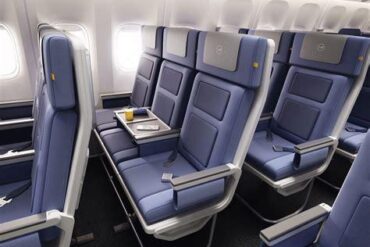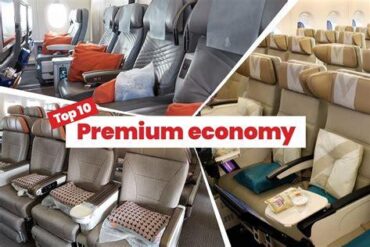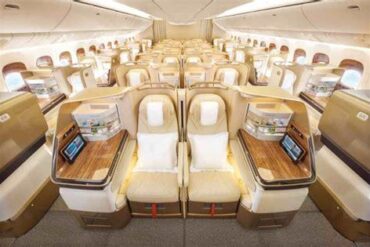
Short-haul flying has always demanded a compromise: squeeze into a dense economy seat or pay a steep premium for a recliner that barely justifies the fare gap. The airlines below have quietly dismantled that choice. By rotating internationally configured widebodies and long-range narrowbodies onto dense regional corridors, they sell long-haul cabin hardware on sectors that land in under six hours. The result is a market where travelers can buy 40-inch pitch, dedicated footrests, and international-grade dining on a flight no longer than a workday. The catch is rarely the product itself. It is the schedule. Every one of these carriers swaps equipment on identical routes on identical days, so the seat you booked is only as reliable as the aircraft rotation. Here is where the six strongest programs actually operate.
Cathay Pacific: Fixed-Shell Premium Economy Across Asia’s Busiest Trunk
Cathay Pacific built one of the most consistent short-haul premium economy products in the world by refusing to build a regional version of it. The carrier’s widebody fleet is configured to international specification and deployed wherever demand justifies the capacity, which means a four-hour hop between Hong Kong International Airport (HKG) and Singapore Changi Airport (SIN) on the 1,588-mile (2,555 km) corridor comes with 28 dedicated premium economy seats in a 2-4-2 layout aboard the Airbus A350-900. Seat pitch reaches 40 inches (102 cm) with 19 inches (48 cm) of width, and the fixed-shell privacy of Cathay’s recliner means the passenger behind can never intrude on the recline in front. Meal service is upgraded beyond the regional economy standard, and cabin crews treat the section as a genuine intermediate tier rather than an economy seat sold under a different name.
The strategy extends well past Singapore. Overnight red-eye sectors to Japan, Singapore, and Indonesia in the four-to-five-hour range routinely draw the same internationally configured A350s, and the airline’s newly redesigned Boeing 777-300ER premium economy cabins now appear on short regional rotations linking Hong Kong to Tokyo Haneda (HND), New Chitose (CTS), and Beijing Capital (PEK). The single greatest risk for a booking traveler is equipment substitution. Cathay regularly rotates regionally configured Airbus A330-300s and A350s with no premium economy section at all onto the same intra-Asia markets, so the cabin can vanish between booking and departure. Check the seat map for every operated flight, not merely the marketed route.
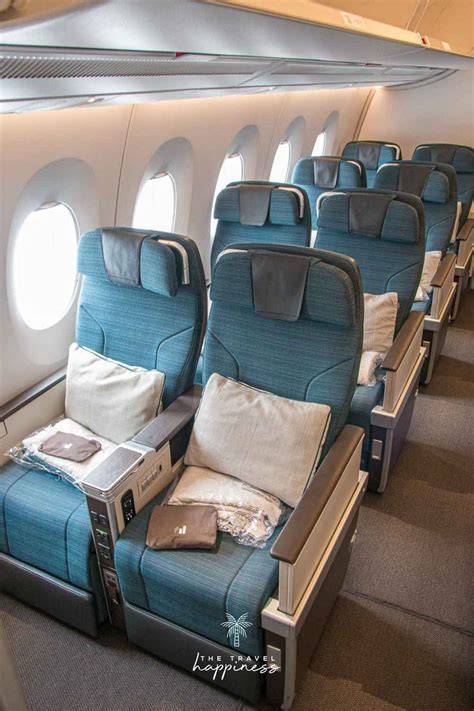
Air New Zealand: The Trans-Tasman Value Case for Premium Economy
Across the Tasman Sea, Air New Zealand turns a three-to-four-hour international hop between Auckland Airport (AKL) and Sydney Kingsford Smith (SYD) or Melbourne (MEL) into the clearest value argument in the category. The carrier schedules Boeing 787-9 Dreamliners on these routes between long-haul rotations to North America and Asia, and the premium economy cabin delivers 41 inches (104 cm) of pitch, dedicated footrests, generous recline, and premium dining in the carrier’s distinctly New Zealand aesthetic. That measurement makes it the most legroom offered by any product on this list, and it arrives on a flight that never leaves regional airspace.
The economics are unusually clean. Air New Zealand’s Business Premier lie-flat product is difficult to justify on a daytime sector of three hours, when nearly the entire flight is spent meal service and descent. Premium economy captures the long-haul benefit that actually matters, the width and the pitch, without charging for a bed that will not be used. For travelers connecting from North America or Asia, this mid-cabin capacity also fills with high-yielding business and leisure demand that keeps the aircraft productive instead of parked between long-haul departures. Buy it on daylight services with confidence, and verify the Dreamliner operating the leg rather than assuming a widebody configuration.
Singapore Airlines: The World’s Shortest A380 Route
Singapore Airlines takes the same widebody logic to its logical extreme by intermittently deploying its flagship Airbus A380 on the four-hour Singapore–Hong Kong corridor, ranking it as the shortest A380 route in the airline’s global network. The main-deck premium economy cabin uses a 2-4-2 layout with 38 inches (97 cm) of pitch and up to 19.5 inches (50 cm) of width, and passengers receive full long-haul hardware: 13.3-inch (34 cm) HD seatback monitors, calf rests, and leather upholstery. On peak seasonal demand the superjumbo becomes a capacity weapon, carrying far more high-yield seats per rotation than any other widebody on the route.
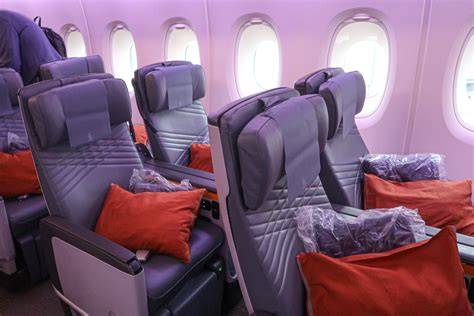
Singapore’s standard regional deployment relies on internationally configured A350-900s and 777-300ERs, which carry a premium economy section with a slightly tighter 38-inch pitch and 19.5-inch width. The fleet also contains medium-haul A350 variants configured in a two-class layout with no premium economy, and these airframes move onto the same Changi routes without warning. That mixed subfleet is the defining hazard of booking premium economy with Singapore Airlines on short sectors. A seat map check at check-in, ideally repeated 72 hours before departure, tells you whether the cabin survived the last schedule change.
Delta Air Lines: Premium Select on Transcontinental Trunk Routes
Delta Air Lines proved the concept in North America by moving Delta Premium Select off exclusively transoceanic flying and onto hub-to-hub transcontinental rotations such as New York John F. Kennedy (JFK) to Los Angeles (LAX) and San Francisco (SFO). Both routes cover 2,475 miles (3,983 km), and directional winds create a useful schedule advantage: eastbound flights regularly land in under five hours and 30 minutes, while westbound winter headwinds stretch toward the six-hour ceiling without exceeding it. The cabin uses customized recliners with up to 38 inches (97 cm) of pitch and 19 inches (48 cm) of width, backed by dedicated footrests, improved catering, and priority boarding that clears the cabin ahead of main economy.
The distinction from Delta Comfort+ is not marginal. Comfort+ adds pitch inside an economy cabin with economy service. Premium Select brings international-cabin dining, wider armrests, and a dedicated section with internationally configured Boeing 767-400ERs and Airbus A330-900s on selected daily frequencies. Delta does not sell it on every JFK–LAX rotation, and the carrier mixes widebodies with domestic narrowbodies offering First and Comfort+ only. Travelers should select a flight number tied to the intended aircraft, accept that schedule changes can trigger a downgrade, and confirm the operated type roughly a week out when Delta files its final equipment.
United Airlines: Premium Plus at a $733 Median Markup
United Airlines has built the largest domestic footprint for an international premium economy cabin by placing United Premium Plus on widebodies flying high-density transcontinental sectors such as Newark Liberty (EWR) to San Francisco (SFO) and Chicago O’Hare (ORD) to Los Angeles (LAX). The 2-4-2 layout on 777-200ERs and 787-10s provides 38 inches (97 cm) of pitch and 19 inches (48 cm) of width, with leather seats, footrests, individual power outlets, and upgraded inflight entertainment screens that mirror the transatlantic product. Positioning internationally configured aircraft on domestic legs spreads capital cost across routes that would otherwise absorb a repositioning flight.
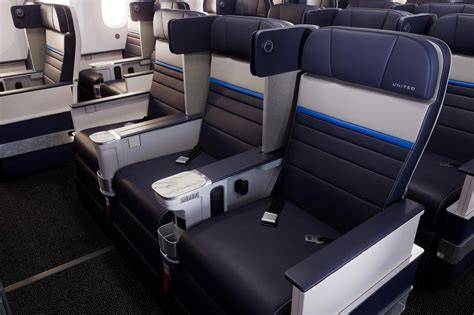
Pricing tells the strategic story. On competitive transcontinental markets, United’s Premium Plus tickets carry a median markup of roughly $733 over standard economy, a figure that captures corporate travelers whose policies restrict lie-flat business class on sectors under six hours. The A321XLR sharpens this further. United’s long-range narrowbody carries 12 dedicated Premium Plus seats in a 2-2 layout, delivering consistent premium economy hardware on single-aisle aircraft instead of relying solely on widebody repositioning schedules. That configuration removes the reliability gap inherent in every widebody-on-short-haul strategy.
American Airlines: The A321XLR Premium Economy Pioneer
American Airlines is leading the single-aisle premium revolution with a purpose-built A321XLR fleet configured with a dedicated 12-seat premium economy cabin positioned between the Flagship Suites and Main Cabin Extra. The aircraft is scheduled on prime transcontinental markets including JFK–SFO and BOS–LAX, where five-to-six-hour sectors will permanently receive long-haul cabin hardware on a narrowbody airframe. The 2-2 layout, outfitted with Recaro seating platforms, offers 37 inches (94 cm) of pitch, deep recline mechanisms, integrated leg and footrests, and 13.3-inch 4K touchscreens.
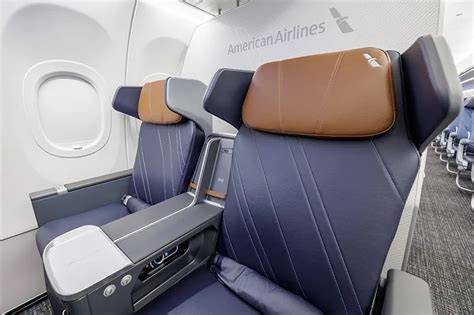
What makes American’s approach durable is the fixed fleet assignment. Every A321XLR leaves the factory with the same cabin, so a passenger booking premium economy is not exposed to the aircraft shuffle that undermines widebody-based strategies on Asian carriers. American combines the hardware with premium dining and priority airport handling, and sells the seat as a middle-tier alternative for travelers who want genuine comfort without business class rates. As the A321XLR fleet grows, this single-aisle configuration will likely define the standard for regional premium flying.
Why Aircraft Swaps Decide the Booking
The six airlines on this list share one operational truth: premium economy on short sectors is a byproduct of long-haul fleet planning, not a purpose-built regional product. Cathay Pacific and Singapore Airlines fly widebodies to relieve slot constraints at congested Asian hubs and absorb intra-regional demand that dense narrowbodies cannot serve. Air New Zealand flies widebodies to swap the same aircraft between trans-Tasman hops and long-haul departures to North America. Delta and United mix widebody repositioning with domestic narrowbodies that carry no premium section at all. American is the exception, and its advantage flows directly from designing premium economy into every A321XLR it takes delivery of.
That structural difference dictates how travelers should book. On Asian and Oceania carriers, confirm the aircraft type on every operated sector, then check the seat map again at check-in, because the cabin can be removed by an equipment substitution without a fare refund. On Delta and United, choose specific flight numbers tied to widebody rotations rather than the route generally, and accept that a schedule change can strip the product overnight. On American, the lower susceptibility to substitution makes the cabin worth booking early. Across all six, premium economy on a flight under six hours offers wider seats, more legroom, and international dining at a fraction of business class, and the discipline of verifying the aircraft is the only thing standing between that value and a seat that never existed.