The modern airline is often imagined as a cockpit and a cabin, yet the aircraft that crosses an ocean at dawn is the visible output of a much larger machine staffed by people who never fasten a seatbelt for work. Behind every departure sits a dispatcher releasing the flight on paper and in law, a maintenance technician who signed the inspection that made the takeoff legal, an avionics specialist who calibrated the instruments that guide it, an engineer who shaped the fuselage now carrying three hundred passengers, and an analyst who decided months earlier what each of those seats should cost. These roles share a defining trait: they command six-figure earning potential in the United States without requiring a pilot’s licence or a single hour in a simulator. For professionals weighing a career in aviation who prefer spreadsheets, torque wrenches, circuit diagrams, or design software to flight decks, this is where the money actually lives.
Why Airline Salaries Cluster Around Non-Flying Specialists
Airlines are safety-critical, heavily regulated, capital-intensive businesses, and each of those qualities pushes compensation upward for the people who carry legal responsibility. The Federal Aviation Administration certifies dispatchers individually, licenses mechanics and avionics technicians through rigorous testing, and audits maintenance programs continuously, which limits the supply of qualified workers and makes their signatures valuable. Aircraft themselves are extraordinarily expensive assets, with a Boeing 777 costing the airline somewhere between $306 million and $442 million depending on the variant and configuration, so the technicians who keep those airframes airworthy are protecting assets whose downtime costs dwarf any salary. Meanwhile, commercial pressure pushes the other way: a single percentage point of revenue improvement across a network of thousands of daily flights is worth tens of millions of dollars, which is precisely why carriers pay analysts well to find it. The result is a market where expertise, liability, and revenue impact combine to lift several ground-based professions into six-figure territory.
Aircraft Dispatcher: The Ground-Based Co-Pilot With Legal Authority
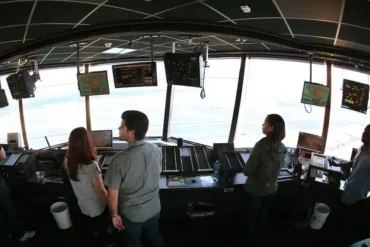
The aircraft dispatcher holds one of the most misunderstood jobs in aviation. An FAA-certificated dispatcher shares defined responsibility with the pilot in command for preflight planning, delay decisions, and the dispatch release that legally authorises a flight, and that shared authority continues after departure. Dispatchers monitor weather, NOTAMs, fuel loads, alternate airports, aircraft status, and routing for every flight on their desk, then stay in contact with crews throughout the journey, feeding them information that may affect safety and participating in cancellation or redispatch decisions when conditions deteriorate. They work inside Operations Control Centres, System Operations Control Centres, or Network Operations Centres rather than control towers, and the scale is enormous: American Airlines, the largest carrier in the United States, maintains a staff of roughly 600 dispatchers and operations specialists supporting about 6,000 daily flights to more than 350 destinations in over 60 countries.
Pay reflects that responsibility and the certification barrier. Glassdoor places dispatcher earnings between $73,000 and $137,000 annually, while Thrust Flight School reports that first-year dispatchers at most regional carriers start between $41,000 and $52,000. Major US airlines, by contrast, pay a first-year dispatcher approximately $95,000, and the top of the scale reaches around $170,000 for an eleven-year veteran. A typical shift cycles through reviewing weather and operational issues at handover, planning upcoming flights, tracking active ones, communicating with crews, and handling disruptions when a routing, aircraft, or airport problem forces a new plan. The role suits people who thrive on structured pressure, can juggle several live flights at once, and want genuine operational authority without leaving the ground.

Aircraft Maintenance Technician: The Signature That Makes Flight Legal
No aircraft departs without a licensed mechanic’s approval, and that fact explains both the pay and the persistent shortage in this trade. Aircraft maintenance technicians inspect, repair, and clear aircraft for flight from nose to tail, and the safety record they underwrite is startling: USAFacts notes that in 2023, 33 plane passengers were injured across 773 billion miles of air travel, meaning a traveller could circle the globe more than 940,000 times for every injury. That margin is not accidental; it is the product of training, recurrent learning, and the discipline of inspectors who check fuselage panels, wiring, hydraulics, engines, and landing gear against tightly written procedures.
US Aviation Academy reports a median annual salary of $79,870 for aircraft mechanics as of May 2025, a mean annual wage of $84,740, and a median hourly wage of $38.40. The bottom tenth of the profession earned under $48,780, while the top tenth exceeded $128,890, a spread that rewards specialisation, seniority, and licensing. The market is tightening: the Aviation Technician Education Council projects a widening deficit of certificated mechanics growing from roughly 9,100 to 20,000 by 2030, equal to 12% of anticipated demand, even though the FAA issued 11,103 new mechanic certificates in 2025, up 23.2% year on year and the highest annual total since the agency began publishing the data. For anyone entering the field, that arithmetic points toward bargaining power and rising starting offers at major carriers.
Avionics Technician: Guardian of the Systems Above the Clouds
Avionics technicians care for the electronic nervous system of a modern jet, installing and maintaining navigation, radio, radar, and autopilot systems while repairing or replacing faulty wiring, sensors, and instrument panels, then verifying everything through post-repair testing. The work carries unusual consequences: a single miswired transponder or an uncalibrated altimeter can render an aircraft unfit to fly, and because modern passenger jets contain hundreds of interconnected electronic components, one failure can cascade into others. That complexity explains why training typically runs eighteen to twenty-four months and covers circuit analysis, digital electronics, and the correct use of diagnostic equipment.
The Bureau of Labor Statistics puts the median annual wage for avionics technicians at $82,280 based on 2025 statistics, with roughly 19,800 employed across the United States. The outlook is among the strongest in aviation: employment is projected to grow 9% between 2025 and 2035, and the Bureau expects about 13,100 openings each year for aircraft and avionics equipment mechanics and technicians combined over that decade, many arising from retirements and career moves. This is a natural next step for electronics hobbyists, military avionics veterans, and maintenance technicians who want to specialise in the most technically intricate part of the aircraft.
Aerospace and Aircraft Engineers: The Design Minds Behind Every Cabin Detail
When passengers settle into a seat, stow a bag, or watch a wing flex in turbulence, every element they encounter was deliberately engineered for ergonomics, mechanical integrity, and commercial viability. Aerospace engineers earn a median annual salary of $134,960 according to the Bureau of Labor Statistics, the highest of the five roles profiled here, and employment in the field is projected to grow 8% between 2025 and 2035, with approximately 3,800 openings each year, many created by retirement and attrition. The Museum of Flight identifies five distinct engineering specialisms inside aviation: industrial engineers plan and refine how aircraft are manufactured; structural engineers design the airframe to withstand flight loads, harsh landings, and taxiing stresses; avionics engineers map the electrical systems spanning cockpit to tail; acoustics engineers test and reduce noise inside and outside the cabin; and sales engineers work directly with airlines, governments, and other buyers to match aircraft to operational requirements. The breadth matters because it means the six-figure engineering route into aviation does not require a single narrow skill set; a strong degree in aerospace, mechanical, electrical, or industrial engineering opens multiple doors.
Revenue Management and Pricing Analyst: The People Behind Every Ticket Price
Airlines cannot survive on full seats alone, and the analysts who decide what each seat sells for, and when, sit at the commercial heart of the business. Revenue management teams study passenger demand, booking curves, competitor fares, and historical sales data to set prices and control inventory across entire networks. JetBlue describes its revenue management team as responsible for maximising ticket revenue on every flight, split between pricing analysts who monitor competitor fares and adjust the airline’s own strategies, and yield analysts who manage seat availability and fare levels to capture demand at the right moment. American Airlines frames the role similarly, describing data-driven pricing and inventory strategies that improve revenue performance across assigned markets.
The entry point is typically an associate position requiring a degree in finance, economics, business, mathematics, or a related discipline plus strong analytical skill. JetBlue lists a salary range of $58,000 to $86,000 for its Associate Analyst Revenue Management role, with ZipRecruiter recording airline revenue management analyst vacancies across a much wider band as experience accrues. Progression toward senior pricing strategy, network planning, or commercial leadership is where six-figure compensation becomes routine, and the skills transfer readily into hospitality, rail, and retail, making this the most portable of the five careers.
Choosing Between Five Six-Figure Airline Careers
The five paths diverge sharply in temperament and entry requirements, so the right choice depends on how someone prefers to think. Dispatchers and revenue analysts work in real time, one under safety-critical pressure and the other under commercial pressure, and both reward decisiveness and comfort with data. Maintenance technicians and avionics specialists spend their days with tools, systems, and physical aircraft, trading desk work for hands-on problem solving and the satisfaction of a signed inspection. Engineers sit furthest upstream, shaping what the others operate and maintain, and command the highest median pay as a result. What unites all five is the structural reality of the industry itself: airlines cannot function without them, regulation limits how quickly new workers can be certified, and the cost of failure is measured in hundreds of millions of dollars. Those forces, more than any single job description, are what keep these non-flying airline careers firmly in six-figure range.