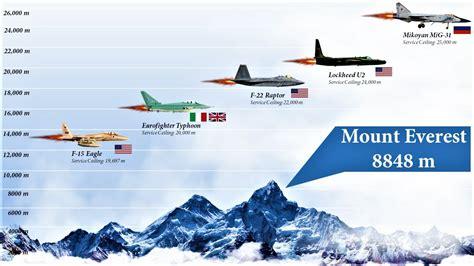
Modern military aviation is often defined by speed, stealth, and sensor technology, but altitude remains one of the most strategically valuable advantages in aerial warfare. The higher an aircraft can fly, the farther its radar horizon extends, the larger the surveillance area it can monitor, and the more difficult it becomes to intercept. Even in the age of advanced missiles and satellite reconnaissance, service ceiling still matters enormously for intelligence gathering, missile launch profiles, survivability, and strategic flexibility.
The world’s highest-flying military aircraft occupy a rare operational space where the atmosphere becomes thin, aerodynamic margins shrink dangerously, and even experienced pilots operate near the edge of physics. At these altitudes, aircraft can encounter the infamous “coffin corner,” where the difference between stall speed and critical Mach speed becomes razor thin. Maintaining stable flight above 65,000 feet is not simply a matter of powerful engines; it requires highly specialized airframes, lightweight construction, advanced flight controls, and carefully managed aerodynamic efficiency.
While official military specifications often conceal the real capabilities of frontline aircraft, enough evidence exists from declassified records, operational reports, and manufacturer data to identify which military aircraft consistently dominate the upper atmosphere today. Some are dedicated reconnaissance platforms designed to quietly observe entire regions from extreme altitudes, while others are high-performance interceptors and stealth fighters capable of climbing into near-space conditions during combat operations.
The following aircraft represent the highest operational ceilings publicly associated with military aviation today, including both acknowledged and shadowy classified programs that continue to fuel speculation across the aerospace world.
Classified High-Altitude Military Aircraft And Secretive Spy Platforms
Some of the highest-flying military aircraft in existence are also the least understood. Secret reconnaissance programs have historically pushed altitude boundaries far beyond officially disclosed numbers, and modern classified aircraft almost certainly continue this tradition. The United States has spent decades developing platforms capable of penetrating contested airspace while remaining difficult to detect, intercept, or even track.
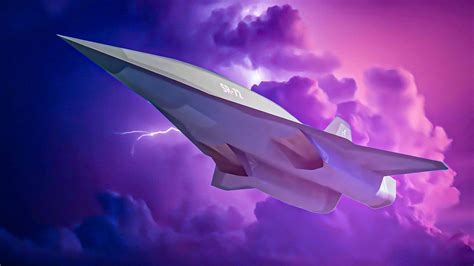
Among the most mysterious aircraft linked to high-altitude operations is the rumored Lockheed Martin SR-72 program. Widely described as the conceptual successor to the legendary SR-71 Blackbird, the SR-72 is believed to combine hypersonic speed with extremely high operational ceilings. Early discussions surrounding the project suggested service ceilings potentially exceeding 80,000 or even 90,000 feet. If accurate, that would place the aircraft among the highest-flying operational military systems ever created.
The secrecy surrounding these programs is intentional. High-altitude reconnaissance remains one of the most strategically sensitive areas of modern warfare. Aircraft such as the rumored RQ-180 stealth reconnaissance drone are believed to operate at altitudes between 50,000 and 60,000 feet while combining stealth shaping with long-endurance intelligence collection. Even the acknowledged RQ-170 Sentinel remains shrouded in uncertainty despite its public exposure following the Iranian drone incident in 2011.
China and Russia are also heavily investing in next-generation high-altitude ISR capabilities. China’s rapid unveiling of advanced drone concepts and tailless stealth aircraft has triggered widespread speculation that entirely undisclosed reconnaissance systems may already exist. In many cases, the true performance of these aircraft may remain hidden for decades, just as the U-2 and SR-71 once did during the Cold War.
What makes classified high-altitude aircraft particularly fascinating is that public specifications are often intentionally misleading. Governments routinely obscure true altitude performance to protect operational capabilities. In practical terms, that means some aircraft publicly described as operating at 60,000 feet may actually be capable of significantly more.
General Dynamics And Boeing F-15 Eagle Still Climbs Into The Stratosphere
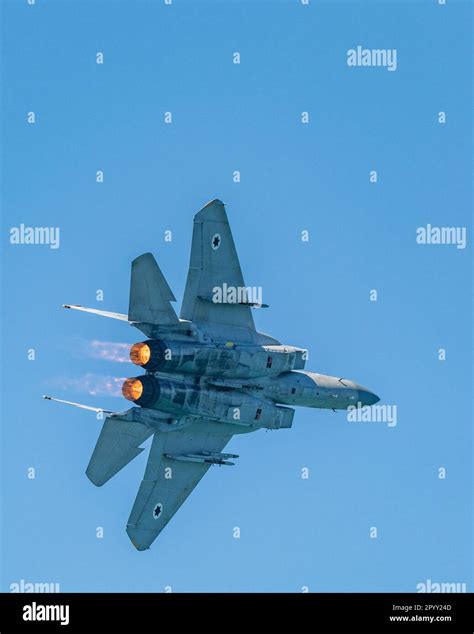
Despite entering service in the 1970s, the F-15 Eagle remains one of the most capable high-altitude fighters ever built. Designed during the Cold War to dominate Soviet aircraft through superior speed, climb rate, and maneuverability, the Eagle was engineered with raw aerodynamic performance as a top priority.
Official United States Air Force material places the aircraft’s service ceiling around 65,000 feet, although the real operational limit may vary depending on fuel state, weapons load, atmospheric conditions, and mission profile. Unlike stealth-focused modern fighters that often balance multiple priorities, the F-15 was built around pure air superiority performance, and that heritage remains obvious in its high-altitude capabilities.
The aircraft’s twin-engine configuration gives it tremendous thrust-to-weight performance, allowing it to climb aggressively into thinner air where many fighters begin losing effectiveness. At higher altitudes, missiles launched from the F-15 gain significant kinetic advantages due to reduced drag and increased energy retention. This can dramatically extend missile engagement ranges in air-to-air combat.
One reason the F-15 continues to serve globally is its extraordinary adaptability. Advanced variants like the F-15EX Eagle II incorporate modern radar systems, electronic warfare upgrades, and expanded payload capabilities while retaining the core aerodynamic strengths of the original platform. Even decades after its first flight, the Eagle remains one of the few fighters consistently associated with operations near 65,000 feet.
The aircraft’s enduring relevance also reflects a broader reality in military aviation: altitude remains valuable even in the stealth era. While stealth reduces detection, altitude still improves radar coverage, sensor reach, and missile effectiveness. The F-15 may not possess the low observability of newer fighters, but its ability to dominate the upper atmosphere continues to make it a dangerous adversary.
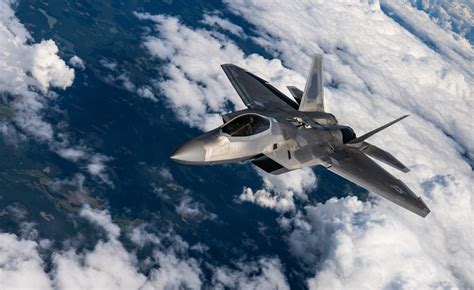
Lockheed Martin F-22 Raptor Combines Stealth With Extreme Altitude
The F-22 Raptor represents one of the most advanced air superiority fighters ever developed, and its high-altitude performance remains central to its combat identity. Although official documentation merely states that the aircraft can fly “above 50,000 feet,” numerous credible reports indicate operational altitudes well above 60,000 feet, with some estimates approaching 70,000 feet under ideal conditions.
Unlike older fighters, the F-22 merges altitude performance with stealth technology, supercruise capability, and highly advanced sensor fusion. This combination allows the aircraft to engage threats while remaining difficult to detect, particularly in the thin upper atmosphere where radar geometry and engagement dynamics change significantly.
The Raptor demonstrated part of this capability during the 2023 Chinese spy balloon incident over the United States. Reports indicated the aircraft intercepted the balloon at approximately 58,000 feet while operating in a challenging high-altitude engagement environment. The incident highlighted the reality that very few combat aircraft are capable of effectively maneuvering and engaging targets at those altitudes.
One of the F-22’s greatest strengths is its ability to sustain high-speed flight without afterburners through supercruise. This allows the aircraft to maintain energy efficiency at altitudes where traditional fighters often struggle. Its thrust-vectoring engines also provide exceptional control authority in thin air conditions that can destabilize less advanced aircraft.
The future successor to the F-22, commonly referred to as the F-47 under the Next Generation Air Dominance initiative, is expected to push these limits even further. Speculation surrounding adaptive-cycle engines suggests dramatically improved fuel efficiency and high-altitude endurance. If the projected performance figures are accurate, the next generation of American air dominance fighters may routinely operate above the already extraordinary ceiling achieved by the Raptor.
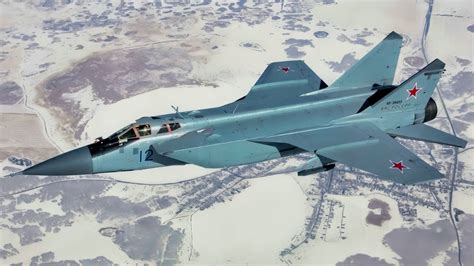
Mikoyan MiG-31 Foxhound Remains Russia’s Ultimate High-Speed Interceptor
The Mikoyan MiG-31 Foxhound occupies a unique position in military aviation because it was specifically engineered for high-speed, high-altitude interception across the vast territories of the Soviet Union. Even decades after its introduction, it remains one of the fastest operational fighter aircraft in the world and among the highest flying.
The MiG-31 evolved from the earlier MiG-25 Foxbat, an aircraft famous for its extraordinary speed and altitude claims during the Cold War. While some exaggerated reports once claimed the MiG-25 could reach nearly 90,000 feet, practical operational ceilings were far lower under combat conditions. The MiG-31 refined that design philosophy into a more sustainable interceptor platform capable of operating around 67,600 feet.
The aircraft’s enormous engines and large airframe allow it to sustain very high speeds at altitude, making it particularly effective for intercepting bombers, reconnaissance aircraft, and cruise missiles across long distances. Unlike lightweight dogfighters, the Foxhound was designed for brute-force interception performance rather than close-range agility.
Today, the MiG-31 is perhaps best known for carrying the Kh-47M2 Kinzhal missile, a high-speed air-launched ballistic weapon heavily promoted by Russian state media. Although frequently described as “hypersonic,” the missile’s operational characteristics remain heavily debated among military analysts. Regardless of the missile’s true classification, the MiG-31’s ability to rapidly climb and launch weapons from extreme altitude significantly enhances the missile’s overall range and speed profile.
The aircraft’s large radar system also benefits from high-altitude operations. At elevated altitudes, radar horizon expands substantially, allowing earlier detection of distant targets. This capability made the MiG-31 a cornerstone of Soviet long-range air defense strategy and continues to give it strategic relevance today despite its aging design.
Myasishchev M-55 Is Russia’s Rare High-Altitude Reconnaissance Specialist
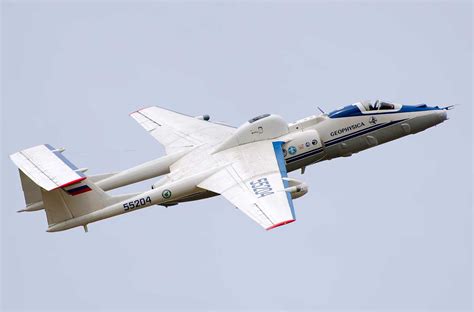
Few military aircraft are as unusual as the Myasishchev M-55. Originally developed by the Soviet Union as a high-altitude reconnaissance and anti-balloon aircraft, the M-55 resembles a hybrid between a spy plane and a glider, optimized for sustained operations in the thin upper atmosphere.
The aircraft traces its origins to Soviet concerns over high-altitude reconnaissance balloons and surveillance platforms that conventional fighters struggled to reach. To solve that problem, Soviet engineers created an aircraft capable of climbing toward 70,000 feet while carrying specialized surveillance equipment.
Only a very small number of M-55 aircraft were ever produced, making it one of the rarest operational military aircraft associated with extreme altitude missions. Reports suggest that just a handful of airframes existed, and for years many analysts believed the type had effectively disappeared from service.
Interest in the M-55 resurfaced after British intelligence assessments suggested Russia might be restoring the aircraft for modern reconnaissance missions. The platform’s exceptional altitude capability remains valuable for intelligence gathering because high-altitude aircraft can observe enormous geographic areas while staying above much of the atmosphere’s distortion and weather interference.
The M-55 also demonstrates an enduring truth about reconnaissance aviation: satellites cannot replace every airborne surveillance mission. Aircraft offer flexibility, persistence, and mission adaptability that orbital systems often lack. A high-altitude reconnaissance aircraft can reposition rapidly, focus sensors dynamically, and maintain continuous observation over targeted areas for extended periods.
Its reappearance in discussions surrounding Russian military modernization suggests that despite the age of the design, there are still operational roles where extreme altitude remains strategically important.
Lockheed U-2 Dragon Lady Still Rules The Edge Of Space
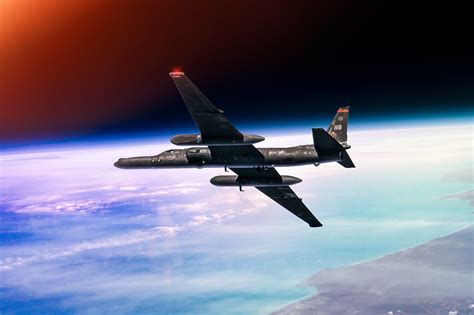
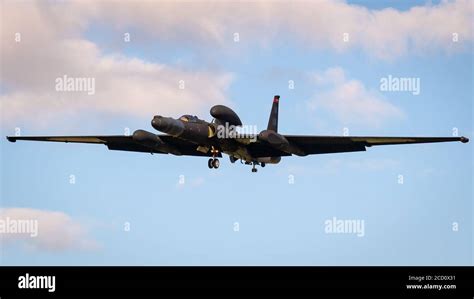
No operational manned military aircraft is more closely associated with extreme altitude than the Lockheed U-2 Dragon Lady. Originally developed during the 1950s for strategic reconnaissance over the Soviet Union, the aircraft became one of the defining symbols of Cold War intelligence operations.
The U-2 was engineered to fly so high that enemy interceptors and anti-aircraft weapons initially could not reach it. Although Soviet missile technology eventually proved capable of shooting down the aircraft, the U-2’s altitude advantage remained extraordinary by aviation standards.
Officially, the aircraft’s service ceiling is listed at approximately 70,000 feet, but multiple credible reports indicate regular operations around 74,500 feet and possible excursions beyond 80,000 feet under certain conditions. At these altitudes, the sky darkens noticeably, atmospheric density becomes extremely low, and pilots operate within incredibly narrow aerodynamic margins.
Flying the U-2 requires immense skill because the aircraft behaves almost like a powered glider near its operational ceiling. The difference between stall speed and overspeed becomes dangerously small, creating the infamous “coffin corner” effect. Even landing the aircraft requires assistance from chase cars driven by fellow pilots who help guide the descent from the runway.
The Dragon Lady’s enormous wingspan allows it to maintain lift in thin air while carrying sophisticated surveillance equipment capable of capturing extraordinarily detailed imagery. Operating above much of the atmosphere also improves image clarity by reducing distortion caused by thicker lower air layers.
Despite the rise of satellites, drones, and stealth reconnaissance systems, the U-2 continues to serve because of its unmatched flexibility and sensor capability. It can be rapidly deployed, upgraded with new payloads, and adapted to emerging intelligence missions far faster than many space-based systems.
More than seventy years after its first flight, the U-2 remains one of the most remarkable military aircraft ever created — a living relic of the Cold War that still patrols the edge of space in the modern era.