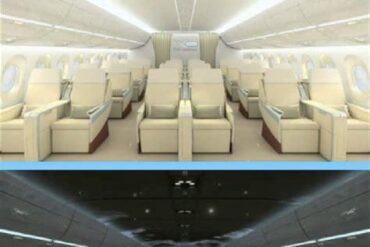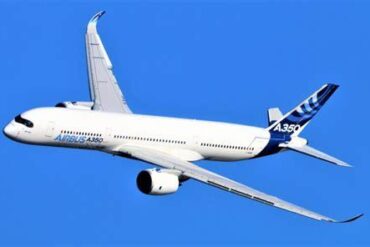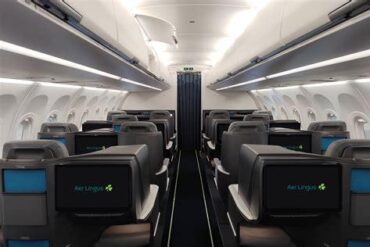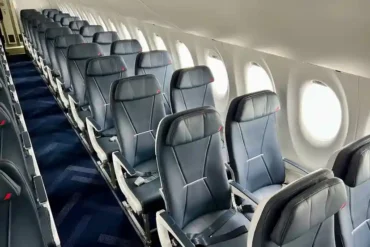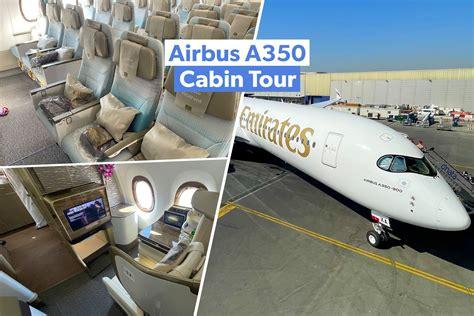
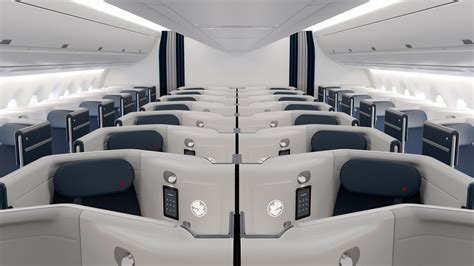
The Airbus A350, particularly the A350-1000, is celebrated not just for its cutting-edge performance but also for its exceptionally high cabin ceiling—one of the most distinctive design features that set it apart in modern aviation. At up to 8 feet (2.45 meters) tall in certain sections, the cabin’s vertical spaciousness is more than an aesthetic triumph; it is a strategic fusion of aerospace engineering, passenger-focused design, and airline adaptability.
From its inception, the A350 was engineered as a clean-sheet widebody aircraft meant to redefine the long-haul travel experience. While other aircraft retrofitted comfort features post-production, Airbus integrated vertical spaciousness into the A350’s DNA. The result is a flying space that does more than move passengers—it rejuvenates them.
Engineering Breakthroughs: How Airbus Achieved the A350’s High Ceiling
The remarkable ceiling height aboard the Airbus A350 is made possible by revolutionary advances in materials science and aerostructural design. At the heart of this lies Airbus’s extensive use of carbon-fiber-reinforced polymers (CFRPs). These composites are significantly lighter and stronger than traditional aluminum, enabling engineers to design a fuselage that is not only wider but also more structurally flexible.
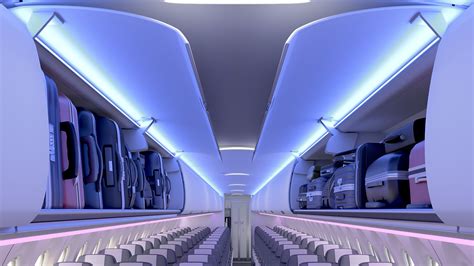
The structural robustness of CFRPs allows for a broader cross-section without compromising safety or fuel efficiency. This added width provides designers the vertical headroom needed to recess overhead bins into the crown area of the fuselage, freeing up headspace along the center aisle. In tandem with this are vertical sidewalls, which ensure shoulder-level space remains uncompromised.
Key Structural Innovations That Enable a Higher Ceiling:
- Carbon-Fiber Composite Fuselage: Reduces structural load and allows for flexible design geometry.
- Vertical Sidewalls: Eliminate the inward curve typical in legacy aircraft.
- Recessed Overhead Bins: Flush-mounted to open up vertical space.
- Modular Lighting and Air Ducting: Designed to fit within slimmer ceiling compartments.
The result is an engineering layout that doesn’t just look spacious—it feels spacious, with less visual clutter, better airflow, and reduced noise transmission.
Passenger Comfort and Perception: Why Height Matters at 35,000 Feet
The psychological effect of a high ceiling in a confined environment like an aircraft cabin cannot be overstated. Passengers frequently describe the A350 as feeling less claustrophobic, even when flying economy class on ultra-long-haul sectors. This isn’t just a marketing tagline; the open vertical space directly affects the cognitive comfort and emotional well-being of those onboard.
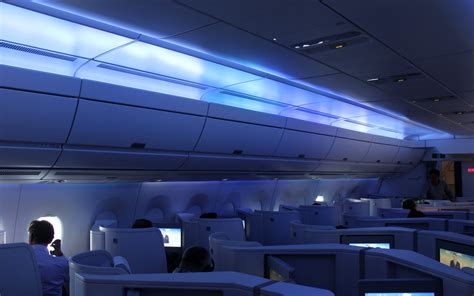
Air circulation also improves significantly. The A350’s HVAC system leverages the higher ceiling to create more effective air distribution, reducing pockets of stagnant air and minimizing temperature inconsistencies. Combined with the A350’s low cabin altitude pressurization (around 6,000 feet) and HEPA-filtered air refreshed every 2–3 minutes, passengers experience fewer symptoms of dehydration, dizziness, or jet lag.
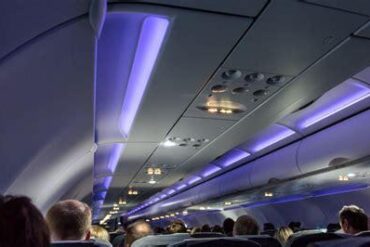
The ambient lighting systems, another hallmark of the A350’s cabin, are installed within the ceiling architecture to enhance the sensation of openness. By simulating natural daylight cycles, these lighting arrays promote circadian rhythm alignment, helping passengers better adapt to new time zones.
Airspace by Airbus: A Holistic Cabin Experience
The high ceiling is not an isolated design flourish—it is a cornerstone of Airspace by Airbus, the manufacturer’s cohesive cabin philosophy. Introduced as a unifying concept across its aircraft families, Airspace aims to deliver enhanced comfort, ambience, service, and design. The vertical spaciousness plays a critical role in each of these pillars.
Features embedded into the A350 under the Airspace brand include:
- Mood Lighting: Transitions through daylight phases to support natural sleep cycles.
- Wider Seats: Especially in economy and premium economy.
- Larger Overhead Bins: Designed to accommodate more carry-on luggage without intruding into headspace.
- Noise Suppression: Advanced insulation and engine placement reduce ambient cabin noise by up to 50% over previous-generation aircraft.
- Touchless Lavatories & Antimicrobial Surfaces: Designed for elevated hygiene standards.
Each of these features is amplified by the feeling of vertical freedom. The high ceiling ties the physical enhancements with sensory aesthetics, creating a coherent environment that is both functional and luxurious.
Comparing the A350 to Its Closest Rival: The Boeing 787 Dreamliner
In the widebody segment, the Boeing 787 Dreamliner is the A350’s most direct competitor. While both aircraft use composite materials and feature modern cabin systems, there are subtle yet impactful differences in spatial design.
Airbus A350 vs. Boeing 787 Cabin Specifications:
| Feature | Airbus A350 | Boeing 787 Dreamliner |
|---|---|---|
| Cabin Height | Up to 8 feet (2.45 m) | Up to 7.8 feet (2.38 m) |
| Cabin Width | 5.61 m (18 ft 5 in) | 5.49 m (18 ft) |
| Overhead Bins | Larger, recessed | Large, but less flush |
| Air Circulation | Advanced airflow with HEPA | Similar but with slightly more localized vents |
| Noise Level | Up to 50% quieter | Quieter than legacy jets but higher than A350 |
Though the numerical differences may seem small, they translate into noticeable real-world improvements, particularly in premium cabins, where headroom, aisle width, and lighting quality play major roles in passenger perception.
Airline Customization and Operational Flexibility
Beyond the comfort of passengers, the A350’s high ceiling delivers tangible benefits to airlines in terms of cabin customization. The extra vertical and horizontal space allows for more diverse seating arrangements, from first-class suites to densified economy layouts, depending on brand positioning and route strategy.
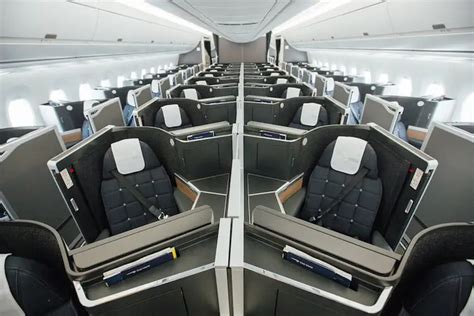
For example, airlines like Qatar Airways, Singapore Airlines, and Cathay Pacific have leveraged the A350-1000’s spatial benefits to install private suites, walk-up snack bars, and even flexible crew rest areas tucked seamlessly into the crown space.
This adaptability also helps optimize boarding and deplaning efficiency. Higher ceilings mean less obstruction during luggage stowage, reducing aisle congestion and improving turnaround times. For high-density routes and premium-heavy operations alike, the spatial freedom enhances operational effectiveness.
Setting a Benchmark for Future Aircraft Design
The success of the A350’s high ceiling represents more than an isolated engineering win—it sets a precedent for future aircraft development. With passenger expectations trending toward health, comfort, and personal space, cabin spaciousness is no longer a luxury—it is a commercial imperative.
As airlines recalibrate post-pandemic travel priorities, the industry is pivoting toward designs that cater to both passenger well-being and sustainability. The A350’s architecture aligns with this evolution. By enabling better airflow, reducing fatigue, and improving in-flight hygiene, the aircraft fosters a healthier onboard ecosystem.
Moreover, Airbus’s modular interior approach makes the A350 future-proof. As new technologies and service models emerge—whether AI-driven personalization, biometric seating, or next-gen IFE systems—the high ceiling allows for future installations without major redesigns.
Conclusion: A Vertical Leap in Passenger Experience
The high ceiling aboard the Airbus A350 is not simply an architectural flourish—it is a strategic embodiment of what the future of aviation should look and feel like. Through a combination of composite fuselage construction, human-centered design, and the integrative Airspace cabin philosophy, Airbus has redefined what it means to travel comfortably over long distances.
At a time when every inch of the aircraft cabin is scrutinized for optimization, the A350’s decision to prioritize vertical space proves that true innovation isn’t always about doing more with less—it’s about doing better with more.