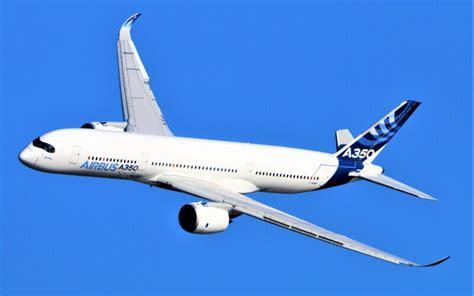
Airbus did not design the A350 merely as a new widebody aircraft. It was conceived as a rethink of how pilots interact with complex machines over ultra-long missions, dense airspace, and increasingly automated flight decks. The result is an aircraft that many pilots quietly describe as calm, intuitive, and mentally economical to operate, even when flying for fifteen hours across multiple time zones. Reduced pilot workload is not a marketing slogan here; it is a design philosophy embedded into hardware, software, ergonomics, and training logic.
Modern airline operations punish cognitive overload. Crews juggle weather, fuel optimization, traffic management, regulatory constraints, and abnormal scenarios while maintaining constant situational awareness. The A350 addresses this reality by absorbing complexity where machines excel and returning clarity where humans are strongest. This balance explains why Airbus refers to the cockpit as the “best office in the sky” without sounding ironic.
What makes the A350 particularly interesting is that its workload reduction is not driven by a single breakthrough. Instead, it emerges from hundreds of small, disciplined design decisions that collectively change how flying feels on a day-to-day basis. Understanding those decisions reveals why the aircraft has become a benchmark for pilot-centric design.
Pilot-Centered Design from the Earliest Concept Phase
The A350 cockpit exists because Airbus treated pilots as co-designers rather than end users. From the earliest XWB studies, Airbus involved line pilots, test pilots, and instructors to stress-test ideas before they hardened into systems. This collaborative approach ensured that new technology served operational reality rather than theoretical elegance.
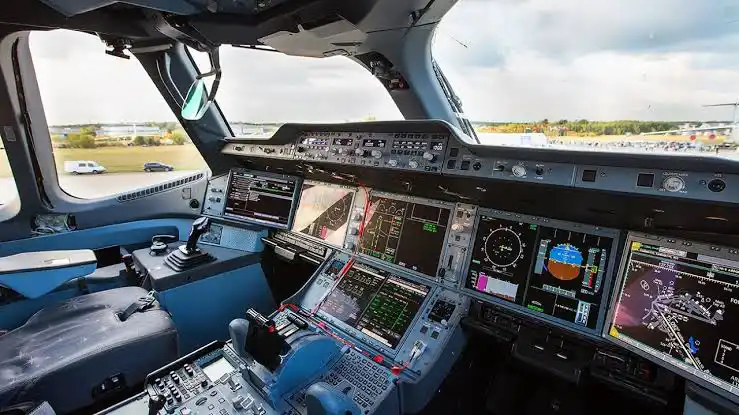
The most visible expression of this philosophy is the six large, identical cockpit displays. Each screen can present any type of information, allowing crews to reorganize their visual priorities instantly. This flexibility eliminates rigid display hierarchies that force pilots to hunt for data under pressure. Information flows toward the crew instead of demanding attention through procedural gymnastics.
These displays are also angled inward and fully touch-capable, reducing both neck movement and manual workload. Interchangeable hardware and software further simplify maintenance and reduce cockpit inconsistencies, indirectly improving reliability and trust. When pilots know that systems behave predictably across fleets, cognitive stress drops even before the aircraft leaves the gate.
Comfort, often dismissed as cosmetic, plays a measurable role in workload reduction. The A350 cockpit seat offers deep lumbar adjustment, reclining support, adjustable armrests, and ample head clearance. On ultra-long-range flights, physical fatigue quietly amplifies mental errors. Airbus treated ergonomics as a safety system rather than a luxury.
Situational Awareness as a System, Not a Feature
Reduced workload begins with awareness. The A350’s head-up displays project flight-critical data directly into the pilot’s forward field of view, minimizing head-down time during high-workload phases such as approach and landing. What elevates these displays beyond earlier generations is their integration with advanced meteorological visualization, allowing crews to perceive weather threats spatially rather than abstractly.
The Flight Management System extends this awareness through its “What If” functionality. Pilots can simulate failures, route changes, or performance constraints mid-flight without disrupting the aircraft’s actual trajectory. This ability to explore consequences safely transforms decision-making from reactive to anticipatory. Instead of asking whether an option is viable, crews can see the answer before committing.
Electronic Centralized Aircraft Monitoring, known as ECAM, has been refined rather than reinvented. On the A350, ECAM logic prioritizes clarity over completeness, presenting only actionable information while suppressing noise. The system guides crews through abnormal procedures with a calm, sequential logic that mirrors human problem-solving rather than overwhelming it.
The Multi-Functional Display checklists represent another subtle workload reducer. Crews can customize checklists to isolate specific abnormalities, avoiding the mental friction of navigating irrelevant steps. The result is a cockpit environment that feels cooperative rather than confrontational when something goes wrong.
The Electronic Flight Bag as a Cognitive Prosthetic
Paper-based flight bags were heavy not only in mass but in mental cost. Searching through binders during time-critical phases fractures attention and invites error. The A350’s Electronic Flight Bag consolidates charts, performance tools, manuals, and aircraft data into a single interactive platform.
What distinguishes the A350 EFB is its deep integration with aircraft systems. Performance calculations draw directly from live data rather than manual entries, reducing both workload and error potential. Route updates, weather overlays, and airport information become part of a unified cognitive workspace instead of scattered references.
This integration quietly reshapes cockpit rhythm. Tasks that once required coordination, verification, and cross-checking become fluid and nearly invisible. The machine handles bookkeeping so pilots can focus on judgment, communication, and strategic thinking.
Safety Automation That Acts Before Humans Cannot
Safety-related workload often peaks when time is scarce and stress is highest. The A350 addresses this by introducing automation that intervenes only when human performance is likely compromised. This philosophy is evident in the Brake to Vacate and Runway Overrun Prevention systems.
By incorporating runway length, contamination data, aircraft weight, and environmental conditions, the system calculates optimal braking automatically. Pilots are relieved from mentally integrating dozens of variables during landing rollout, a phase where cognitive margins are already thin.
Automatic Emergency Descent represents an even more radical step. In the event of unresponsive crew following rapid decompression, the aircraft autonomously descends to a safe altitude. This feature does not replace pilots; it protects them during physiological vulnerability. Workload disappears entirely when consciousness is at risk, and Airbus designed accordingly.
The On-board Airport Navigation System reduces taxi workload by displaying real-time aircraft position overlaid on detailed airport maps. Ground operations, often underestimated in risk, become clearer and calmer. Wrong turns, runway incursions, and ambiguous signage lose their power to surprise.
Commonality as a Training and Mental Load Strategy
Learning a new aircraft traditionally imposes a heavy cognitive toll. Airbus counters this through fleet commonality, ensuring that A350 pilots encounter familiar logic, layouts, and philosophies. The similarity between the A330 and A350 cockpits is not accidental; it is a deliberate workload mitigation strategy.
Cross Crew Qualification allows pilots to transition with dramatically reduced training time. This efficiency lowers stress during qualification and reinforces confidence during early line operations. Familiarity reduces the mental bandwidth spent remembering how systems work, freeing capacity for operational judgment.
Airlines benefit from Mixed Fleet Flying, but pilots benefit psychologically. Flying multiple aircraft within a shared design philosophy keeps skills sharp without fragmenting mental models. The cockpit feels like an evolution rather than a reinvention.
When Automation Becomes a Double-Edged Sword
The A350’s sophistication introduces a paradox. Automation reduces workload, yet excessive abstraction can distance pilots from system understanding. Some crews express concern that deep automation may erode intuitive system knowledge, especially for those transitioning from older aircraft.
The learning curve is steep for pilots unfamiliar with modern Airbus philosophy. Systems interconnect in ways that demand conceptual understanding rather than rote memory. While automation covers much of this complexity, the underlying architecture remains demanding.
Reliability concerns have also surfaced, particularly during early service years. Systems failures, while rarely safety-critical, can disrupt operations and increase pilot vigilance. Trust in automation is fragile; it grows slowly and can be damaged quickly.
Economic realities add another layer. The A350’s high acquisition cost limits fleet size across airlines. For pilots, specialization can become a career constraint if opportunities narrow unexpectedly.
A350 in Operational Context
The A350’s operational record reinforces its workload philosophy. After a challenging early development phase, the aircraft entered service in 2014 and rapidly demonstrated exceptional utilization rates. Airlines such as Finnair achieved over twenty hours of daily flying, a testament to both reliability and crew sustainability.
Ultra-long-range missions highlight the cockpit’s strengths. Flights exceeding thirteen hours demand not just physical endurance but cognitive resilience. The A350’s calm automation, ergonomic design, and situational clarity support crews across circadian lows and operational monotony.
The aircraft’s versatility, spanning medium-haul efficiency and ultra-long-range reach, underscores how workload reduction scales across mission profiles rather than favoring one niche.
Why Reduced Workload Ultimately Equals Better Flying
The A350 does not remove pilots from the loop. It reshapes the loop to respect human limits. By absorbing complexity, clarifying information, and intervening only when necessary, the aircraft creates a cockpit environment that feels composed even when operations are demanding.
Reduced workload is not about doing less. It is about doing the right things with greater clarity. The A350’s success lies in its understanding that safety, efficiency, and pilot well-being are not competing goals but mutually reinforcing outcomes of thoughtful design.
In an industry obsessed with performance metrics, the A350 quietly champions something more fundamental: mental sustainability. Pilots who are less overloaded make better decisions, communicate more effectively, and manage risk with greater precision. That may be the most valuable innovation Airbus has delivered, even if it cannot be measured in knots or nautical miles.