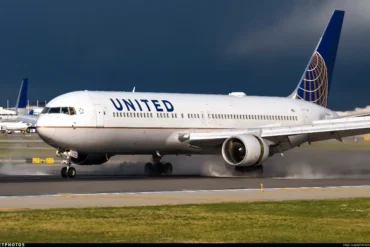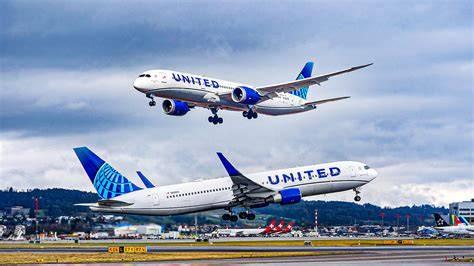
United Airlines built its transatlantic identity on the Boeing 767. On September 8, 1982, the carrier became the launch customer for the twinjet, flying the first revenue 767 and proving that a two-engine widebody could safely cross the North Atlantic when four-engine jets still dominated the market. More than four decades later, 53 of those airplanes remain on the property, forming the backbone of the airline’s European network out of Newark Liberty International Airport (EWR) and Washington Dulles International Airport (IAD). That long farewell is now entering its final chapter. United intends to retire every remaining 767 by 2030 and replace them with Boeing 787 Dreamliners, a swap that represents the most consequential reshaping of its widebody strategy since the twinjet era began.
The arithmetic of the current fleet explains the urgency. Sixteen stretched 767-400ER aircraft average 23 years of age, while 37 older 767-300ER airframes average 29 years. These are not museum pieces, but they are approaching the heavy maintenance thresholds where aluminum fatigue, corrosion and engine overhauls conspire to drain cash. United’s answer is not a modest refresh. It is a firm order for 150 Boeing 787 Dreamliners, with options for 50 more, a bet that the composite widebody can carry United’s premium ambitions further than any aluminum jet ever could.
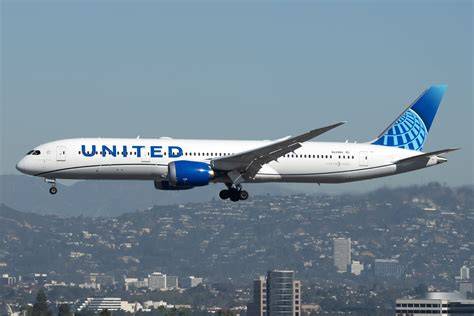
How Surging Transatlantic Demand Pushed United Toward a Premiumized Cabin
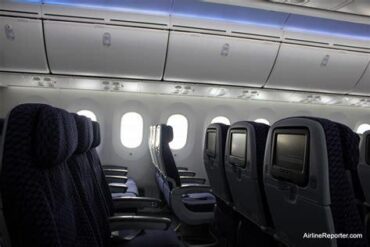
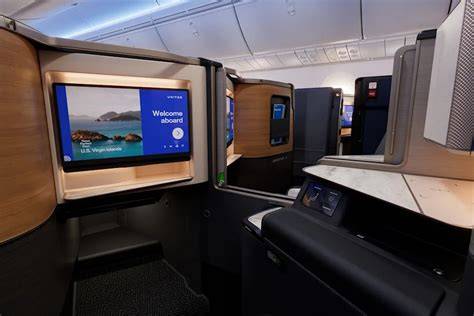
The post-pandemic travel recovery did not simply refill United’s transatlantic seats; it changed who was buying them. Year-round leisure demand to Europe collided with a stubborn return of business travel, and United concluded that the way to grow revenue without flooding its best routes with discounted coach inventory was to add premium seats rather than total seats. The Dreamliner’s cabin architecture made that shift feasible. United is deploying 222-seat Elevated Boeing 787-9s configured with 99 premium seats, including 64 enclosed Polaris suites with sliding privacy doors, wireless charging and large 4K screens, plus 35 Premium Plus recliners. On slot-constrained hubs such as London Heathrow Airport (LHR), United can lean on the stretched 787-10, trading some range for capacity in a market where landings and departures are rationed by the slot coordinator.
That configuration is a direct rebuke to the 767 era, when business class meant open, doorless seats and overhead bins that punished anyone traveling with a roll-aboard. The premium mix also reframes the economics of a route. A 787-9 carrying 64 Polaris suites on a seven-hour overnight crossing generates a far richer revenue per departure than a 767-300ER, and United can harvest that premium demand without diluting its coach fares to fill the back of the airplane.
Why the 787’s Composite Fuselage Changes the Passenger Experience
The most tangible upgrade is one passengers feel rather than see. The 787’s single-piece carbon-fiber fuselage can withstand higher internal pressure without the metal fatigue that constrains a riveted aluminum airframe, allowing the cabin to be maintained at the equivalent of 6,000 feet (1,829 meters) rather than the 767’s traditional 8,000 feet (2,438 meters). Humidity climbs from below 10 percent, a ceiling imposed largely to protect metal joints from corrosion, to roughly 16 percent. After seven hours in the air on a red-eye to London or Frankfurt, that difference translates into measurable blood oxygen levels, fewer headaches and a markedly softer landing on the body clock.
The same architecture underwrites nearly every other comfort claim. A wider composite cabin improves personal space across all classes, oversized bins swallow each passenger’s roll-aboard, sculpted sidewalls and wider aisles ease movement during meal service, and dynamic LED mood lighting helps cabin crew choreograph time-zone transitions. The Dreamliner windows are 65 percent larger than the 767’s and use electronic dimming instead of plastic pull blinds. Acoustic insulation around the engine nacelles and the absence of noisy high-pressure bleed-air lines, a byproduct of the type’s all-electric architecture, make the cabin noticeably quieter at takeoff and cruise.
Range, Speed and Route Flexibility: The 787’s Operational Edge
The 787 is not merely a nicer cabin bolted onto a similar mission. The 787-9 flies up to 7,565 nautical miles (14,010 kilometers), against roughly 5,980 nautical miles (11,075 kilometers) for the 767, and its Mach 0.85 cruise speed can shave up to 50 minutes off an eastbound Atlantic crossing. That speed matters more than it sounds, because it helps United hit tight European arrival slots while preserving aircraft rotations. The added range also lets United move 787-9s onto Pacific missions from the West Coast for seasonal destinations without the penalty of a dedicated subfleet, which is precisely the flexibility a single-aisle-heavy network cannot offer.
Payload tells the same story. Each transatlantic 787-9 can carry up to 52,400 pounds (23,768 kilograms) of high-margin commercial freight in its belly, supported by a maximum takeoff weight of 560,000 pounds (254,011 kilograms), compared with 412,000 pounds (186,880 kilograms) for the 767-300ER. On routes where passenger demand dips seasonally, that cargo capacity is the difference between a marginal flight and a profitable one.
United CEO Scott Kirby framed the order in expansive terms in 2022, describing United as having emerged from the pandemic as the world’s leading global airline and the flag carrier of the United States, with the order solidifying that lead and creating opportunities to connect more people to more places. Stan Deal, then president and CEO of Boeing Commercial Airplanes, called United’s commitment a testament to the market-leading operating economics and reliability of the 787 family and to the synergies of operating one of the largest, most efficient fleets in the skies.
Engines, Bleedless Systems and Composite Wings Behind the 25 Percent Fuel Saving
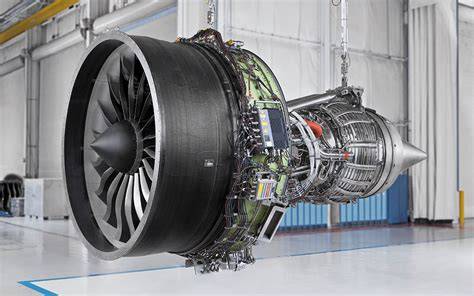
The 25 percent fuel efficiency advantage over the 767 is not a single breakthrough but the compounding of several. United’s older 767s fly on Pratt & Whitney PW4060 or General Electric CF6-80C2B6F engines with 94-inch (239-centimeter) titanium fans, a 4.8-to-1 bypass ratio and roughly 60,200 pounds of thrust (268 kilonewtons). The 787-9’s General Electric GEnx-1B engines are rated to 75,000 pounds of thrust (334 kilonewtons) and feature 111-inch (282-centimeter) carbon-fiber fan blades, a composite fan case that removes more than 400 pounds (181 kilograms) per engine and an 8.8-to-1 bypass ratio that trims fuel burn by well over 20 percent while cutting nitrogen oxide emissions by 55 percent.
The second gain comes from how the airplane powers itself. The 767 draws hot compressed bleed air above 392 degrees Fahrenheit (200 degrees Celsius) from its engine cores to run air conditioning, start engines and heat the wing leading edges, robbing the turbines of useful thrust. The 787 replaces those titanium ducts with a bleedless all-electric architecture driven by four engine-mounted generators producing 1.4 megawatts, a change worth roughly 4 percent in cruise fuel consumption. The third gain lives in the structure itself. Carbon-fiber composites constitute half of the 787’s structural weight, and the long, thin wings flex upward by roughly 10 feet (3 meters) at the tips in flight, smoothing turbulence and reducing drag at Mach 0.85.
Delivery Delays Force Costly 767 Overhauls and Keep Airbus A350 Options Alive
The strategy is sound; the timetable is not. Production at Boeing’s North Charleston facility has been slowed by Federal Aviation Administration safety inspections following quality problems with composite materials, forcing United to cut its planned near-term Boeing deliveries from 165 aircraft to just 63 and pushing most new widebody arrivals beyond 2026. The financial consequence was a 200 million dollar hit from factory delays and groundings, and operational consequence is more uncomfortable: United must keep 30-year-old aluminum airplanes safe and compliant while it waits.
High-time 767-300ER and 767-400ER airframes now face extensive structural inspections rather than quiet retirement to desert storage. Tail N641UA, with nearly 100,000 flight hours and 20,000 landings, needs costly overhauls of its older General Electric engines alongside thorough wing and tail scanning inspections. Every dollar spent there is a dollar not spent on the future fleet, which is why Kirby built a hedge. United leased 35 Airbus A321neo jets to cover short-term domestic flying and kept its delayed order for 45 Airbus A350-900 widebodies alive, preserving European factory slots and a genuine alternative should South Carolina’s assembly problems persist.
Kirby has been consistent about the underlying logic, saying that long-term planning has helped United surge past competitors that stood still, and that adding new, larger aircraft lets the airline take full advantage of its growing flying opportunities at home and abroad. Boeing’s Deal echoed the sentiment, noting that the 787 would give United the synergies of operating one of the largest and most efficient fleets in the sky. For passengers, the payoff is already visible on the flightline: a wider cabin, a lower cabin altitude, a quieter ride and a suite with a door that closes. For United, the wager is that retiring the airplane that made its Atlantic network, and replacing it with the Dreamliner, is less a fleet decision than a repositioning of the entire premium transatlantic product.