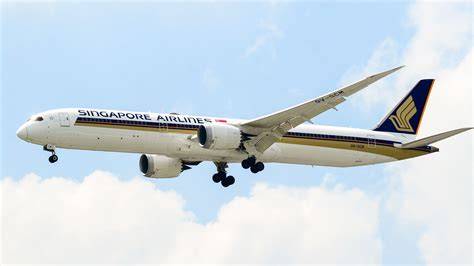
The 787-10 Dreamliner is Boeing’s longest fuselage Dreamliner, yet it carries the shortest maximum range of the three variants. Boeing designed it for high-frequency, high-demand medium-length sectors, where moving a large passenger volume efficiently matters more than spanning oceans. With a maximum range of 7,500 nautical miles (13,890 km), it can still fly traditional long-haul missions when needed. Singapore Airlines takes it in a strikingly different direction, deploying the aircraft on routes so short they normally belong to narrowbody jets. That decision is not a quirk of scheduling. It reflects fleet architecture, capacity economics and the geography of one of the world’s most competitive aviation markets.
How Singapore Airlines Ended Up Flying Dreamliners on Very Short Routes
The reasoning begins with the aircraft itself. The 787-10 entered the Singapore Airlines fleet as a modern widebody replacement for older jets, offering 337 seats in a high-density layout that ferries large numbers of passengers per departure. It is fuel-efficient, versatile and cost-effective across a broad band of route lengths, which makes it a workhorse rather than a niche long-haul machine. The second half of the answer sits in the carrier’s fleet composition: Singapore Airlines lacks the narrowbody capacity to absorb short-haul demand at the volume its network generates. With only a modest single-aisle fleet, the Dreamliner must fill a role that in other airlines’ hands would fall to an A321neo or a 737.
Cirium schedule data shows Singapore Airlines flying the 787-10 on 26 routes in November, totalling 1,129 operations and more than 380,000 seats. The majority of those 26 routes are regional, each coming in at less than a third of the 787-10’s range. In other words, the airline is deliberately operating an aircraft capable of 7,500 nautical miles on sectors that consume a small fraction of that capability, because the business case lies in seats and frequency rather than distance.
The Ten Shortest 787-10 Routes From Singapore Changi
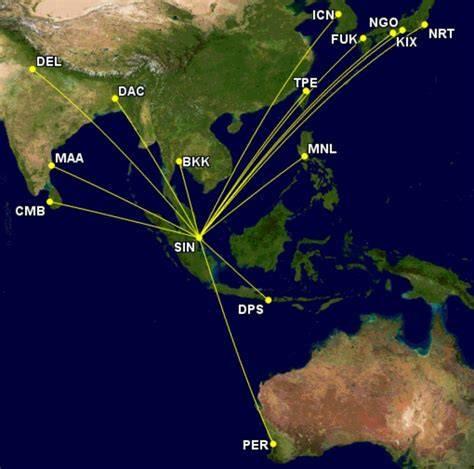
All of the shortest services originate at Singapore Changi Airport (SIN), the carrier’s hub and the anchor of its regional network. The shortest is the 675-mile (1,086 km) hop to Tan Son Nhat International Airport (SGN) in Ho Chi Minh City, with 30 operations and 10,110 seats scheduled. Next comes the 854-mile (1,374 km) service to Juanda International Airport (SUB) in Surabaya, with 60 operations and 20,220 seats. The third-shortest is the 876-mile (1,410 km) sector to Suvarnabhumi Airport (BKK) in Bangkok, which carries a remarkable 106 operations and 35,722 seats, generating over 31 million available seat miles.
The 1,037-mile (1,668 km) route to I Gusti Ngurah Rai International Airport (DPS) in Bali follows, with 60 operations and 20,220 seats. Then comes the carrier’s most frequent Dreamliner route: the 1,474-mile (2,372 km) service to Ninoy Aquino International Airport (MNL) in Manila, with 120 monthly operations, 40,440 seats and almost 60 million available seat miles, a figure surpassed by only two other Dreamliner routes. The remaining entries on the ten-shortest list are Hong Kong International Airport (HKG) at 1,587 miles (2,554 km), Guangzhou Baiyun International Airport (CAN) at 1,638 miles (2,636 km), Bandaranaike International Airport (CMB) in Colombo at 1,709 miles (2,750 km), Hazrat Shahjalal International Airport (DAC) in Dhaka at 1,794 miles (2,887 km) and Chennai International Airport (MAA) at 1,817 miles (2,924 km), each with 30 operations and 10,110 seats.
That frequency profile reveals the strategy in its plainest form. The shortest route, SIN to SGN, runs daily, producing 6.8 million available seat miles from just over 10,000 seats. The airline is not stretching the Dreamliner; it is using it as a high-capacity shuttle between megacities that generate relentless business and leisure demand.
The 787-10’s Position Within the Singapore Airlines Fleet
The fleet itself explains why. Singapore Airlines operates just 26 Boeing 737 MAX 8 jets, its only single-aisle aircraft, each configured with 154 seats across economy and business class. That is less than half the 337-seat capacity of a 787-10. Cumulatively, the 737 fleet offers 4,004 seats, against 9,436 for the Dreamliners. When regional demand surges, the 787-10 simply takes a larger bite out of it than any narrowbody could, which matters enormously in a region packed with densely populated, fast-growing cities.
The widebody fleet reinforces the logic from the opposite direction. Singapore Airlines’ most numerous widebody is the Airbus A350-900, with 65 aircraft at an average age of 7.6 years. Its range of 8,500 nautical miles (15,750 km), extendable to 9,700 nautical miles (17,964 km), makes it a natural fit for long-haul and premium-dense missions, not for a 675-mile sector where its efficiency advantages never materialise. The carrier also operates 12 Airbus A380s averaging 12.8 years, 27 Boeing 777s averaging 14.1 years and 28 Boeing 787-10s averaging 5.9 years, for a total of 165 aircraft at an average age of about nine years. The 737 fleet averages just 4.9 years, making it the youngest type in the inventory, yet its small numbers leave the capacity gap the Dreamliner fills.
How Singapore Airlines Configures Its Dreamliners
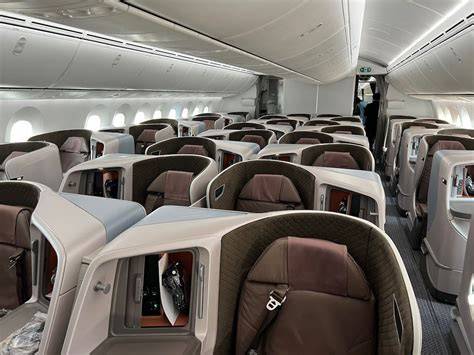
The cabin layout is engineered for exactly this mission. Premium passengers get 36 business class seats in a 1-2-1 configuration, and the rest of the aircraft is given over to a vast 301-seat economy cabin. There is no premium economy on this jet, and only one row of economy is marked as extra legroom. Business class seats offer 60 inches (152 cm) of pitch and 20 inches (51 cm) of width that expands when the armrests are lowered, with full flat-bed recline. Economy provides 32 inches (81 cm) of pitch, 17 inches (43 cm) of width and 5 inches (11.6 cm) of recline.
Thirty-six business seats is a substantial premium cabin for a high-capacity philosophy, but the staggered layout compresses those seats into a relatively compact footprint. The lie-flat beds are shorter in pitch and narrower in width than long-haul business travellers expect, a deliberate trade that keeps the seat count high without sacrificing the flat-bed product on dense regional sectors.
Where the Dreamliner Still Stretches Its Legs
Despite the dominance of sub-2,000-mile flying, four Singapore Airlines 787-10 routes exceed 3,000 miles (4,830 km) in November: Adelaide Airport (ADL), Tokyo Narita International Airport (NRT), Chubu Centrair International Airport (NGO) near Nagoya, and Osaka’s Kansai International Airport (KIX). Only one of these leaves Asia, and the longer intra-Asian sectors largely reflect Japan’s geographic isolation from the rest of the continent.
Adelaide is the longest at 3,351 miles (5,400 km), flown 52 times with 17,524 seats and 58.7 million available seat miles. The airline marked 40 years of Adelaide service in 2024, having first flown there in 1984, eighteen months after the city’s international terminal opened, using a 747. The A350 joined the route in October 2023 and now flies alongside the 787. Kansai, meanwhile, is the highest-frequency route above 3,000 miles, with 90 frequencies, 30,330 seats and more than 92 million available seat miles, the highest total of any Singapore Airlines Dreamliner route.
Boeing Problems That Could Hamper Dreamliner Operations
Concentrating a specific route on a single aircraft type always carries risk, and a Federal Aviation Administration airworthiness directive covering all 787 variants illustrates the exposure. The order addresses sealant defects that could create a spark inside the jet’s fuel tanks during a lightning strike. “The unsafe condition, if not addressed, could result in development of an ignition source within the fuel tank volume,” the FAA order states. The FAA says 60 of the 170 US-registered 787s fall under the directive, requiring safety inspections. Singapore Airlines’ Dreamliners are not covered, but could be affected if the issue exists fleet-wide. Impacted aircraft need sealant inspections where the wings meet the fuselage, plus adhesion checks, with FAA estimates of 34 hours and $2,890 per jet in inspection costs before any repairs. Across more than 1,100 Dreamliners worldwide, the problem could cause meaningful disruption.
Elsewhere in the widebody fleet, Boeing delays create their own pressure. Singapore Airlines holds an outstanding order for 31 Boeing 777X jets, placed in June 2017 and February 2021, with no options for additional purchases. The family has been repeatedly delayed by certification issues, although Boeing insists certification and deliveries will finally arrive in 2027. Given the 777X’s enormous size, its eventual arrival should further entrench the need for Singapore Airlines to keep deploying its 787-10s on short, high-capacity routes, freeing the largest aircraft for the longest missions.