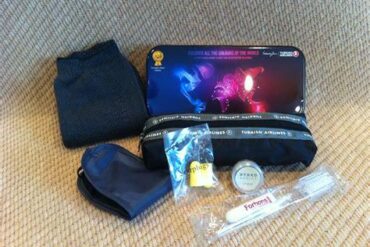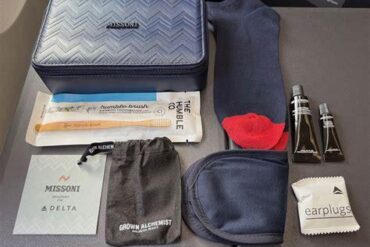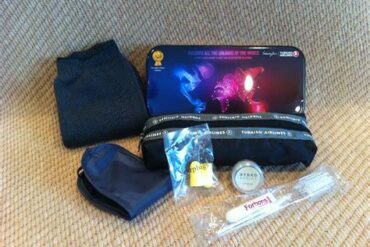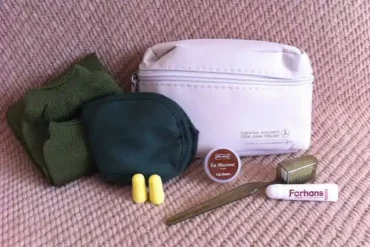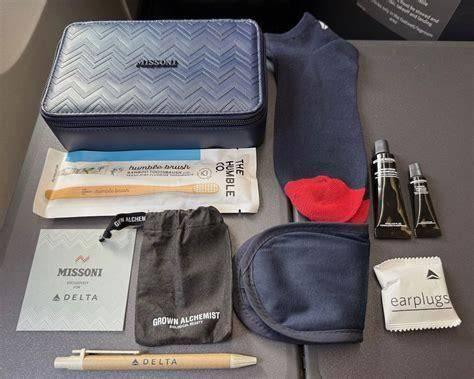
The amenity kit was once one of flying’s quiet rituals: a small pouch handed out by cabin crew on a darkened long-haul cabin, holding an eye mask, a pair of socks, a toothbrush and the small promise that someone had thought about your comfort at 35,000 feet. In 2026 that ritual survives, but barely, and almost never in the cabin where most people actually sit. Complimentary amenity kits in economy class now exist only on a handful of full-service carriers, and even then only on ultra-long-haul or overnight services. What used to be an automatic inclusion has become a route-specific privilege, a branding gesture, and occasionally a quiet favor from a crew member who notices you look exhausted.
The forces behind the retreat are familiar and well documented. Raising the standard of the cheapest fare has always meant separating what passengers pay for from what they expect, and amenity kits were an easy item to place on the “bring your own” side of that ledger. Toothbrushes, eye masks and socks are inexpensive, easily packed at home, and often left untouched in the seat pocket after landing. Sustainability targets added a second, harder argument: single-use plastic wrappings, disposable dental kits and unclaimed pouches all count against a carrier’s waste reduction commitments. Where kits remain, they tend to be pared back, reusable, and offered on the routes where rest is genuinely scarce and the cabin lights stay down for seven hours or more. Everything else is now a request, a purchase, or simply gone.
Etihad Airways Gives Economy Passengers a Reusable Tote on Flights Over Six Hours
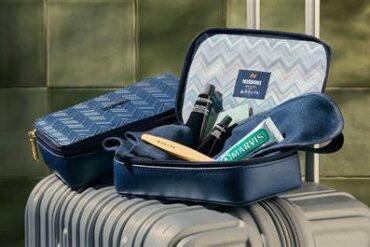
Etihad Airways remains one of the few full-service carriers that still distributes amenity kits in economy class, and its criteria are unusually clear. The Abu Dhabi-based airline offers them on long-haul flights exceeding roughly six hours, which in practice means the Europe, North America and Asia-Pacific sectors where passengers expect to sleep. The kit itself is deliberately unglamorous in the best sense: a reusable tote bag containing noise-canceling earplugs, an eye shade and a small hand cream. There are no luxury cosmetics, no branded fragrance, and no attempt to replicate the premium cabin experience at the back of the aircraft. Rather than a disposable bag of single-use plastics, the format leans into practicality and multiple reuse. The thinking is straightforward: the pouch should outlive the flight, the contents should address the two problems economy passengers actually face, which are noise and dry cabin air, and the whole item should be cheap enough to justify at scale on a widebody.
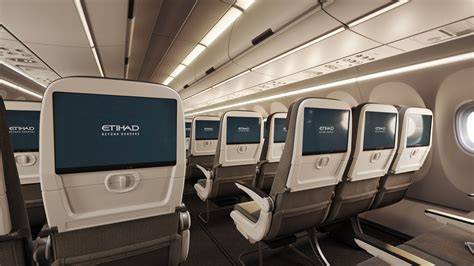
That kit sits inside a broader inflight product that has been steadily tightened. Etihad’s economy seats carry adjustable headrests and recline suitable for rest or work, and each seat has a personal entertainment screen loaded with films, television, music and games. The amenity kit works as a modest satisfaction driver on top of that hard product, not as a flagship feature. It also functions as a branding tool: a printed tote that appears in airport photographs and hotel rooms long after landing, at a fraction of the cost of a business class pouch.
Qantas Packages a Dental Set and Eye Mask in Recycled Felt
Qantas has taken a similar route but with a more visible environmental story. The oneworld carrier continues to offer economy amenity kits on selected long-haul and ultra-long-haul international routes, packaged in a decorative felt pouch made from recycled PET bottles. The contents are modest and predictable: a dental set, an eye mask and earplugs. Where premium cabins now compete on luxury brand collaborations, Qantas has aimed its economy kits squarely at simple comfort and demonstrable sustainability, an approach that lets the airline claim a tangible reduction in virgin plastic while still handing passengers something.
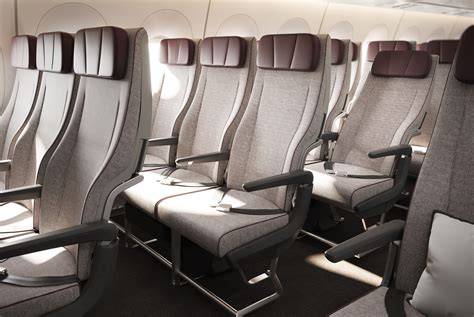
The clearest illustration is the non-stop service between Perth Airport and London Heathrow, operated by the Boeing 787-9 and capable of stretching to 17 hours block time. On a sector of that length, a dental set and an eye mask are not perks but practicalities, and the kit earns its place. On shorter international sectors where the kit is not distributed as standard, the airline offers a selection of additional travel essentials on request across its network, which is the industry’s standard compromise: the product exists, but you have to ask for it. Qantas is simultaneously rebuilding its fleet around the Airbus A350-1000ULR for Project Sunrise, the non-stop links to Europe and the United States, alongside the A220-300, A321XLR and additional 787s. Longer flights mean more justification for comfort items, and the carrier’s order book of more than 200 aircraft suggests the ultra-long-haul economy experience will keep receiving attention.
Emirates Uses Wildlife Artwork and Sustainable Pouches on Overnight Long-Haul Flights
Emirates, the Dubai-based giant known for opulence across every cabin, still provides economy amenity kits, though availability is narrower than its reputation suggests. Kits are primarily offered on long-haul services and often only on overnight flights, which means a daytime Dubai to London sector may see none at all while a late-night departure to Sydney sees the full set. That distinction reflects a sensible operational logic: the kit exists to support sleep, so it appears when sleep is the plan.
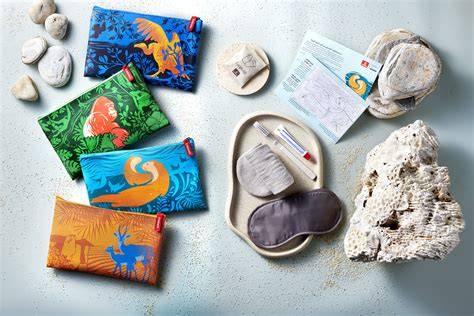
What distinguishes the Emirates kit is design. For several years the airline has produced kits in partnership with wildlife conservation groups, with hand-drawn artwork highlighting endangered species printed across the pouch. Contents are the familiar comfort basics, including socks, an eye shade, earplugs and a dental kit, all held in a reusable pouch made from recycled polyester and paper rather than virgin plastic film. Each kit carries a small message and a distinctive illustration, and some passengers collect them. The product doubles as a sustainability statement and as a branding asset that spreads across Instagram long after the flight.
The wider Emirates product is in the middle of significant renewal. A multi-billion-dollar retrofit program is under way, with more than 200 Airbus A380 and Boeing 777-300ER aircraft scheduled to receive refreshed cabins featuring next-generation seats across classes, upgraded inflight entertainment and fast satellite WiFi. That investment is aimed at the whole aircraft, not just premium cabins, and it underscores a broader point: this carrier treats passenger perception of its entire product, including economy, as a competitive asset.
Qatar Airways Retains the Kit but No Longer Guarantees It
Qatar Airways has the strongest historical record in this group. Earlier versions of its economy amenity kits included a lip balm from Institut Karité Paris, a Miradent dental kit, an eye mask, socks and earplugs, and the airline won industry recognition for the quality of its economy offering because of that attention to detail. In 2026, however, availability is no longer reliable. Passenger reports indicate kits are distributed on selected long overnight segments only, and they may be absent on shorter or daytime flights entirely. On a late-night departure from Doha to a distant destination, expect the pouch. On a daytime regional hop, expect to bring your own.
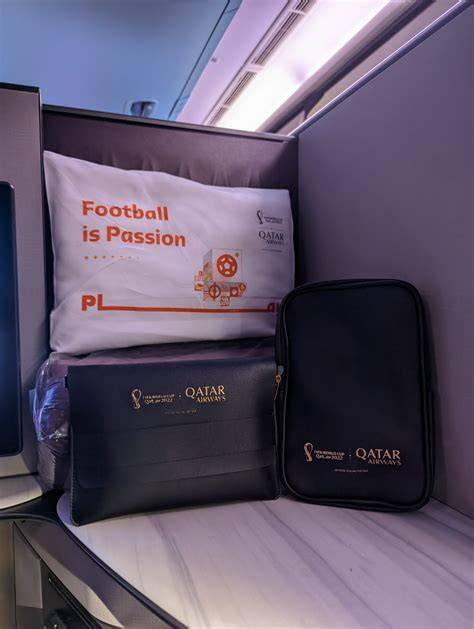
The gap between cabins has widened alongside that retreat. Qatar Airways’ premium cabins continue to draw attention for their luxury-branded kits, particularly since its partnership with the French perfumer Diptyque, which supplies scented body care, face creams and eau de toilette in stylish pouches. The economy kit, by contrast, has quietly moved from expectation to possibility. The airline’s reputation for service remains intact, but the product hierarchy is now explicit: the back of the plane receives the basics, and only when the route earns them.
Why Economy Amenity Kits Are Disappearing From Most Cabins
The decline has three drivers, and all three point in the same direction. Cost pressure and unbundled fare models have made every inclusion a line item to be justified against the price of the cheapest seat, and airlines have found that removing kits rarely changes a purchase decision, especially when the fare is chosen largely on schedule and price. Sustainability commitments have made disposable plastic pouches, wrapped toothbrushes and unclaimed items a visible liability, and reducing or removing them is one of the easiest waste wins a carrier can claim. Operational targeting has done the rest: where kits survive, they are aimed at ultra-long-haul or overnight services where comfort needs peak and cabin lighting works in the kit’s favor.
The practical result is a product that varies enormously by route, departure time and aircraft. A passenger can fly a seven-hour overnight flight on a full-service carrier and receive a pouch, or fly the same airline’s daytime equivalent of nearly the same length and receive nothing. For travelers, the lesson is to assume nothing, pack an eye mask, earplugs and a toothbrush from home, and treat any kit as a bonus. For airlines, the remaining kits are a low-cost differentiation tool in a cabin where differentiation is genuinely rare, and that is precisely why a small group of carriers still hand them out.
What the Luxury Cabins Reveal About the Rest of the Aircraft
The contrast at the other end of the aircraft explains a great deal. The most elaborate amenity kits in 2026 sit in first and business class, where Emirates has partnered with Italian luxury house Bvlgari on kits containing exclusive fragrances, premium toiletries and even gold-lacquered mirrors in collectable faux-leather pouches. Qatar Airways’ Diptyque kits hold scented body care, face creams and eau de toilette in pouches designed to be kept. Singapore Airlines has built a long tradition of luxury kits, with first class products from Lalique and other high-end names and business class kits built around premium skincare and sophisticated packaging. These are marketing instruments as much as comfort items, and they are worth their cost because premium fares carry the margin that pays for them. Economy kits operate on the opposite logic: they must cost almost nothing, survive scrutiny on sustainability grounds, and ideally become a walking advertisement. Etihad’s printed tote, Qantas’ recycled felt pouch and Emirates’ conservation artwork each satisfy that brief, which is why they survive while generic plastic-wrapped kits have gone.