That number printed on a seat-map legend rarely tells the whole story. Most mainline economy cabins settle between 17 and 18 inches (43 to 45 cm) of seat width, and a large share of US-carrier widebody seats now sit at the hard edge of 17 inches. A small group of airlines refuses to play along: Japan Airlines, Korean Air, Singapore Airlines, Asiana, Cathay Pacific, and a handful of regional-jet specialists such as JetBlue, Delta, and Breeze keep genuine elbow room in the cheapest cabin. A few carriers go the other way, most famously the French low-cost carrier French Bee, whose A350-1000s squeeze seats down to 16.7 inches. For 2026, the widest economy seat in the sky belongs to a United Airlines rival from Tokyo, and the margin is almost invisible on paper but unmistakable in row 54.
Why Aircraft Cabin Width Decides Economy Seat Width
Airlines do not invent seat width. Fuselage geometry hands them a fixed cabin cross-section, and the row count per side does the rest. An Airbus A320 or Boeing 737 is always configured six abreast, an Airbus A220 five abreast, an Airbus A350 or Boeing 787 typically nine abreast, and a Boeing 777 typically ten abreast. Whether a passenger settles into Ryanair’s 737 with 17-inch seats or Southwest’s 737 with roughly 17.8-inch cushions, the cabin interior is still about 11.62 feet (3.54 meters) wide with six passengers in each row, so the arithmetic barely moves. Within that constraint, carriers have a thin toolbox: thinner sidewall and insulation panels (worth roughly 0.3 to 0.6 inches per seat), slimmer armrests, marginally narrower aisles, revised seat shells, and denser cushioning. Cutting armrest width is the favored trick because removing a whole seat row costs revenue, but a thinner divider does not actually move passengers further apart. The lesson for travelers is blunt: judge a seat by its abreast count, not by the marketing adjective attached to it.
Japan Airlines Economy: The Widest Seats on a Mainline Carrier
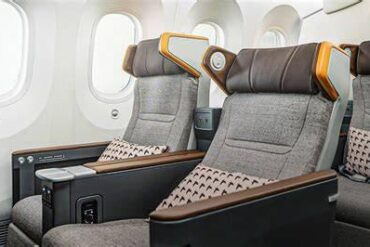
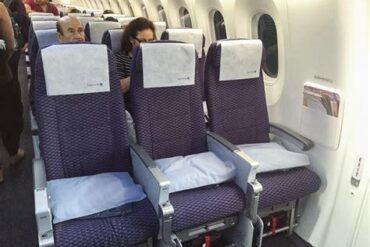
Japan Airlines holds the crown. It is one of the last airlines still configuring the Boeing 777-300ER nine abreast in a 3-3-3 layout rather than the ten-abreast 3-4-3 crush that became standard once the type proved profitable at high density. JAL’s own figures put its JAL SKY SUITE 777 economy seat at approximately 47 cm (about 18.5 inches) and its legacy 767 seat at approximately 45 cm (about 17.7 inches). Airline-by-airline variation across aircraft makes a single “widest” claim difficult to police, but on balance JAL offers the most generous economy footprint of any mainline operator worldwide.
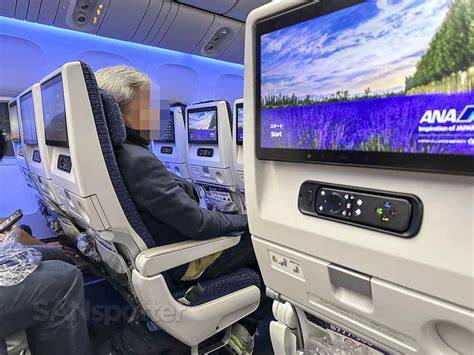
The more remarkable choice sits in JAL’s Dreamliners. The carrier configures its 787 economy cabin eight abreast in a 2-4-2 layout instead of the industry-standard nine-abreast 3-3-3, a decision it says yields an extra 5 cm of seat width. The JAL SKY SUITE 787 therefore comes in at roughly 48 cm (about 18.9 inches). All Nippon Airways flew early eight-abreast Dreamliners too, but later reconfigured them to nine abreast, leaving JAL essentially alone in keeping the roomier 787 cabin. The catch is fleet-dependent. The benefit lands most reliably on long-haul 777-300ER and 787-9 routes, and it vanishes the moment a flight is swapped onto an older 767 or a dense domestic configuration.
Korean Air and the Nine-Abreast 777 Club
Korean Air sits beside JAL in the nine-abreast 777 camp, and its retention of that layout came with a public fight. The airline planned to reconfigure its 777-300ERs to ten abreast and backtracked after a public outcry, a rare instance of passenger protest defeating a densification plan. The question that always follows is whether its 787s will stay eight abreast in the JAL SKY SUITE 787 mould or end up nine-abreast like nearly everyone else’s, and that answer determines whether it keeps pace with its Tokyo rival.
Singapore Airlines, Cathay Pacific, and the A380 Advantage
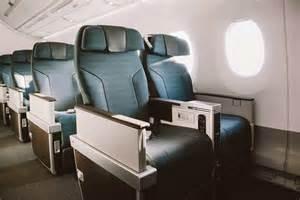
Singapore Airlines has built much of its reputation on the cabin floor. Its widebody economy seats measure roughly 18.5 to 19 inches (47 to 48 cm) on selected aircraft, reaching the top of the mainline range. Cathay Pacific of Hong Kong offers up to 18.5 inches (47 cm), and both carriers configure their 777s nine abreast, preserving the lateral margin their reputations rest on. The Airbus A380 suits them beautifully. Designed to deliver 18 inches as its standard, the double-decker typically serves 17.5 to 18.5 inches depending on the operator, and Airbus has described Singapore Airlines’ A380 economy seat as 18.5 inches wide with improved back support, a six-way adjustable headrest with foldable wings, and an ergonomically designed footrest with adjustable positions.
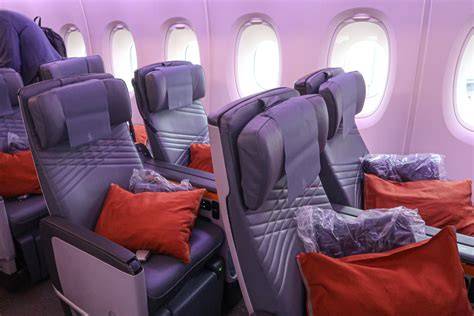
Asiana Airlines proves that a second-tier Korean carrier can lead on width. Its A380s, 747-8s, and 777s advertise seats of 18 to 18.9 inches, with its A380 economy cabin quoted at 18.9 inches alongside 33 inches (83.8 cm) of pitch. Korean Air’s own A380s run 18.1 inches with 33 to 34 inches of pitch. ANA, JAL’s main domestic and international rival, offers around 18 inches on each of its three A380s. Delta’s A220s aside, the three big US carriers rarely appear anywhere near the top of this table, though JetBlue and the A220 operators deserve separate treatment.
The Aircraft That Produces Wide Seats: A380, A220, A350, and 787
Engineers, not marketers, decide which aircraft travelers should hunt. The A380 was engineered around 18-inch seats, so even its ten-abreast cabins, as flown by Emirates, Singapore Airlines, and others, often hold up better than a ten-abreast 777. The Airbus A220, originally the Bombardier CSeries, is the narrowbody surprise: five abreast in a 2-3 configuration gives it unusually wide seats for its size, and Delta, JetBlue, Breeze, and Air Canada all exploit that. The A350 also over-performs relative to its narrower fuselage because it is normally nine abreast, and the new production standard added another four inches of usable cabin width through thinner walls.
The Boeing 777 is the clearest cautionary tale. The 777-300ER was designed to seat nine abreast comfortably, and it is a physically wider aircraft than the A350, yet almost every operator now crushes in ten abreast. On United and American, that translates into seats of 17 inches or narrower, while an A350 passenger in a supposedly tighter aircraft often gets more room at the shoulder. The A350 can legally seat ten abreast, and the stretched A350-1000 has the exit limit for up to 480 passengers, but only a handful of low-cost operators attempt it. French Bee’s 480-seat A350-1000s deliver that 16.7-inch (42.4 cm) seat, and its Premium Blue cabin recovers the loss with a 2-4-2 layout of 18 to 19-inch seats.
JetBlue, Delta, and Breeze: America’s Widest A220 Seats
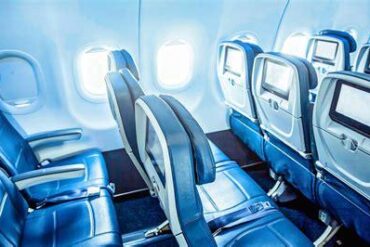
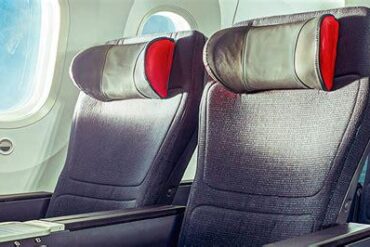
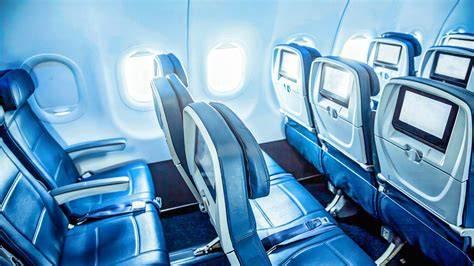
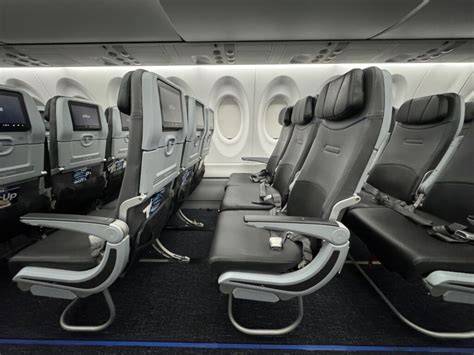
JetBlue is the US carrier to beat. Its economy seat width spans roughly 17.3 to 18.6 inches, with the widest seats on its A220-300s, and it lists its A320s and A321s at 18 inches, with the A320 Classic at 17.8 inches. On the A220, seats in the AC pair measure 18.5 inches while those in the DEF trio reach 19 inches, the widest economy seat any US airline sells. Delta, the world’s largest A220 operator, offers 18.6 inches (47 cm) in Delta Main and 18.1 inches (46 cm) in Delta Comfort. Breeze Airways fits 18-inch seats with just 30 inches of pitch, wide but tight front-to-back, so legroom and width must be weighed together.
Southwest Airlines and the 737 Width Paradox
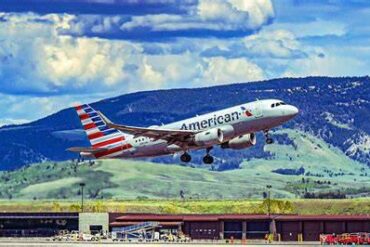
Southwest Airlines should not be in this conversation. The 737, designed in the 1960s, is roughly seven inches (about 18 cm) narrower inside than the 1980s-designed A320, yet both fly six abreast. Southwest closes the gap anyway, using slimmer armrests, thinner seat backs, and optimized cushioning to hand more width to the seat bottom and hip area, and its 737 MAX 8s and retrofitted 737-800s deliver roughly 17.8 inches. The comparison inside that market segment is unflattering to rivals: American typically offers 17 inches, United up to 17.3 inches, and Delta around 17.5 inches. Southwest also used to be the only major US carrier letting plus-sized travelers request an extra seat at no charge, a policy it changed by January 2026, when it began stating that passengers who “encroach upon the neighboring seat(s) should proactively purchase the needed number of seats prior to travel”. That matches the US industry norm of paying for an extra seat or upgrading to a premium cabin.
How to Find the Widest Economy Seat in 2026
The decision tree is short. Book a Japan Airlines 787 if the 2-4-2 Dreamliner cabin is scheduled, and check the aircraft type immediately before departure. Choose a nine-abreast 777 from JAL, Korean Air, or Singapore Airlines over a ten-abreast 777, and treat any ten-abreast 777 as a warning about narrow shoulders. Prefer any A380, where the design floor of 18 inches keeps the worst outcomes tolerable, and opt for the A350 over a densified 777-300ER on long-haul routes. On short-haul services, take the A220 wherever JetBlue, Delta, or Breeze flies it, and remember that Southwest’s 737s genuinely beat most US domestic economy seats despite the older airframe. Window and aisle seats on a two-seat side come with an armrest that cannot be contested, an advantage no spec sheet captures. Seat width is chosen in the airline’s planning office, but the row a traveler selects decides whether that choice reaches the armrest in row 34.