Commercial aviation has always been a study in compromise. Airlines juggle range, fuel burn, fleet commonality, and revenue per square meter of cabin space. Passengers, meanwhile, measure the experience in far simpler terms: How much room do I actually have? In 2026, the battle for comfort in economy class is increasingly defined by a single, tangible metric—seat width.
Across most long-haul fleets, economy seats hover between 17 and 18 inches wide. That single inch may look trivial on paper, but in the confined geometry of a pressurized aluminum tube, it can determine whether a transpacific flight feels survivable or punishing. A handful of airlines, however, are deliberately resisting the industry trend toward denser layouts. They are preserving wider cabins, fewer seats abreast, and in some cases, restoring configurations that most competitors abandoned years ago.
By 2026, these airlines stand out for offering the widest economy seats in the world—not by accident, but by design.
Japan Airlines: The Benchmark for Wide Economy Seats
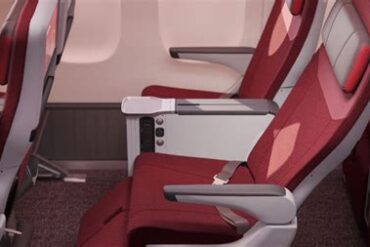
Japan Airlines has quietly established itself as the global benchmark for economy class seat width. While most airlines configure the Boeing 777-300ER ten-abreast in economy (3-4-3), JAL maintains a nine-abreast layout (3-3-3). That decision alone transforms the onboard experience.
In numerical terms, JAL’s Boeing 777-300ER seats measure approximately 18.5 inches (47 cm) wide. On its Boeing 767 fleet, seats measure around 17.7 inches (45 cm). These figures may seem incremental compared to competitors, but the real story lies in the structural tradeoff: removing an entire seat per row across a widebody cabin sacrifices revenue density in exchange for shoulder space.
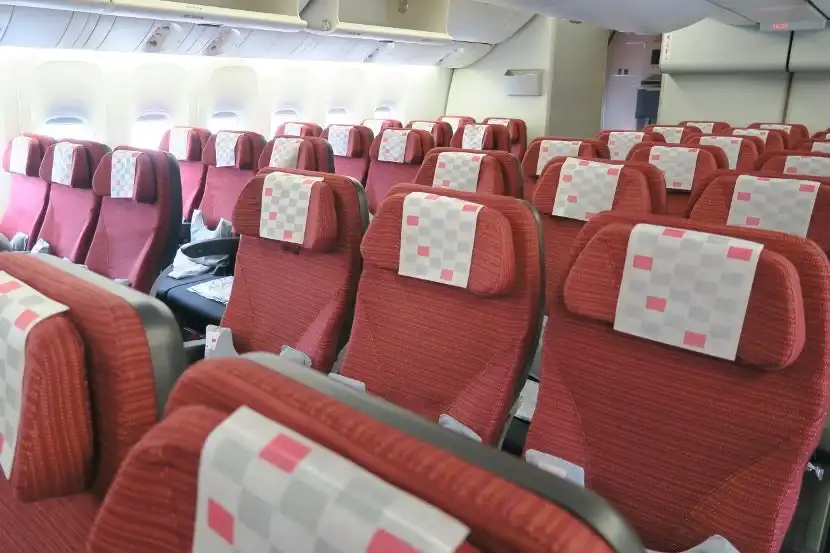
The story becomes even more striking on the Boeing 787. The Dreamliner was designed for nine-abreast economy (3-3-3). JAL configures its 787s eight-abreast (2-4-2), creating seats approximately 18.9 inches (48 cm) wide. That is nearly two inches wider than some 787s operated elsewhere.
In practical terms, this means fewer shoulder collisions, less elbow competition, and a perceptibly calmer cabin environment. For long-haul travelers crossing the Pacific, those extra centimeters accumulate into real fatigue reduction. Japan Airlines’ strategy demonstrates that aircraft design potential and airline configuration philosophy are not the same thing.
Singapore Airlines: Premium Comfort in Standard Economy
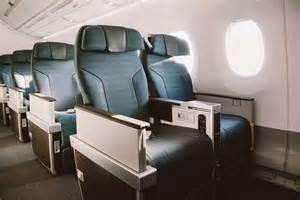
Singapore Airlines has long positioned itself at the premium end of global aviation, and its economy seat width reflects that brand strategy. On many of its widebody aircraft—including Boeing 777s and Airbus A350s configured nine-abreast—seat width ranges between 18.5 and 19 inches (47–48 cm).
The Airbus A380, in particular, represents one of the most comfortable economy cabins in operation today. The aircraft was designed with 18-inch seats as a baseline. Singapore Airlines pushes that envelope slightly further, pairing width with ergonomic sculpting, reinforced lumbar support, and adjustable headrests with foldable wings.
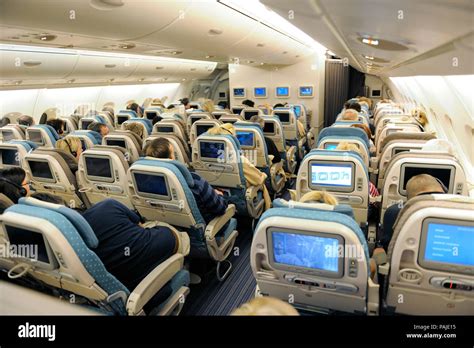
The A380’s double-deck design also contributes to psychological spaciousness. Cabin height, lighting architecture, and sidewall curvature all influence how width is perceived. A seat that measures 18.5 inches inside a well-designed cabin feels meaningfully different from the same dimension in a tighter fuselage.
Singapore Airlines proves that economy comfort can be a strategic differentiator rather than a casualty of yield optimization.
Korean Air and Asiana: Preserving Nine-Abreast 777 Layouts
Korean Air remains one of the few carriers globally to configure the Boeing 777-300ER nine-abreast. In an era where 3-4-3 layouts dominate, this choice preserves seat widths around 18 inches or slightly more, depending on subfleet.
When Korean Air briefly signaled plans to reconfigure to ten-abreast, public reaction was swift and negative. The carrier ultimately retained its wider layout, reinforcing the notion that seat width is not merely a technical detail—it is part of brand identity.
Asiana Airlines, in the process of integration with Korean Air, historically offered 18 to 18.9-inch-wide seats on aircraft such as the Airbus A380 and Boeing 747-8. On its A380 fleet, economy passengers benefit from approximately 18.9 inches of seat width and 33 inches of pitch, creating one of the most generous standard-class experiences in Asia.
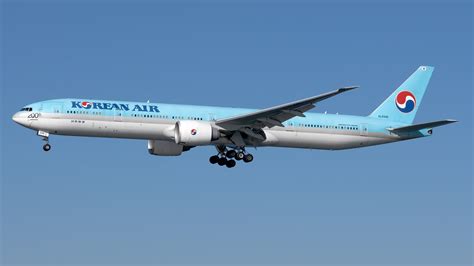
These carriers illustrate a broader trend among certain Asian airlines: resisting extreme densification on long-haul fleets in favor of passenger comfort metrics that remain measurable and marketable.
Airbus A380: Engineering Wide Seats by Design
The Airbus A380 deserves special attention. From inception, it was engineered to provide 18-inch economy seats as standard, something Boeing’s 777 originally offered only at nine-abreast before market forces drove densification.
In practice, A380 economy seats range from 17.5 to 18.5 inches, depending on configuration. Airlines such as Emirates, Singapore Airlines, and ANA utilize ten-abreast layouts (3-4-3), yet still deliver widths comparable to or better than many narrower twinjets configured more tightly.
The aircraft’s 10-abreast configuration does not carry the same compression penalty seen on 777s configured 10-abreast because the A380’s main deck cabin cross-section is inherently broader. As a result, even when fully optimized, the seat experience remains comparatively generous.
This underscores a crucial distinction: aircraft cabin width and seat width are not identical variables. Configuration decisions mediate the relationship between structural potential and passenger reality.
Airbus A350 vs. Boeing 777: The Cabin Geometry Paradox
The Boeing 777-300ER is physically wider than the Airbus A350. Yet in 2026, passengers often experience wider seats on the A350. The reason is straightforward: configuration density.
Most 777-300ER operators configure ten-abreast seating, reducing seat widths to around 17 inches or slightly less. Airlines such as United and American exemplify this approach. Meanwhile, most A350 operators maintain nine-abreast layouts, typically delivering 18-inch seats.
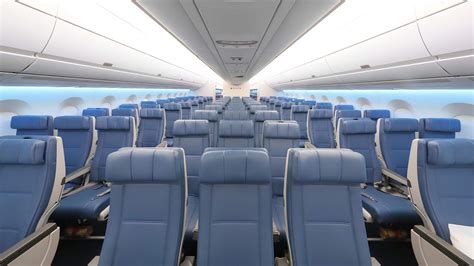
Airbus refined the A350’s interior sidewalls, gaining approximately four additional inches of usable interior space compared to earlier standards. That marginal gain supports consistent 18-inch seats without sacrificing aisle width.
However, configuration extremes exist. French Bee operates high-density A350-1000 aircraft seating up to 480 passengers, with economy seat widths of 16.7 inches (42.4 cm). In that layout, the theoretical spaciousness of the A350 gives way to maximum capacity economics.
The lesson is simple: aircraft capability does not guarantee passenger comfort. Airline strategy ultimately defines the lived experience.
The Airbus A220: The Narrowbody With Unexpected Space
Among single-aisle and regional aircraft, the Airbus A220 stands apart. Originally developed as the Bombardier CSeries, the A220 features a five-abreast configuration (2-3), immediately granting it an advantage over six-abreast Boeing 737 and Airbus A320 cabins.
JetBlue’s A220-300 offers seats measuring 18.5 inches on the two-seat side and 19 inches on the three-seat side. These are some of the widest economy seats in North America on a narrowbody aircraft.
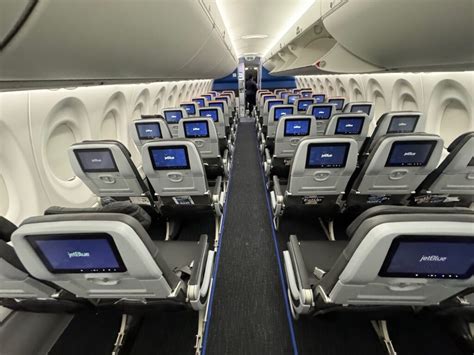
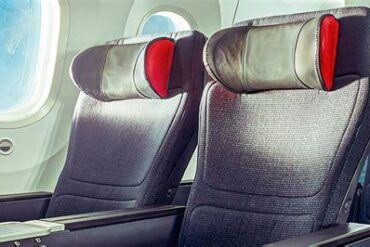
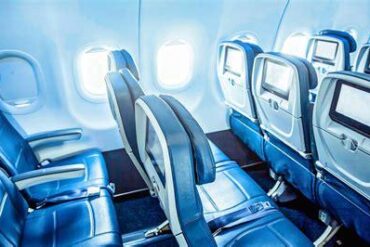
Delta Air Lines, the world’s largest A220 operator, provides 18.6-inch-wide seats in Delta Main. Breeze Airways and Air Canada also maintain approximately 18-inch widths.
The geometry matters. Because the A220 was designed from scratch in the 21st century, its cabin cross-section optimizes window alignment, shoulder clearance, and aisle width in a way legacy narrowbodies cannot easily replicate. In medium-haul markets, the A220 has become an unexpected champion of lateral comfort.
JetBlue: A Consistent Commitment to Width
JetBlue’s broader fleet strategy reinforces its comfort-oriented brand. Across much of its Airbus A320 and A321 fleet, economy seat widths measure around 18 inches. Even its older A320 Classic aircraft maintain approximately 17.8 inches, above many competitors.
On longer domestic and transatlantic routes, this width advantage compounds with relatively competitive seat pitch, creating a product that consistently exceeds U.S. legacy carrier norms. While the difference between 17.3 and 18 inches might appear modest, shoulder clearance increases perceptibly, particularly for larger passengers.
In a market segment often driven by fare wars, JetBlue’s width strategy functions as quiet differentiation.
Southwest Airlines: Maximizing Space Within Constraints
Southwest Airlines operates exclusively Boeing 737 aircraft, a type narrower than the Airbus A320 family by approximately seven inches in cabin width. Yet Southwest manages to deliver seats around 17.8 inches wide, slightly exceeding many U.S. competitors flying the same aircraft type.
This is achieved through thinner armrests, optimized seat-back structures, and refined cushioning geometry. The physical cabin envelope does not change—the Boeing 737 remains 11.62 feet wide internally—but micro-optimizations redistribute space to the seat base.
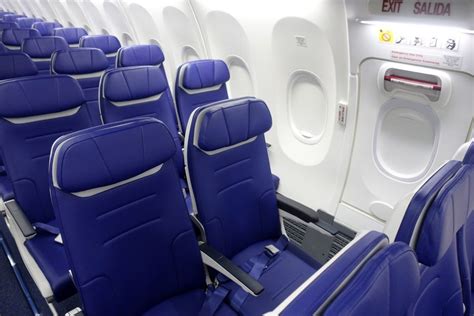
These engineering adjustments demonstrate how marginal design tweaks can meaningfully influence passenger perception. While Southwest does not compete with the 18.5-inch champions of Asia, it maximizes width within a constrained fuselage.
Why Seat Width Matters More Than Ever in 2026
As long-haul traffic rebounds and ultra-long-range routes proliferate, economy seat width becomes more consequential. Flights exceeding 14 hours amplify every spatial compromise. Shoulder overlap, armrest negotiation, and hip clearance accumulate into fatigue.
Airlines cannot easily alter fuselage diameter, but they can choose how many passengers share it. The decision between nine- and ten-abreast seating on a 777 translates directly into nearly two inches per passenger. Over hundreds of seats per aircraft, that decision represents millions in potential annual revenue—yet also millions in perceived brand value.
In 2026, the airlines offering the world’s widest economy seats are not merely delivering comfort. They are signaling priorities. Japan Airlines, Singapore Airlines, Korean Air, select A380 operators, and A220-heavy carriers such as JetBlue and Delta demonstrate that space can remain part of the value proposition.
The numbers tell the story plainly. While 17 inches remains common, true comfort leaders consistently deliver 18 to 19 inches in standard economy. In a world where cabin densification has become routine, those extra centimeters are acts of defiance—small rebellions in aluminum and composite.
For passengers willing to choose airlines strategically, width is no longer hidden in technical seat maps. It is measurable, searchable, and increasingly decisive. The sky in 2026 may be crowded, but on the right aircraft, it is still wide enough to breathe.