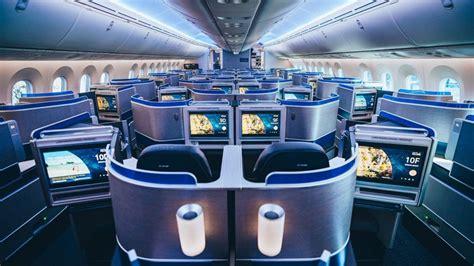
Business class in 2026 is no longer a polite upgrade from economy. It has become a battleground of square inches, shoulder room, and sleeping real estate. Airlines now compete not only on champagne labels and designer amenity kits, but on the measurable geometry of comfort. Seat width, once a footnote in technical specifications, has evolved into one of the most decisive factors separating a merely good premium cabin from an extraordinary one.
Direct aisle access is now standard. Lie-flat beds are expected. Privacy doors are increasingly common. Yet true spaciousness remains rare. Many modern business-class cabins rely on clever angles, staggered layouts, and optical tricks to simulate roominess inside tightly packed fuselages. Only a handful of airlines have chosen a more radical path: reduce density, sacrifice seat count, and deliver genuinely expansive personal space.
This ranking examines the five airlines offering the widest business class seats in 2026, measured by physical width and usable horizontal footprint rather than brand prestige or perceived luxury. The result highlights which carriers have truly prioritized room to stretch, turn, dine, and sleep without restriction.
Air France Business Class: Design-Led Comfort Within Traditional Dimensions
Air France has invested heavily in redefining its long-haul business class over the past decade. The latest generation cabin features sliding privacy doors, refined upholstery, mood lighting, and a distinctly French sense of understated elegance. The aesthetic coherence is immediate: soft greys, brushed metallic accents, and carefully layered textures create an atmosphere that feels curated rather than engineered.
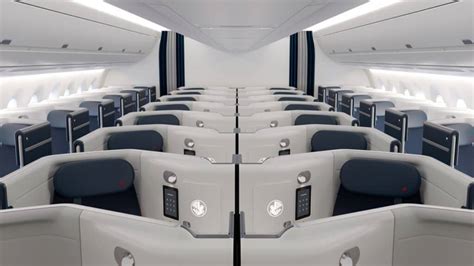
Despite these enhancements, seat width generally ranges between 21 and 23 inches, placing Air France squarely within conventional industry proportions. The airline has not pursued extreme expansion of physical dimensions. Instead, it focuses on spatial harmony. Storage compartments are discreetly integrated. Surfaces feel uncluttered. The visual field remains calm.
When seated upright, the space feels composed rather than vast. Shoulder room is adequate, and the bed converts into a comfortable flat surface, yet the footprint remains disciplined. Air France’s strategy prioritizes ambiance and material refinement over radical geometry. For travelers who value polished design and balanced proportions, this restraint works beautifully. However, in a ranking driven strictly by width, it does not challenge the leaders.
Air France demonstrates that sophistication does not require maximum girth. Still, those seeking the broadest sleeping platform in the sky will find larger canvases elsewhere.
Cathay Pacific: Reverse-Herringbone Precision and Controlled Space
Cathay Pacific’s long-haul business class relies on the widely respected reverse-herringbone configuration. Seats angle away from the aisle, creating a cocooned environment that enhances privacy without requiring fully enclosed suites. The layout is elegant and efficient, a careful orchestration of geometry inside a widebody fuselage.
Seat width typically measures 20 to 21 inches, depending on aircraft type. On paper, these figures appear modest. Yet Cathay Pacific compensates through meticulous ergonomic shaping. The cushioning supports natural posture, and the side console placement allows passengers to settle without feeling exposed.
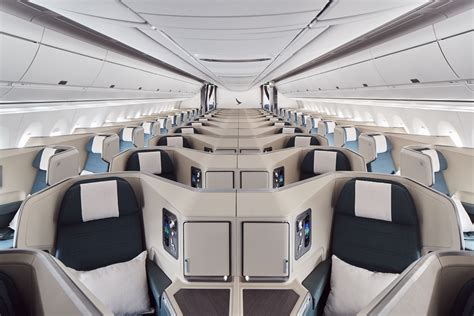
The fully flat bed delivers strong sleep quality, aided by premium bedding and subtle cabin lighting. However, the inherent compromise of the reverse-herringbone design is lateral limitation. The footwell narrows toward the bottom, and shoulder freedom, while sufficient, does not approach the breadth seen in more space-forward products.
Cathay Pacific represents a philosophy of disciplined engineering. Rather than stretching dimensions, it refines them. The result is a cabin that feels orderly, composed, and intelligently arranged. It excels in privacy and functionality, but it does not compete for the title of widest business class seat in 2026.
Qatar Airways Qsuite: Spatial Engineering Over Raw Width
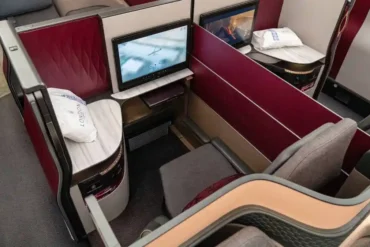
Few business class products have reshaped industry expectations as dramatically as Qatar Airways’ Qsuite. Its introduction signaled a shift toward modularity and privacy, complete with sliding doors and movable panels that allow multiple seating configurations. Couples can convert center seats into a double bed. Groups of four can create a shared quad suite. The adaptability remains unmatched.
Physically, the seat measures approximately 21 to 22 inches wide, aligning with standard premium cabin dimensions. Qsuite’s innovation lies not in expansion, but in spatial manipulation. High walls and enclosed doors transform perception, giving passengers a private, first-class–like enclosure without increasing the seat’s horizontal measurement.
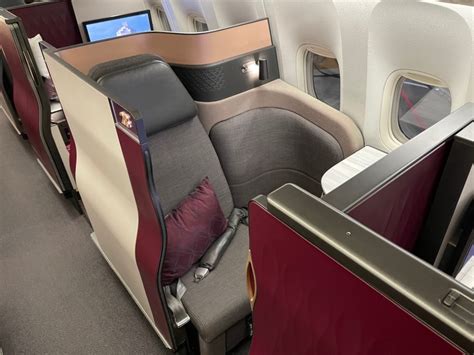
The cabin feels immersive. Lighting is adjustable. Surfaces are textured and layered. The psychological effect is significant. Enclosure often enhances perceived space, even if actual width remains conventional. This is architectural illusion executed at 35,000 feet.
Yet measured strictly by inches, Qsuite does not approach the upper tier. Its brilliance is experiential rather than dimensional. Travelers who value privacy, flexibility, and seclusion will find it exceptional. Those seeking maximum shoulder clearance and bed width will look further up the ranking.
Singapore Airlines: Expansive Traditional Seating at 30 Inches Wide
Singapore Airlines takes a different approach. Rather than enclosing passengers within high partitions, it emphasizes sheer physical breadth. On aircraft such as the Airbus A350 and Boeing 777, its long-haul business class seats measure approximately 28 to 30 inches in width, making them among the widest conventional business class seats currently in service.
This width is immediately noticeable. Shoulders rest naturally without brushing against side panels. Dining feels spacious rather than confined. Laptop use does not encroach on elbow territory. The sense of openness is architectural rather than cosmetic.
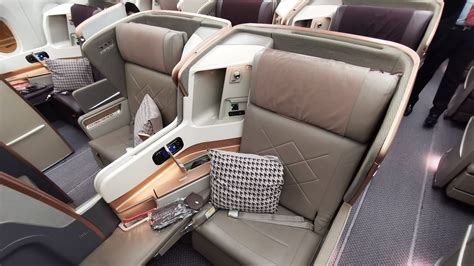
When converted into a bed, the sleeping surface maintains substantial width across the torso. Unlike many staggered configurations that taper at the feet or hips, Singapore Airlines’ design preserves lateral consistency. The bed feels stable, broad, and closer to a first-class platform than a typical business seat.
There are no sliding doors. Privacy relies on shell design and seat positioning. Yet the absence of enclosure does not diminish comfort. In fact, some travelers prefer the freedom of movement that comes with an open layout.
Singapore Airlines demonstrates that in-flight luxury can be defined by generous dimensions alone. At roughly 30 inches wide, it establishes a clear separation from standard 21-inch seats and secures its place near the top of the industry.
All Nippon Airways “The Room”: The Widest Business Class Seat in the World
At the summit stands All Nippon Airways’ “The Room.” Installed on select Boeing 777-300ER aircraft, this product reimagines what business class can physically occupy inside a widebody cabin. ANA did not simply widen a seat. It reallocated space entirely.
The usable horizontal footprint measures approximately 35 to 38 inches, depending on measurement methodology. That figure places The Room in a category of its own. The breadth is not subtle. It is immediate and transformative.
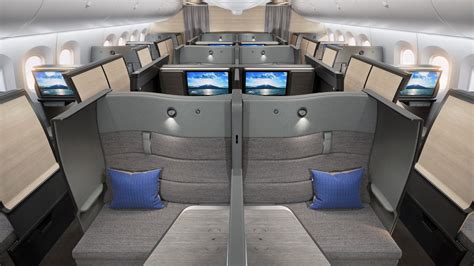
Seated upright, passengers experience unrestricted shoulder movement. The side console feels like part of the living area rather than a boundary. When reclined into bed mode, the sleeping surface remains remarkably wide, eliminating the constriction common in staggered designs. Turning during sleep does not require negotiation with armrests or walls.
Sliding doors add privacy, but they are secondary to the defining characteristic: scale. The Room feels closer to international first class than traditional business class. The cabin sacrifices density to achieve this. Fewer seats occupy the same fuselage space compared to typical layouts. That tradeoff is deliberate.
ANA’s design philosophy centers on uncompromised personal territory. In a market obsessed with efficiency, this decision stands out as almost rebellious. The result is the widest business class seat in 2026, and no competitor currently matches its horizontal expanse.
Why Seat Width Matters More Than Ever in 2026
Seat width directly affects comfort in ways marketing language cannot disguise. At cruising altitude, subtle constraints amplify. Narrow shoulders become pressure points. Limited elbow room turns meals into balancing acts. Constricted bed surfaces disrupt sleep cycles.
As ultra-long-haul flights exceeding 15 hours become increasingly common, lateral freedom becomes critical. Wider seats allow natural posture shifts, improve circulation, and reduce fatigue. The difference between 21 inches and 30 inches is not cosmetic; it alters biomechanics over extended periods.
The aviation industry often emphasizes technological innovation, but the human body remains constant. Hips, shoulders, and spines respond predictably to space. Airlines that expand horizontal dimensions acknowledge this biological reality.
In 2026, only a select group of carriers have chosen to prioritize this measurable form of comfort. Singapore Airlines delivers expansive traditional seating. ANA redefines scale entirely. Others rely on precision engineering and privacy solutions rather than pure width.
The hierarchy is clear. For travelers seeking the widest business class seats in the world, ANA’s The Room leads decisively, followed by Singapore Airlines’ broad long-haul seats. Qatar Airways, Cathay Pacific, and Air France offer refined, innovative, and aesthetically impressive cabins, but they remain within conventional dimensional limits.
The evolution of business class continues. Some airlines pursue density. Others pursue enclosure. A rare few pursue genuine spatial generosity. In the end, inches matter. At 35,000 feet, personal territory is the final frontier, and in 2026, a handful of airlines have chosen to expand it boldly.