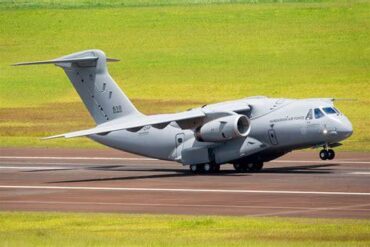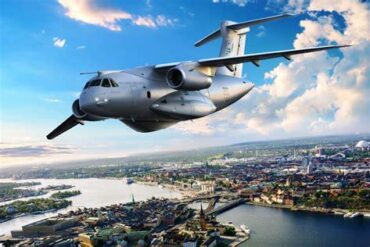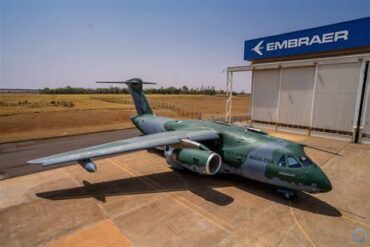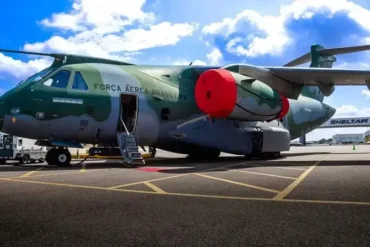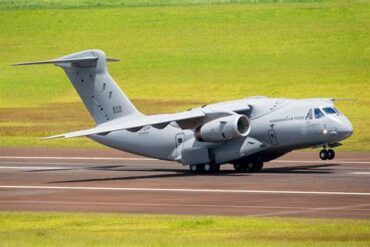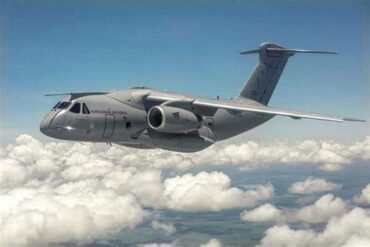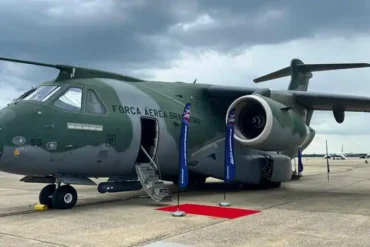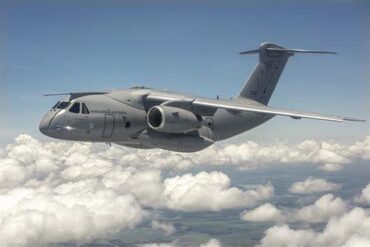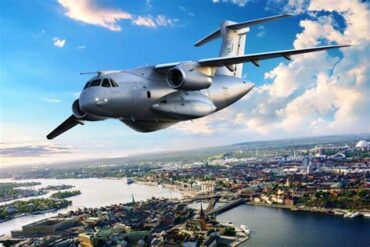
Embraer’s KC-390 Millennium has quietly become one of the most successful new military transport aircraft programs outside the United States. What began as an ambitious Brazilian effort to replace the country’s aging C-130 fleet has developed into a European defense success story, with the aircraft now selected or contracted by a growing group of NATO nations. Five NATO air forces have formalized purchases of the aircraft: Portugal, Hungary, the Netherlands, the Czech Republic, and Sweden. Austria, which is also buying the aircraft, is not a NATO member.
The momentum is particularly significant because the C-390 sits in a difficult but increasingly important space between tactical airlifters such as the Lockheed Martin C-130 Hercules and much larger strategic transports such as the Boeing C-17 Globemaster III. It combines a high-speed turbofan-powered airframe with a substantial cargo compartment, tactical runway capability, aerial refueling equipment, and a multi-mission design. That combination has made it attractive to European air forces searching for a modern C-130 replacement without buying an aircraft that is unnecessarily large for their requirements.
Yet there is an extraordinary contradiction at the heart of the KC-390’s growing international success. European NATO members are increasingly embracing an aircraft that appears well suited to dispersed operations, austere airfields, rapid logistics, and modern coalition warfare. The United States Air Force, meanwhile, has shown no comparable appetite for buying the Brazilian-designed aircraft—even while struggling with an aging KC-135 tanker fleet, delays and deficiencies surrounding the KC-46A Pegasus, and an increasingly urgent need to operate from distributed locations.
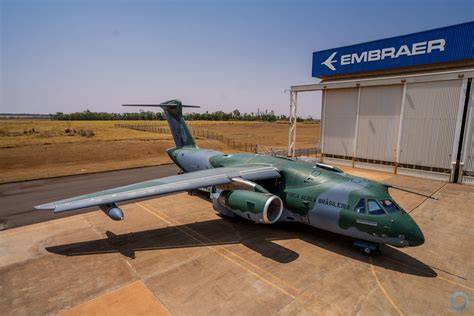
The KC-390 Has Become a European C-130 Replacement
The most important development is not simply the number of aircraft sold. It is who is buying them and why. European operators have generally viewed the KC-390 as a replacement for aging C-130 fleets while gaining capabilities that go beyond traditional tactical airlift.
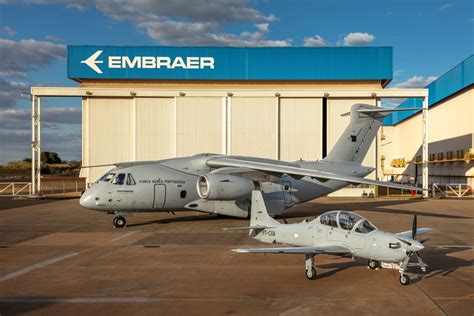
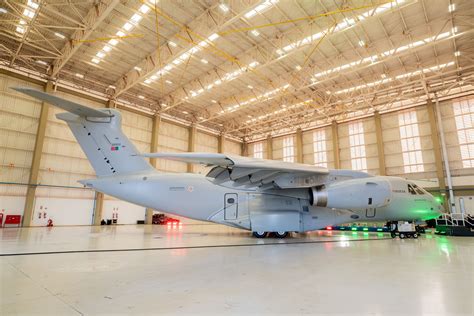
Portugal became the first international KC-390 customer and received its first aircraft in 2023. Hungary followed with its own aircraft, receiving the first in September 2024 and the second in November 2025. The Netherlands signed for five aircraft, while Austria ordered four through a joint procurement arrangement with the Dutch government. The Czech Republic contracted for two, and Sweden later signed for four. Portugal subsequently ordered a sixth aircraft and added options intended to facilitate future purchases by partner nations.
The Czech Republic provides a particularly useful example of the program’s maturation. Embraer delivered the country’s first C-390 in July 2026, only 20 months after the acquisition agreement was signed. The aircraft was delivered in a NATO-standard configuration, reinforcing the growing interoperability of the type within European military structures.
That European customer base matters because military transport aircraft are rarely purchased simply as isolated machines. They become part of a logistics ecosystem involving training, maintenance, spare parts, tactical doctrine, simulators, interoperability standards, and multinational exercises. As more European operators adopt the KC-390, the platform becomes increasingly useful to each additional customer because the aircraft can operate inside an expanding regional support and operational network.
Why the Millennium Fits Modern European Warfare
The KC-390 was designed around a different philosophy from the traditional C-130. It retains the ability to operate from difficult and relatively austere airfields, but it uses turbofan engines rather than turboprops. That gives the Millennium a substantially higher cruise speed and changes how it can fit into modern air operations.
Embraer states that the C-390 can carry up to 26 metric tons of cargo and operate from temporary or unpaved runways. The company has also highlighted its ability to perform troop and cargo transport, aeromedical evacuation, search and rescue, firefighting, humanitarian missions, and aerial refueling.
This combination is particularly attractive to countries that need one aircraft to perform several missions. A European air force does not necessarily require hundreds of specialized aircraft. Instead, it can obtain a relatively compact fleet capable of moving troops and equipment, supporting disaster relief, evacuating casualties, transporting oversized loads, and providing fuel to compatible aircraft.
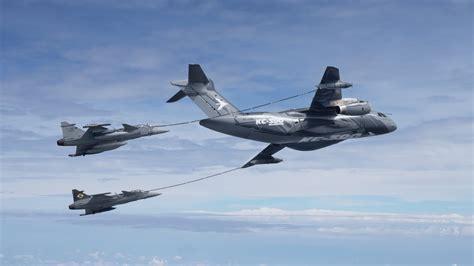
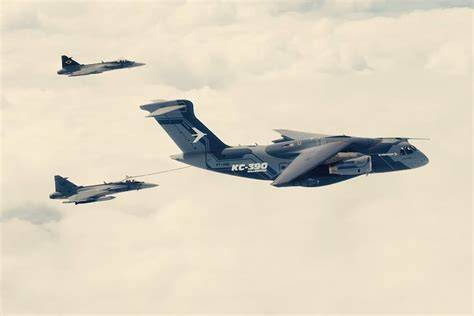
The aircraft’s speed is also strategically relevant. A turbofan-powered tanker or transport can operate at higher speeds than a propeller-driven Hercules. During aerial refueling, that difference can reduce the degree to which fast fighter aircraft must slow down to remain behind the tanker. In an environment where every minute spent in a predictable location can matter, faster transit and refueling can translate into greater operational flexibility.
The C-390 is therefore not simply a faster C-130. It represents a different interpretation of what a medium military airlifter should provide in an era of distributed operations.
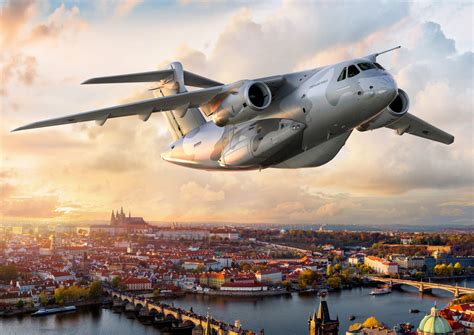
Agile Combat Employment Changes the American Equation
At first glance, the KC-390 seems to have an obvious application inside the United States Air Force’s Agile Combat Employment concept. ACE seeks to make American airpower harder to destroy by dispersing aircraft and personnel across a wider network of operating locations instead of concentrating combat forces at a small number of large bases.
The concept is especially important in the Indo-Pacific. A conflict involving China would place enormous pressure on American air bases, runways, fuel storage facilities, command centers, and logistics hubs. Large fixed installations are valuable because they concentrate infrastructure, but that same concentration can make them attractive targets.
A dispersed force requires aircraft capable of moving people, fuel, weapons, spare parts, and equipment between locations that may be far less developed than traditional American air bases.
This is where the KC-390 appears particularly interesting. A Boeing KC-46A Pegasus is a large strategic tanker optimized around enormous fuel capacity and long-range operations. The KC-390 is much smaller and was designed from the beginning to function as a tactical airlifter as well as a tanker.
That difference could make the Brazilian aircraft useful for missions where a KC-46 would simply be too large, too infrastructure-dependent, or unnecessarily expensive to deploy.
The challenge is that the USAF’s requirements are not identical to those of European air forces.
The Fuel Capacity Problem Is Impossible to Ignore
The biggest obstacle is simple: the KC-390 does not carry anything close to the amount of fuel carried by the KC-46A or KC-135.
The figures cited in the reference material illustrate the fundamental mismatch. The KC-390 carries roughly 70,000 pounds of fuel, while the KC-46A can carry approximately 212,000 pounds and the KC-135 roughly 200,000 pounds.
That is not a minor difference. It fundamentally changes the aircraft’s role.
The USAF operates aerial tankers as strategic infrastructure. A KC-135 or KC-46 can remain part of a long-range air campaign while transferring large quantities of fuel to multiple aircraft. Replacing a KC-135 with a KC-390 on a one-for-one basis would therefore make little sense if the objective were simply to preserve the same refueling capacity.
The USAF could buy several smaller tankers to compensate, but that would create another problem: more aircraft, more crews, more maintenance personnel, more spare parts, more basing requirements, and more logistical overhead.
In other words, the KC-390’s strongest argument is also the reason it cannot simply replace the KC-135.
It is a different class of solution.
The Missing Boom Has Been a Major American Roadblock
There is another technical reason the USAF has historically had limited interest in the KC-390: its aerial refueling architecture has not matched the requirements of the American tanker fleet.
The aircraft has demonstrated aerial refueling using underwing pods and probe-and-drogue equipment. That is highly useful for many aircraft, including compatible fighters and other KC-390s. However, the USAF relies heavily on the flying boom system.
This distinction is crucial because many major American aircraft are designed around boom refueling rather than probe-and-drogue operations. A KC-390 without a fixed boom would therefore have a much smaller addressable customer base inside the U.S. military.
Embraer and American defense companies have recognized the problem. The company has pursued partnerships aimed at developing a boom-equipped version of the aircraft, initially working with L3Harris and later pursuing cooperation with Northrop Grumman. The objective is to expand the aircraft’s compatibility with U.S. Air Force, Navy, and Marine Corps aircraft.
That could remove one of the largest technical barriers.
But removing a technical barrier does not automatically create a procurement program.
The KC-46 Problem Is Bigger Than the KC-390 Opportunity
The temptation is to look at the KC-46 program’s difficulties and conclude that the USAF should simply buy the KC-390 instead. The reality is considerably more complicated.
The Pegasus was acquired through a fixed-price development and procurement arrangement, and Boeing has absorbed substantial costs from the program. The aircraft has also experienced significant technical challenges, including problems involving its remote vision system and refueling boom.
Yet the USAF has already invested enormous sums in KC-46 infrastructure, training, maintenance, logistics, engineering, and production. Boeing has established a domestic industrial base around the aircraft, and thousands of American workers are connected to the program.
Abandoning or dramatically reducing the KC-46 in favor of an imported alternative would therefore carry significant economic and political consequences.
The United States does not purchase military aircraft solely by asking which airplane has the best technical specifications. Industrial policy, congressional politics, existing infrastructure, supply chains, workforce considerations, security requirements, and long-term sustainment all influence procurement decisions.
That reality becomes even more important when the proposed alternative is manufactured by a Brazilian company.
Made in America Is a Powerful Constraint
The KC-390’s foreign origin is arguably a bigger obstacle than its airframe design.
Replacing a substantial portion of the KC-135 fleet would require a large number of aircraft. A procurement program involving hundreds of airframes could move billions of dollars away from established American aerospace and defense production lines.
Embraer has attempted to address that concern by proposing significant U.S. industrial participation. The company has discussed establishing American production infrastructure and investing in domestic assembly capabilities if a sufficiently large order materializes.
That is strategically significant because it changes the conversation from “buy a foreign aircraft” to “build an American-supported version of a foreign-designed aircraft.”
The distinction is important, but it does not erase the political challenge.
The United States has a long history of using major defense procurement programs to maintain critical manufacturing capabilities. Tankers are particularly sensitive because they are central to American power projection. Washington has strong incentives to maintain domestic expertise in large military aircraft, aerial refueling systems, engines, avionics, and sustainment.
A KC-390 procurement would therefore have to provide benefits that were compelling enough to overcome those entrenched interests.
The C-390 Could Still Complement the KC-46
The strongest American argument for the Millennium is not necessarily replacement.
It may be complementarity.
The USAF does not have to choose between a KC-390 and a KC-46 for every mission. A mixed fleet could theoretically assign different aircraft to different operational problems.
The KC-46 could remain the heavy strategic tanker, carrying large fuel loads from major bases and supporting long-range missions. A smaller KC-390 derivative could operate closer to dispersed combat units, move cargo, conduct tactical refueling, and support ACE locations where a massive strategic tanker is less practical.
That would be particularly relevant to the emerging force structure surrounding collaborative combat aircraft. The USAF has been developing uncrewed combat aircraft intended to accompany crewed fighters and expand the number of available combat platforms.
Those aircraft will need fuel.
A distributed fleet of smaller tankers could potentially place refueling capacity closer to forward operating locations. The concept would resemble the way modern militaries increasingly think about logistics: not one enormous supply node, but a network of smaller, mobile nodes that are more difficult to target.
The KC-390’s ability to combine transport and tanker missions could make such a model attractive.
Europe Is Providing the Real-World Test Case
European adoption gives the KC-390 something that marketing brochures cannot provide: operational credibility.
Portugal is already operating the aircraft, and Hungary has moved beyond initial deliveries into fleet sustainment. In June 2026, Embraer and OGMA completed the first scheduled 24-month maintenance of a Hungarian KC-390, demonstrating that the European support ecosystem is becoming increasingly mature.
The Czech Republic’s first delivery in July 2026 further expanded the operational footprint. Meanwhile, Sweden’s purchase adds another NATO member with sophisticated airpower requirements to the customer base. Embraer’s own 2026 reporting lists firm KC-390 orders for Portugal, Hungary, the Netherlands, Austria, Sweden, the Czech Republic, South Korea, Brazil, and Uzbekistan, while noting that the announced selections by Slovakia and Lithuania were not yet included in its firm backlog at the time of reporting.
This distinction matters when discussing the phrase “five NATO air forces.” The five formal NATO customers with contracted aircraft are Portugal, Hungary, the Netherlands, Czech Republic, and Sweden. Slovakia has selected the aircraft but its contract was not yet effective in Embraer’s reported backlog, while Lithuania’s procurement situation has also evolved. Austria is purchasing the C-390 but is not a NATO member.
That makes the five-NATO figure defensible while avoiding the common mistake of treating every European selection as an active firm order.
Why the USAF Still May Not Touch It
Ultimately, the KC-390’s lack of a USAF order is not evidence that the aircraft is unsuccessful. Quite the opposite.
It demonstrates how military procurement is shaped by requirements that can be very different from those of allied nations.
The USAF needs enormous strategic tanker capacity. It has already committed heavily to the KC-46 program. It has an industrial relationship with Boeing, established bases and training systems, and a congressional mandate to preserve and modernize the tanker fleet. A KC-390 would not solve the basic capacity problem created by retiring KC-135s unless the Air Force purchased a much larger number of aircraft.
The aircraft also arrives at a time when the USAF is wrestling with several competing modernization priorities, from the B-21 Raider and next-generation fighters to collaborative combat aircraft and long-range weapons.
Adding another tanker type would bring substantial complexity.
Yet there is a compelling strategic irony here. The same Air Force that increasingly emphasizes dispersal, survivability, agility, and operations from austere locations is evaluating a tanker fleet dominated by large aircraft designed primarily around strategic capacity.
That does not make the KC-390 an obvious replacement.
It makes it an intriguing gap-filler.
The Bigger Question Is What a Tanker Should Be
The KC-390 debate ultimately exposes a much larger question about American airpower.
For decades, the tanker was primarily a flying gas station. The priority was fuel capacity, range, and the ability to support large numbers of combat aircraft across enormous distances. Those requirements remain essential.
But modern warfare increasingly demands that aircraft survive in environments saturated with long-range missiles, electronic warfare, cyberattacks, drones, and advanced fighters.
A tanker that is enormously capable but tied to a vulnerable operating pattern can become a strategic liability.
The KC-390 offers a different proposition: less fuel, more agility, tactical airlift capability, faster movement, and better compatibility with austere operations. Its limitations are obvious, but so are the advantages.
That is why five NATO air forces have decided that the aircraft makes sense for their future fleets.
The United States may eventually reach a similar conclusion—but probably not by replacing the KC-135 fleet with KC-390s one aircraft at a time. The more plausible scenario would be a specialized American variant, equipped with a compatible boom, supported by domestic production, and purchased as a complementary platform rather than as a direct KC-46 replacement.
For now, however, the USAF appears committed to solving its tanker problem from within its existing industrial and procurement architecture.
The Embraer KC-390 Millennium therefore occupies an unusual position. It has proven that a non-American military transport can win major NATO customers, replace aging Hercules fleets, and build a credible multinational ecosystem. It has also demonstrated that an aircraft can be technically compelling without automatically becoming a realistic Pentagon purchase.
Europe is betting that the Millennium is the right size for a new generation of tactical air mobility.
Washington still has to decide whether it needs the same thing—or whether its tanker fleet is simply too large, too deeply embedded, and too strategically important to make room for it.