Long-haul economy travel has always been a subtle battle between endurance and ergonomics. The tray table might wobble, the aisle traffic never quite stops, and sleep becomes an abstract concept rather than a biological necessity. Yet among these constraints, one feature quietly determines whether a flight feels tolerable or torturous: seat recline.
Recline is not just about leaning back a few inches. It’s a mechanical negotiation between seat engineering, cabin density, and human anatomy. A difference of even one inch can alter spinal pressure, redistribute body weight, and significantly improve sleep quality over ten hours at cruising altitude. In 2026, a handful of airlines have leaned—quite literally—into this science, delivering economy seats that punch far above their class.
The fascinating part is that this evolution isn’t evenly distributed. Asian and Middle Eastern carriers dominate, not by accident, but through a design philosophy that treats economy passengers as long-term customers rather than short-term revenue units. Widebody aircraft, smarter seat architecture, and better cabin layouts all converge into a surprisingly luxurious experience… at least by economy standards.
By dissecting the top five airlines offering the best economy seat recline in 2026, a pattern emerges: comfort is engineered, not accidental. And once you see the details, it becomes impossible to unsee the difference.
Why Seat Recline Matters More Than You Think
There’s a small illusion at play when people think about airplane seats. They assume legroom—or seat pitch—is the primary comfort metric. It isn’t. Recline and pitch work together, but recline often does the heavier lifting, especially on overnight flights.
When a seat reclines, it changes the angle of your pelvis and spine. This reduces pressure on the lower back and shifts body weight more evenly across the seat. In ergonomic terms, it minimizes lumbar compression, which is a fancy way of saying your back doesn’t feel like it’s negotiating with gravity for survival.
Now add duration. On a 12-hour flight, the human body cycles through micro-adjustments every few minutes. Without sufficient recline, these adjustments become constant disruptions. With deeper recline, the body stabilizes into a semi-resting state. That’s the difference between dozing and actually sleeping.
This is why a jump from 5 inches to 6 inches of recline is not incremental—it’s transformative. And when you hit 7 inches, you’re flirting with something dangerously close to premium economy territory.
5. Singapore Airlines A350-900: Precision Comfort With Six Inches of Recline
Singapore Airlines has built a reputation on consistency, and its Airbus A350-900 economy cabin is a masterclass in refined design. The long-haul configuration delivers six inches of recline, paired with a 32-inch seat pitch, creating a balanced environment that supports both relaxation and posture.
What makes this setup particularly compelling is the seat model itself: the Safran Z300. This isn’t just a padded chair—it’s a carefully engineered structure designed to distribute pressure evenly across the back and thighs. The nine-abreast configuration on the A350 ensures seats remain relatively wide, avoiding the cramped feeling common on denser layouts.
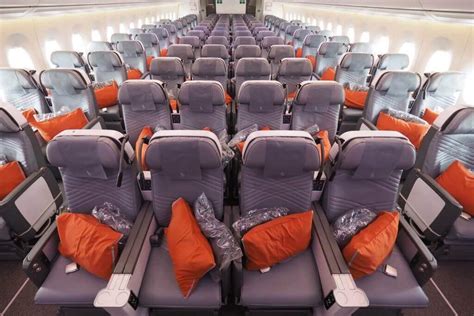
Singapore Airlines operates multiple A350 variants, but only the long-haul versions deliver the full six-inch recline. These aircraft form the backbone of routes connecting Singapore to Europe, North America, and Australia. The result is a consistent long-distance experience where comfort isn’t sacrificed for efficiency.
The curious twist is that only about a quarter of the airline’s fleet features this exact configuration. That scarcity makes it something of a hidden gem—an economy seat that quietly rivals premium cabins on less optimized airlines.
4. Etihad Airways A380 and Boeing 787: Recline Meets Privacy Engineering
Etihad Airways approaches economy seating with a slightly different philosophy: add micro-luxuries where possible. Its six-inch recline is impressive, but the real innovation lies in the privacy wing integrated into the seat design.
This feature, built into the Safran 5751 seat, acts like a subtle barrier between passengers. It doesn’t isolate you completely, but it reduces visual intrusion—an underrated factor in perceived comfort. Humans are oddly sensitive to peripheral motion, and minimizing it can make a seat feel more restful.
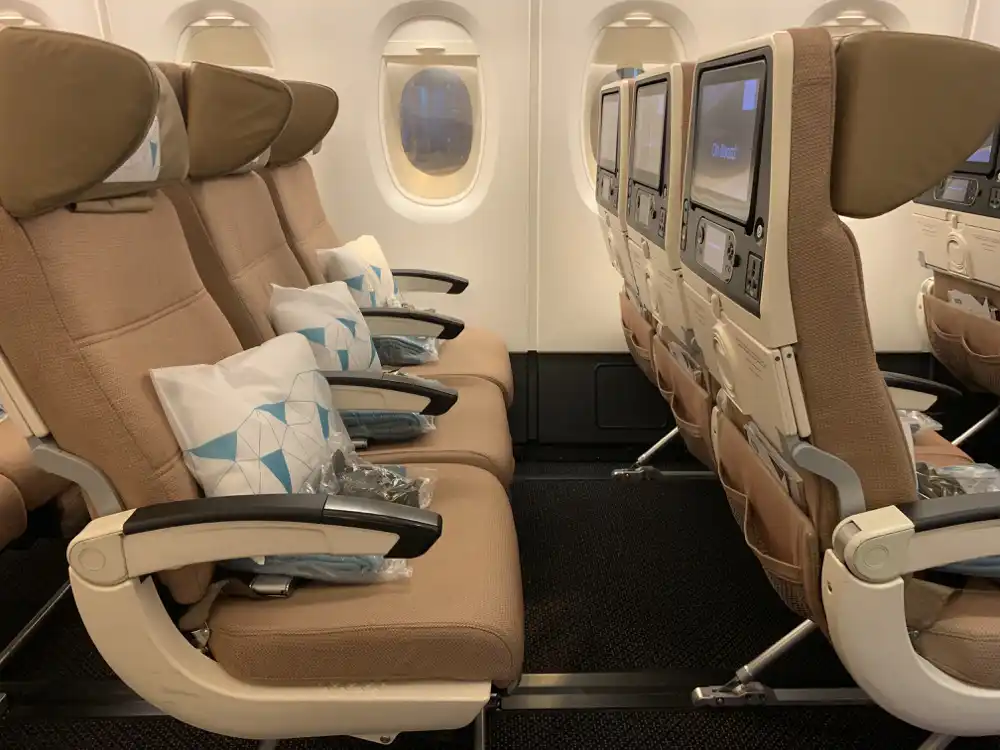
On the Airbus A380, the experience reaches its peak. The aircraft’s wider fuselage allows for seats nearly 19 inches wide, giving passengers more lateral space to pair with the generous recline. On the Boeing 787, the same seat design is slightly narrower due to the aircraft’s structure, but the recline remains unchanged.
Etihad’s newer aircraft introduce the Recaro CL3710, dialing recline down to five inches. That shift reveals something important: seat design is always a compromise between weight, space, and cost. The older configuration, still flying on many routes, remains the sweet spot for comfort.
3. Cathay Pacific Long-Haul Fleet: Consistency Across Aircraft Types
Cathay Pacific doesn’t rely on a single aircraft or seat model to deliver comfort. Instead, it achieves something more difficult: consistency across an entire long-haul fleet.
Whether you’re on an Airbus A350, Airbus A330, or Boeing 777-300ER, you’ll find six inches of recline in economy. That uniformity reduces uncertainty, which is a hidden stressor in travel. You know what you’re getting before you even board.
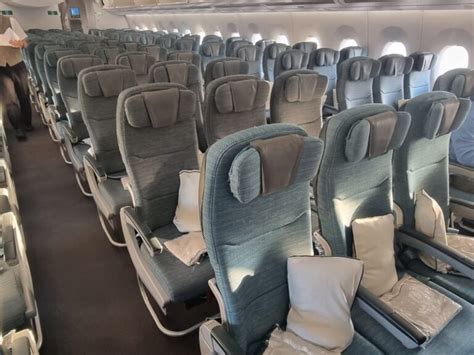
Different aircraft use different seat models—Safran 5751, Collins Aerospace Pinnacle, HAECO Vector, and Recaro CL3710—yet they converge on the same recline standard. Most configurations also offer 32 inches of pitch, reinforcing a sense of spaciousness.
There’s a caveat, and it’s a subtle one. On the Boeing 777-300ER, seats are arranged ten-abreast, reducing width to about 17.3 inches. That makes recline even more important, as lateral space is limited. Fortunately, the six-inch recline compensates by allowing passengers to shift posture more effectively.
Every seat includes a seatback screen, ensuring that comfort isn’t just physical but also experiential. A distracted mind, it turns out, perceives discomfort less intensely—a psychological trick airlines quietly exploit.
2. Emirates A350 and Boeing 777: When Recline Beats Screen Size
Emirates is famous for spectacle—onboard bars, massive screens, and extravagant branding. But in 2026, the real story lies in a quieter upgrade: six inches of recline on the Airbus A350 and Boeing 777.
This is particularly notable because the airline’s iconic Airbus A380 offers only four inches of recline in economy. The newer aircraft flip that script, prioritizing physical comfort over visual wow-factor.
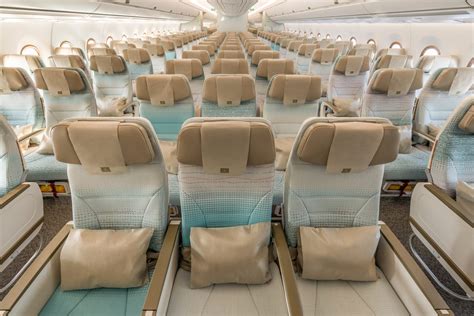
The introduction of the Safran Z400 seat marks a significant leap forward. With 32 inches of pitch and 18-inch width on the A350, the seating environment feels balanced and modern. The 13.3-inch seatback screen remains among the largest in the industry, but it no longer overshadows ergonomics.
On the Boeing 777, the story becomes more complex. Emirates operates a large and varied fleet, with both older and newly refurbished cabins. Regardless of configuration, all maintain the six-inch recline standard, creating a consistent baseline of comfort.
There’s an interesting engineering trade-off here. Increasing recline requires careful seat spacing to avoid encroaching on the passenger behind. Emirates manages this through refined seat mechanisms that shift the seat pan slightly forward as it reclines—a clever bit of mechanical choreography.
1. Qatar Airways A380: The Seven-Inch Outlier
At the top of the hierarchy sits a rare beast: the Qatar Airways Airbus A380 economy seat with seven inches of recline. This isn’t just industry-leading—it’s borderline disruptive.
Seven inches may not sound dramatic, but in biomechanical terms, it significantly changes the body’s resting angle. It allows for a deeper recline without forcing the neck into an awkward forward tilt. Combined with 18-inch seat width and a 10.6-inch touchscreen, the result is an economy seat that edges toward premium territory.
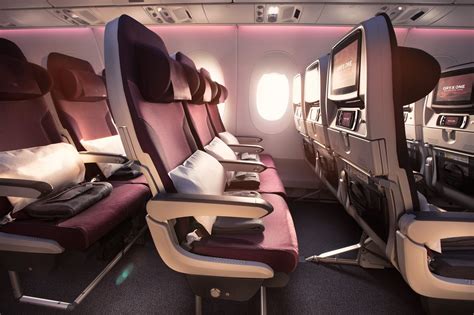
The seat itself is based on the Recaro CL3710, a design known for its structural efficiency and comfort. The 31-inch pitch remains standard, proving that recline—not legroom—is the defining factor here.
What makes this even more intriguing is its exclusivity. The A380 is the only aircraft in Qatar Airways’ fleet offering seven inches of recline. Other aircraft hover around six inches or less, making this configuration something of a unicorn in modern aviation.
It’s a reminder that aircraft design still matters. The A380’s sheer size allows for comfort features that smaller planes struggle to accommodate. In an era where airlines are phasing out superjumbos, this level of economy comfort may become increasingly rare.
The Hidden Pattern: Widebodies, Seat Design, and Passenger Psychology
Zoom out, and a pattern emerges that feels almost like a law of nature. Widebody aircraft consistently deliver better recline and comfort than narrowbodies. The reason is structural: wider fuselages allow for better seat geometry, more spacing flexibility, and less aggressive cabin densification.
But there’s also a psychological layer. Passengers perceive space not just through measurements, but through visual openness, seat shape, and motion freedom. A well-designed seat with six inches of recline can feel dramatically more comfortable than a poorly designed seat with the same specs.
Airlines that understand this treat economy as a system, not a seat. Recline, width, pitch, lighting, and even screen placement all interact. When done right, the experience feels cohesive. When done poorly, every flaw amplifies the others.
Final Thoughts: The Subtle Art of Flying Better in Economy
The modern economy cabin is a paradox. Airlines are under constant pressure to increase density, yet passenger expectations continue to rise. The result is an arms race of millimeters—tiny adjustments that collectively define the experience.
The five airlines highlighted here demonstrate that comfort is not about extravagance, but precision. A single extra inch of recline, a slightly wider seat, or a smarter seat mechanism can transform a long-haul flight from endurance test to manageable journey.
In 2026, the smartest travelers aren’t just choosing airlines—they’re choosing specific aircraft and seat configurations. Because somewhere between five and seven inches of recline lies a simple truth: comfort isn’t given, it’s engineered.