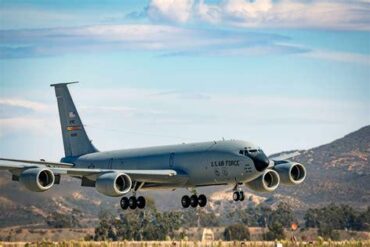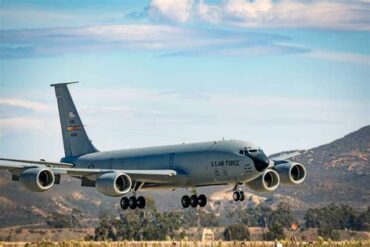
For nearly seven decades, the Boeing KC-135 Stratotanker has been one of the quiet foundations of American airpower. It rarely receives the attention given to fighters, bombers, or stealth aircraft, yet the United States could not sustain long-range combat operations on anything approaching its normal scale without aerial refueling. The KC-135 has spent generations extending the reach of American aircraft, allowing them to remain airborne for hours longer and operate thousands of miles from their home bases.
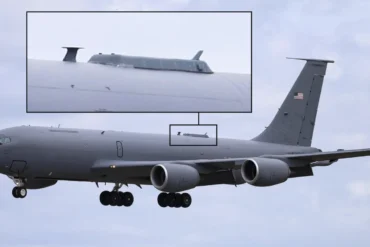
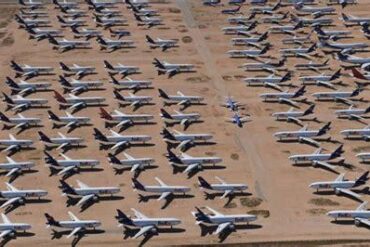
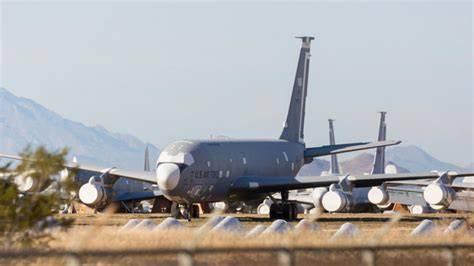
Few aircraft illustrate that extraordinary longevity better than KC-135 tail number 58-0011, better known by the nickname “Ethel.” Built during an era when the Cold War was still in its infancy, the tanker eventually accumulated approximately 41,000 flying hours while passing through an astonishing succession of missions and military eras. By December 19, 2025, however, its flying career appeared to be over. Ethel made what was expected to be its final flight to Davis-Monthan Air Force Base in Arizona, joining the enormous aircraft storage facility commonly known as the Boneyard.
That would normally have been the end of the story. Instead, the aging Stratotanker was pulled back out only a few months later. The reason was not a dramatic return to combat. Ethel was instead moved from storage to the Oklahoma City Air Logistics Complex at Tinker Air Force Base, where its remaining components could help keep other KC-135s flying after the demands of a major air campaign placed additional strain on the tanker fleet.
The KC-135 Stratotanker Became the Backbone of American Aerial Refueling
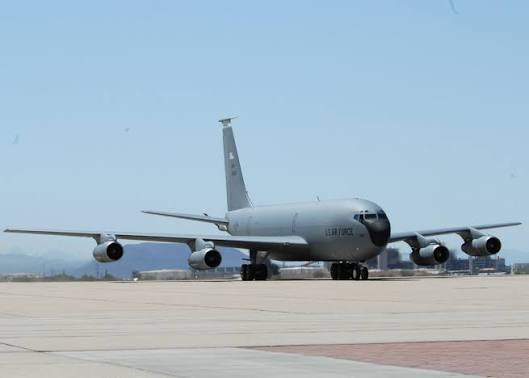
The KC-135 entered service in August 1956, and its importance was immediately tied to a fundamental problem of modern military aviation: aircraft could travel farther and remain useful longer if they did not have to repeatedly return to an airfield for fuel. Over time, that simple capability became one of the most important force multipliers in the United States military.
A total of 820 KC-135s entered service, creating a tanker fleet that would support American operations throughout the Cold War and beyond. The aircraft was derived from the same basic jet-age design philosophy that produced the Boeing 367-80 prototype and the early 707 family, giving the Stratotanker a swept-wing configuration and a relatively efficient high-speed cruise profile for its era. More importantly, its internal fuel capacity and dedicated refueling equipment allowed it to turn its own fuel into operational range for other aircraft.
The KC-135’s longevity is particularly remarkable because its service life spans several completely different generations of warfare. Stratotankers supported the Cold War nuclear deterrent, later participated in peacekeeping and humanitarian operations, and became essential to the enormous air campaigns associated with Iraq and Afghanistan. The aircraft also continued serving as American forces confronted new operational demands in the Middle East during the 2020s.
The tanker was not simply another support aircraft. It became part of the infrastructure that made American global military mobility possible. Fighters could deploy farther, bombers could remain on station longer, transports could reach distant destinations with fewer limitations, and commanders could maintain air operations without being completely constrained by the location of runways and fuel trucks.
Ethel’s 66 Years Tell the Story of the Stratotanker’s Extraordinary Service
Ethel’s history provides an unusually tangible example of what the KC-135 represented. By the time the aircraft finally left operational service, it had accumulated around 41,000 flight hours, an enormous figure for any aircraft, let alone a jet designed in the 1950s.
The aircraft also had experience beyond the traditional tanker role. During the 1960s, Ethel served as a nuclear command-and-control aircraft, placing it directly within one of the most sensitive missions of the Cold War. Its later history likely included participation in many of the major American combat operations conducted during the decades that followed.
That means generations of military personnel interacted with the aircraft. Pilots flew it, boom operators managed refueling connections from its rear station, maintainers inspected its engines and structure, and support personnel kept it ready for missions around the world. An aircraft such as Ethel therefore represents much more than its airframe. It is a physical record of decades of military aviation.
The KC-135 also proved remarkably adaptable. Early aircraft used Pratt & Whitney TF-33-PW-102 turbofan engines, while upgraded KC-135R aircraft received four CFM International CFM-56 turbofans, dramatically improving performance, fuel efficiency, and reliability. With its modernized configuration, the Stratotanker could reach approximately 530 mph at 30,000 feet, operate up to around 50,000 feet, and carry as much as 200,000 pounds of transferable fuel.
Why Aerial Refueling Is So Important to US Airpower
The strategic value of a tanker is easiest to understand by considering what happens without one. A fighter or bomber operating far from its home base must eventually land for fuel unless another source is available. Landing takes time, requires an appropriate airfield, consumes fuel during the approach and departure, and introduces additional logistical requirements.
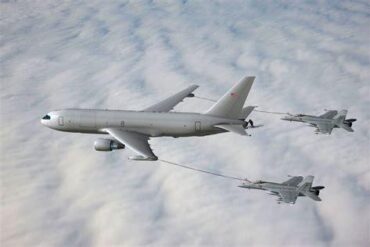
An aerial refueling aircraft eliminates much of that limitation. A receiver aircraft can rendezvous with the tanker, connect to the refueling system, take on fuel while airborne, and continue toward its objective or remain on station. The result is not merely greater range. It is greater flexibility, which can be even more important during combat.
The United States has built an enormous global military infrastructure around this principle. One historical example was the tanker bridge across the Atlantic used to support the rapid movement of American forces toward Iraq. The Northeast Tanker Task Force, operated by the Maine and New Hampshire Air National Guard, contributed more than 1,700 sorties and over 130 million pounds of fuel by the time the bridge mission ended on September 11, 2003.
Those numbers illustrate why tankers are sometimes described as the aircraft that make other aircraft possible. A fighter may deliver the weapon, a bomber may carry the payload, and a transport may move personnel, but the tanker can determine whether those aircraft can reach the required location and remain there long enough to accomplish their missions.
Operation Epic Fury Put Additional Pressure on the KC-135 Fleet
The continued importance of the Stratotanker became particularly visible during Operation Epic Fury, the major US-Israeli air campaign against Iran that began on February 28 and officially concluded on May 5. The operation involved a broad mix of American aircraft, including fighters, bombers, reconnaissance platforms, electronic warfare aircraft, heavy airlifters, and unmanned systems.
Among the most prominent heavy aircraft were B-1B Lancers and B-52H Stratofortresses, with 15 B-1Bs and six B-52Hs forward deployed according to the supplied reference material. Keeping such a large and geographically dispersed force operating required substantial tanker support.
The campaign therefore placed significant demands on a tanker fleet that was already in the middle of a complicated transition. The United States operates and maintains roughly three-quarters of the world’s aerial refueling fleet, but the number of aircraft available at any particular moment is considerably smaller than the total inventory suggests. Tankers undergo maintenance, modernization, training, deployments, and other commitments, meaning the entire fleet cannot simply be treated as immediately available.
The reference material identifies 374 KC-135s and 105 KC-46As in the USAF inventory, but the operational picture became even more complicated after aircraft were lost or damaged. Seven Stratotankers were involved in the reported losses associated with the operation, including one destroyed in a deadly mid-air collision over western Iraq, one seriously damaged, and five destroyed while parked during an Iranian missile and drone attack on Prince Sultan Air Base in Saudi Arabia.
Suddenly, an aircraft type already approaching the end of its service life became even more valuable. That is where Ethel’s strange post-retirement journey began.
Ethel Flew to the Boneyard in December 2025
On December 19, 2025, KC-135 58-0011 completed what was expected to be its final flight and arrived at Davis-Monthan Air Force Base. The base is famous for its massive aircraft storage operation, where retired military aircraft can be preserved, stored, or retained as sources of spare parts.
For Ethel, reaching the Boneyard represented the logical conclusion of a remarkable career. After roughly 66 years of service and tens of thousands of flight hours, the aircraft had reached the point where its value was no longer primarily measured by the number of missions it could fly.
Yet military logistics rarely follows a perfectly straight line. The KC-135 fleet still needed support, and some of its surviving aircraft required components that were increasingly difficult to obtain. An old tanker that could no longer return to operational flying could nevertheless contain valuable parts.
Only four months later, Ethel was recalled from storage.
The Old KC-135 Was Needed for Parts Rather Than Another Combat Mission
Ethel’s return was unusual because the aircraft was not being resurrected as an operational tanker. Instead, it was moved from the Boneyard to the Oklahoma City Air Logistics Complex at Tinker Air Force Base.
There, the retired Stratotanker could provide parts for active KC-135s, particularly aircraft that had suffered battle damage and required repairs. In other words, Ethel’s final contribution to the fleet was not to refuel another aircraft in the sky. It was to help keep another tanker capable of doing exactly that.
There is something fitting about that ending. After spending decades carrying fuel for other aircraft, Ethel effectively continued supporting the mission by donating components to other Stratotankers. The aircraft was no longer flying, but its service to the tanker fleet had not completely ended.
Its story also demonstrates how difficult it can be to retire a genuinely indispensable aircraft. When an air force operates a large fleet of aging platforms, retirement is not simply a matter of parking an aircraft and replacing it with something newer. Every withdrawal reduces the pool of available airframes, spare parts, experienced personnel, and operational flexibility.
The KC-46 Pegasus Is Replacing the Stratotanker
The United States is nevertheless moving decisively toward a new generation of aerial refueling. The KC-46 Pegasus is gradually replacing the KC-135 and bringing substantially newer technology into the tanker fleet.
The Pegasus can refuel fixed-wing aircraft using both a modernized boom and hose-and-drogue systems, giving it broad compatibility with different receiver aircraft. Its boom is operated through a fly-by-wire control system, while two underwing hose-and-drogue pods allow the aircraft to support compatible aircraft through a different refueling method.
The KC-46 also has significant utility beyond carrying fuel. It can transport up to 18 463L cargo pallets, normally carry 58 passengers, or accommodate as many as 114 passengers in contingency configurations. Its aeromedical configuration can carry 58 patients, including litter and ambulatory patients.
At McConnell Air Force Base, the transition is particularly visible. The base has hosted KC-135s since 1971, but the 22nd Air Refueling Wing has increasingly shifted toward the Pegasus. New maintenance and training infrastructure was built as part of the conversion, and the first two KC-46s arrived there in January 2019.
By early April, McConnell had received its 25th KC-46, moving the installation closer to becoming the USAF’s largest KC-46 operating location and eventually an all-Pegasus tanker base.
Ethel’s Final Mission Was Really a Final Contribution
The KC-135’s retirement is often described as the end of an era, and that description is justified. Few military aircraft have remained relevant for as long or supported such a broad range of American operations.
But Ethel’s story makes the transition more complicated. Its final mission was supposed to end at Davis-Monthan, surrounded by hundreds of other retired aircraft beneath the Arizona desert sky. Instead, operational demands created one last requirement for the old tanker. Its airframe still contained something the active fleet needed.
That is perhaps the clearest measure of the KC-135’s extraordinary longevity. Even after 66 years and approximately 41,000 flight hours, Ethel remained useful to the force. It could no longer provide fuel from the air, but its parts could help another Stratotanker continue doing the job.
The KC-46 will eventually carry the United States into the next era of aerial refueling, offering modern sensors, systems, cargo flexibility, and new capabilities designed for decades of future operations. Yet the Pegasus inherits a mission architecture built over generations by the Stratotanker.
Ethel’s journey from a Cold War command-and-control aircraft to a veteran tanker, then to the Boneyard, and finally back to an Air Force maintenance complex is therefore more than an unusual retirement story. It is a compact illustration of how deeply the KC-135 is woven into American airpower. Even after its final flight, the 66-year-old aircraft still had one more way to serve.