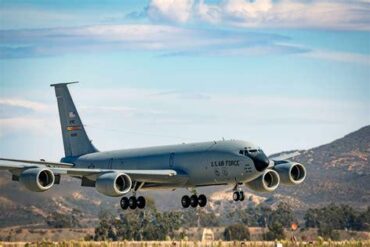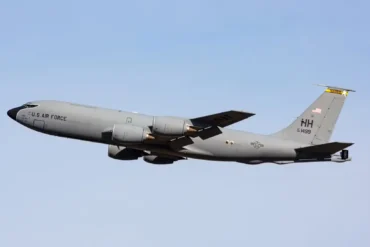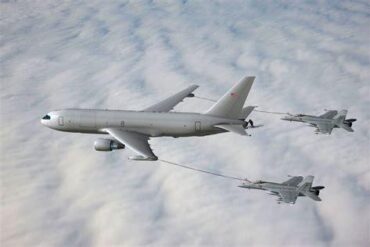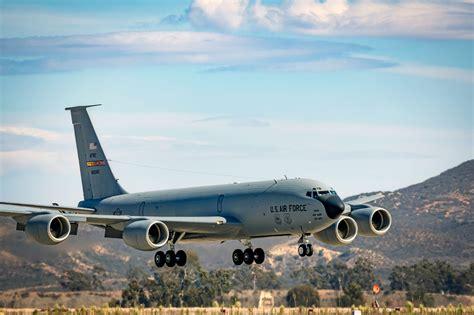
Originally commissioned in the 1950s and continuously upgraded over decades of service, the KC-135 Stratotanker is once again at the forefront of aerial refueling innovation. As outlined in the Fiscal Year 2026 United States Air Force budget request, the Air Force is seeking funding to integrate a Drone Delivery Mechanism (DDM) into the KC-135 fleet. This modification could usher in a new era of tanker survivability by equipping these Cold War-era aircraft with the capability to deploy unmanned aerial vehicles (UAVs) mid-flight, enhancing protection and tactical versatility in high-threat environments.
The plan reflects a strategic push to extend the operational relevance of legacy platforms while responding to the rapidly evolving nature of modern warfare. The goal is not simply survivability, but transformation—from a passive aerial gas station to an active node in contested airspace operations.
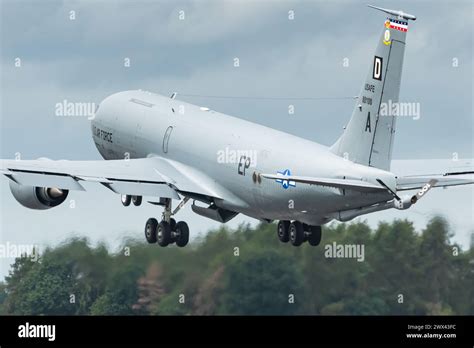
From Fuel Hauler to Force Multiplier: The Vision Behind the Drone Delivery Mechanism
According to budget documentation and reporting from The War Zone, the envisioned Drone Delivery Mechanism would entail significant structural alterations to the KC-135—specifically retrofitting its aft door to accommodate a Common Launch Tube (CLT) system. This system is designed to launch compact drones such as the Coyote or Altius-600, each capable of a range of mission sets including reconnaissance, surveillance, decoy operations, and electronic warfare.
Unlike traditional countermeasure systems that rely on chaff, flares, or evasive maneuvers, the DDM initiative would offer proactive threat detection and neutralization capabilities. The drones can act as forward scouts or electromagnetic interference agents, gathering data, jamming enemy systems, or even drawing fire away from the tanker itself.
In essence, the KC-135 would transform from a target into a force multiplier, expanding its utility beyond the traditional logistics domain into the sphere of manned-unmanned teaming in contested environments.
Flight Testing and the Road to Budget Inclusion
Preliminary flight demonstrations for the DDM took place in Fiscal Year 2024, providing critical data and operational feasibility insights. These tests paved the way for the DDM’s formal inclusion in the FY2026 Air Force budget proposal. The concept is currently under evaluation by key stakeholders including the Air Force Life Cycle Management Center and Air Mobility Command, who are overseeing potential transition into a full-fledged Program of Record.
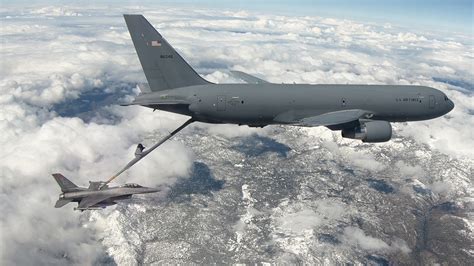
The scope of this transformation is not trivial. Integrating a CLT system requires addressing a multitude of airworthiness, safety, and interoperability issues. The KC-135, while durable, was not originally designed to interface with modern autonomous systems. Nevertheless, successful DDM integration could yield profound operational dividends, setting a precedent not just for legacy aircraft but for next-generation platforms like the KC-46A Pegasus.
Strategic Relevance in a Contested Battlespace
The military importance of this upgrade is best understood within the context of today’s highly contested air domains. From the Indo-Pacific region to the eastern flank of NATO, adversaries have developed and deployed advanced anti-access/area denial (A2/AD) systems capable of reaching deep into air corridors once considered safe for support aircraft. Long-range surface-to-air missiles (SAMs) and integrated air defense networks (IADNs) pose an increasing threat to high-value enablers like tankers, which are essential for maintaining the operational reach of fighter jets and bombers.
The DDM-equipped KC-135 offers a partial solution to this conundrum. With the ability to deploy UAVs at standoff ranges, the Stratotanker can better scout ahead, identify radar signatures, and potentially saturate enemy defenses with decoys, thereby preserving the integrity of strike packages and increasing the survivability of the broader air campaign.
Beyond Passive Defenses: Rethinking Aerial Tanker Protection
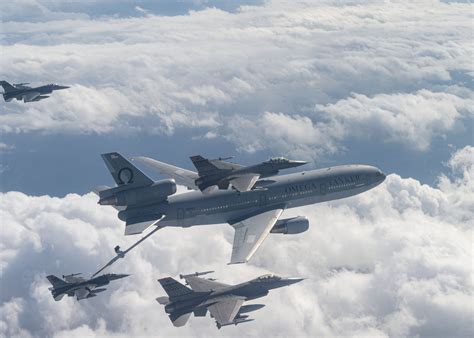
The Air Force has previously equipped the KC-135 with Large Aircraft Infrared Countermeasures (LAIRCM), which aim to confuse or disable incoming infrared-guided missiles. While effective in some scenarios, these systems are reactive and limited to close-proximity threats. The DDM, by contrast, embodies a proactive defense doctrine, extending the tanker’s influence far beyond its fuselage.
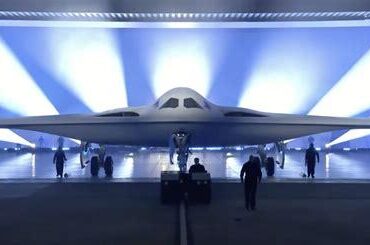
This tactical shift is particularly significant because aerial refueling is a lynchpin capability. Without tankers, the reach of fighters like the F-35 or bombers like the B-2 and B-21 becomes severely limited. Therefore, protecting these assets is not a luxury—it’s a necessity. The drone launcher initiative is a calculated response to this strategic imperative.
Technology Integration: The Coyote and Altius-600 Drones
The two main drone platforms under consideration—Raytheon’s Coyote and Anduril’s Altius-600—bring different capabilities to the table. The Coyote is a low-cost, expendable UAV that can be outfitted with sensors or EW modules, while the Altius-600 is a more advanced platform offering longer endurance, greater payload capacity, and multi-mode mission adaptability. Both drones have been used in combat trials and special missions, providing an operational pedigree that suits the high-stakes demands of aerial tanker defense.
In terms of launch mechanisms, the Common Launch Tube has already proven its versatility on platforms like the B-52 Stratofortress, giving program managers confidence that its adaptation to the KC-135 is technically achievable. However, engineering challenges remain in ensuring that structural integrity, aerodynamic flow, and weight distribution are not compromised during deployments.
Implications for Air Mobility Doctrine
The DDM upgrade goes beyond tactical enhancements; it could reshape the doctrine of air mobility operations. Traditionally, tankers have relied on fighter escorts or safe corridors to conduct refueling. In tomorrow’s battlespace, those luxuries may vanish. A tanker that can scout ahead or create its own protective envelope through drone deployment will dramatically reduce the dependency on other assets, free up fighters for offensive missions, and extend the survivability of expeditionary operations.
Moreover, this project signals a larger trend within the Pentagon toward manned-unmanned teaming (MUM-T)—a concept that’s also being explored in the Next-Generation Air Dominance (NGAD) program. Integrating autonomous systems into support roles allows for risk dispersion, mission adaptability, and faster decision loops, key attributes in a rapidly accelerating battlespace.
Budgetary Outlook and Program Viability
The FY2026 budget includes initial research and development funds earmarked for advancing the DDM concept. Full-scale procurement will depend on successful testing phases, risk assessments, and Congressional approval. Given the strategic necessity and relatively low cost compared to developing new aircraft, the project enjoys bipartisan support from defense committees focused on force readiness and modernization.
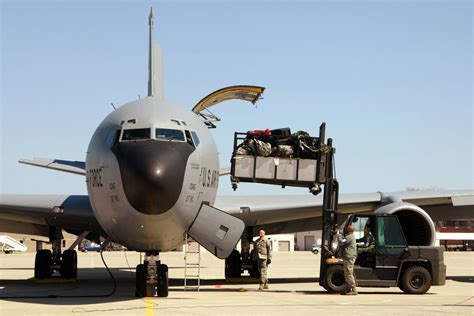
The Air Force’s transparent emphasis on adapting older systems to meet current threats aligns with broader Department of Defense goals focused on agility, cost-efficiency, and resilience. If successfully adopted, the DDM project could provide a blueprint for similar enhancements across other aging platforms, extending their utility well into the 21st century.
Conclusion: A Legacy Aircraft Reinvented for 21st Century Warfare
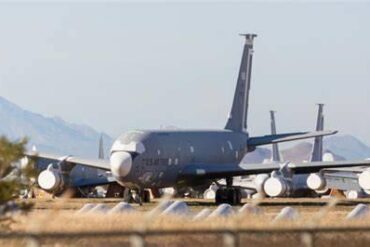
In a world where air superiority can no longer be assumed, the Air Force’s initiative to transform the KC-135 Stratotanker into a drone-launching platform reflects a critical pivot in military doctrine. Far from being relegated to the boneyard, the Stratotanker is being reinvented as a survivable, active component of frontline air operations.
With its integration of UAVs, the KC-135 could serve not only as an aerial refueler but also as an intelligence node, electronic warfare platform, and tactical decoy launcher. This adaptability underscores the growing realization that support aircraft are as strategically vital as their combat counterparts, and they must be just as capable of surviving and adapting to modern threats.
If the DDM program receives continued funding and technical validation, it may go down as one of the most significant transformations of a legacy aircraft in U.S. military history—marking a turning point in how air power is projected and sustained across the globe.