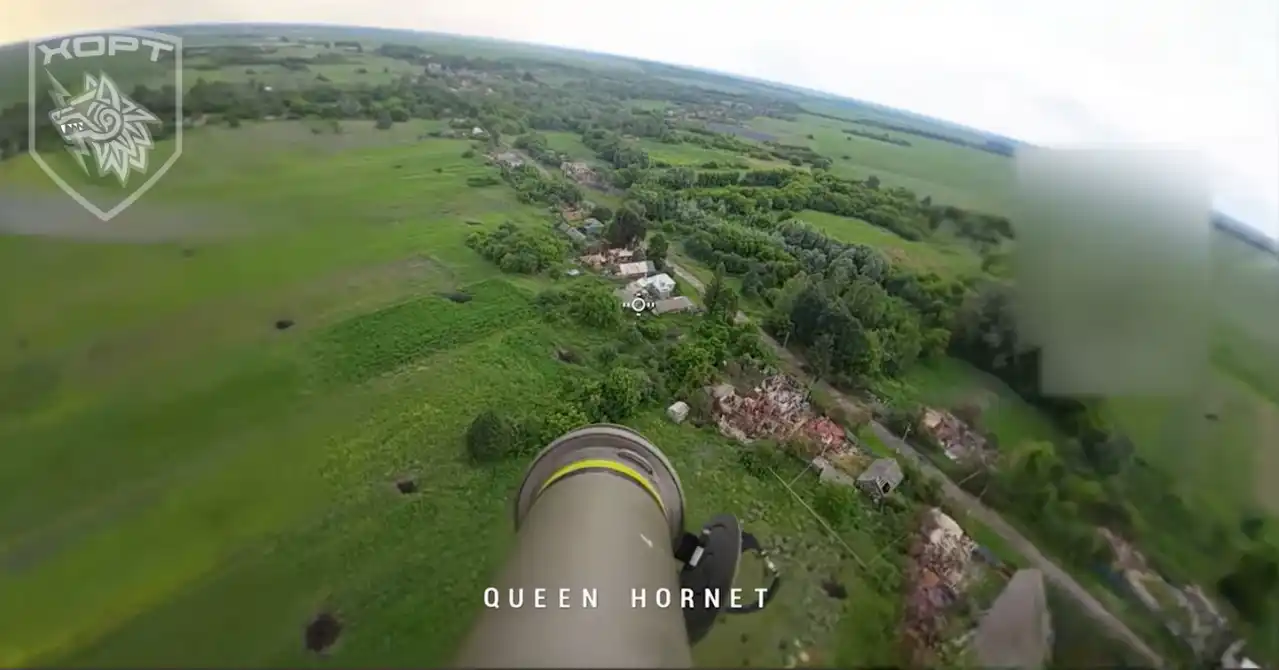
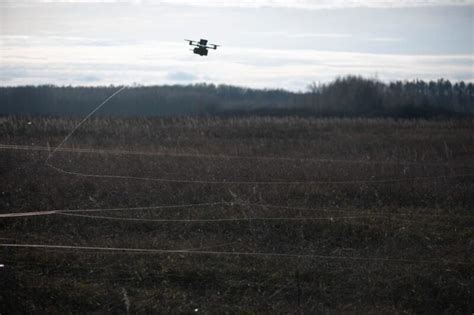
Ukraine’s defense innovation continues to evolve at a breathtaking pace as the country’s military successfully tested a fiber-optic guided FPV drone equipped with a disposable hand-held anti-tank grenade launcher. The trial, conducted in live combat conditions, marks a significant step in Ukraine’s countermeasure strategy against Russia’s heavily armored ground forces. This pioneering effort, spearheaded by the 420th Separate Battalion of Unmanned Systems ‘KHORT’, showcases the growing potential of unmanned systems in redefining modern battlefield tactics.
Queen Hornet: Ukraine’s Tactical FPV Drone Innovation
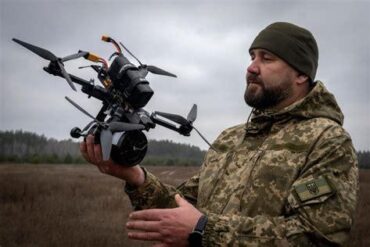
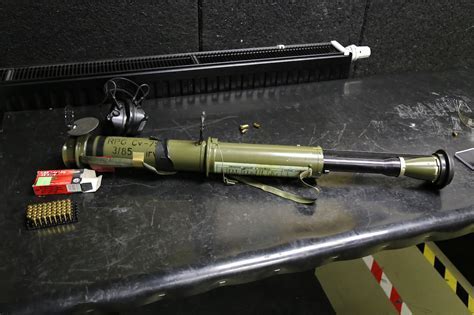
At the core of this advancement lies the Queen Hornet drone, a 15-inch tactical unmanned aerial vehicle developed by Ukraine’s domestic drone community, Wild Hornets. Unlike conventional kamikaze or transport drones, the Queen Hornet is a modular, multi-role system capable of fulfilling bomber, transport, surveillance, and relay operations. In this specific deployment, the drone was modified to carry the Czech-made RPG-75—a lightweight, disposable anti-tank grenade launcher—mounted as a primary offensive payload.
The Queen Hornet’s integration with a fiber-optic guidance system dramatically changes its battlefield performance. This technology ensures uninterrupted communication between the drone and the operator, even in the presence of aggressive Russian electronic warfare systems, which have been a major hurdle in previous radio-controlled drone operations. The fiber-optic connection also enables high-definition video transmission, enhancing the operator’s targeting accuracy and decision-making.
Technical Capabilities and Payload Configurations
The Queen Hornet’s payload flexibility is central to its battlefield utility. When carrying a maximum load of 9.5 kilograms, it can operate over a range of 5 kilometers. Reducing the payload to 6 kilograms extends its range dramatically to 17 kilometers, making it ideal for deep penetration missions across contested zones.
In the RPG-75 test configuration:
- Weapon payload: 3.2 kg (RPG-75 launcher)
- Fiber-optic coil: ~1.5–2 kg (estimated)
- Remaining capacity: Leaves enough margin for additional stabilization, sensors, or future upgrades.
The RPG-75 grenade launcher is a single-use, 68mm caliber launcher with a max range of 1000 meters and an effective range of 300 meters, designed to defeat up to 300mm of armor plating. While the rocket grenade in the test did not detonate on impact—suggesting room for refinement in fuzing mechanisms—the successful targeting and delivery confirmed the viability of the launch system.
Fiber-Optic Guidance: Countering Russian EW Superiority
One of the critical challenges Ukrainian drone operators have faced is Russia’s dominance in electronic warfare (EW). By relying on signal jamming, spoofing, and GPS denial, Russian forces have disrupted countless radio-controlled drone missions. The Queen Hornet’s fiber-optic guidance represents a decisive countermeasure.
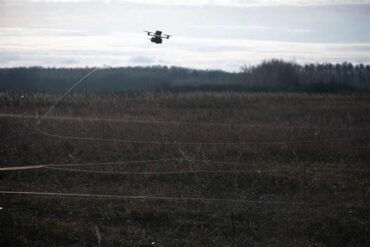
Unlike traditional FPV drones that communicate via radio frequencies, the fiber-optic drone uses a physical tether to transmit both command signals and real-time video. This eliminates the vulnerabilities of RF-based controls, rendering Russian EW systems ineffective against this drone. Moreover, the added benefit of consistent high-resolution visuals ensures precise targeting, especially against mobile or camouflaged enemy units.
Evolving Drone Warfare: From Radio-Control to Optics-Based Combat
This isn’t Ukraine’s first attempt to arm drones with grenade launchers, but it’s certainly the most technologically advanced to date. In September 2024, the Bulava unmanned unit from the Bohdan Khmelnytsky Separate Presidential Brigade revealed a radio-controlled Queen Hornet drone variant carrying a Bulspike-AP anti-personnel grenade launcher. However, that system lacked the sophisticated optical guidance introduced in this latest test.
With the move from radio frequency control to fiber-optic control, Ukrainian drone warfare has entered a new stage. The radio-controlled version, while easier to deploy, suffered from low immunity to jamming and limited range. The fiber-optic system addresses both, providing a secure, long-distance tethered solution that is more difficult to intercept or disrupt.
Operational Insights and Future Deployment Scenarios
The 420th Battalion’s successful test serves more than a symbolic role. It provides a concrete proof-of-concept that drones can reliably deliver anti-armor munitions under combat conditions with high accuracy and resilience against enemy interference. This opens up a range of strategic deployment options:
- Urban combat: where dense EW environments make RF control unreliable
- Anti-armor ambushes: allowing drone teams to strike from concealed positions
- Deep reconnaissance with lethal capabilities: enabling drones to not only observe but also neutralize targets
As the fiber-optic coil itself is relatively lightweight, combat engineers have flexibility to install coils of 15 to 20 kilometers, depending on the mission scope. The cost-benefit balance is also promising; such drones could provide low-cost, high-impact firepower that complements or even replaces costly ATGMs in certain scenarios.
Challenges in Warhead Activation and Reliability
Despite the operational success, the RPG-75 warhead failed to detonate in this test. This shortcoming raises important engineering questions. Was the impact force insufficient? Did the drone’s delivery method alter the warhead’s trajectory or arming mechanism? Or perhaps the mounting method needs refinement to ensure proper alignment and detonation conditions.
To resolve these issues, collaboration between drone engineers and ordnance specialists will be key. The team behind Queen Hornet will likely explore alternatives such as:
- Modifying the fuze delay or sensitivity
- Reinforcing impact trajectories to mimic ground-launch angles
- Switching to more drone-compatible munitions with contact fuzes or programmable detonation
Until a reliable detonation mechanism is achieved, the platform’s lethal capability remains theoretical. However, the targeting and delivery aspects have already proven to be mature and combat-ready.
Ukrainian Innovation Under Fire: The Road to Mass Production
The test by the KHORT battalion underscores Ukraine’s rapid prototyping and battlefield feedback loop. Unlike traditional defense procurement systems, Ukraine’s wartime drone development operates in a continuous innovation cycle. Prototypes are often tested within weeks of initial design, and feedback loops are short, direct, and brutal.
Organizations like Wild Hornets are at the center of this revolution. Acting both as R&D and production hubs, they iterate on designs based on direct input from soldiers in the field. In previous statements, representatives from the Bulava unit emphasized their ambition to reach mass production levels, with an eye on standardizing modular drone-launcher systems across multiple brigades.
Strategic Impact and the Future of Tactical Drones
The Queen Hornet’s successful field test points toward a future of highly decentralized, lethal drone teams capable of taking on armor, fortifications, and supply routes without needing air superiority. These drones blur the line between loitering munition and guided missile, especially as AI-assisted target recognition becomes a possibility.
By using fiber-optics, Ukraine has opened the door to silent, undetectable drone approaches, guided with sniper-like precision. If paired with new munitions that can be reliably detonated on drone impact, this concept could soon scale to multiple launch platforms.
Moreover, the Queen Hornet can be modified as a drone carrier, a concept seen in limited testing where a mothership drone deploys smaller kamikaze drones mid-flight. Combined with its communications repeater role, this makes it a true battlefield force multiplier.
Conclusion: Ukraine’s Drone Doctrine Matures
With this latest test, Ukraine has signaled a decisive pivot from improvised drone strikes to engineered, systematized tactical UAV warfare. The Queen Hornet with RPG-75 not only embodies technical ingenuity but also represents a clear blueprint for future frontline deployments.
While technical refinements are necessary—particularly in warhead integration—the platform’s survivability, accuracy, and resilience in the face of electronic warfare make it a promising addition to Ukraine’s drone arsenal. As drone-centric warfare becomes the new normal, the Queen Hornet may well become a cornerstone of Ukraine’s evolving battlefield doctrine, one fiber at a time.