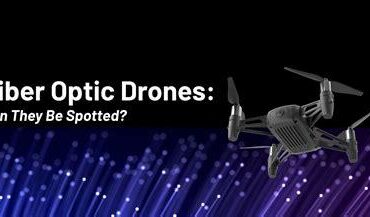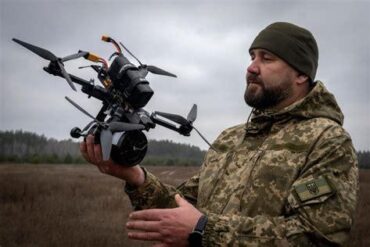
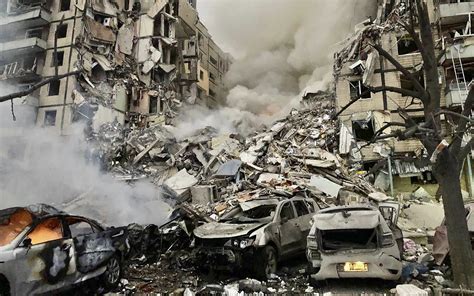
An acrid haze cloaks the Ukrainian town of Rodynske, where the war’s latest and most terrifying weapon has left a smoldering scar. A 250kg glide bomb ripped through the town’s administrative heart and three residential blocks, marking a new phase in Russia’s brutal push toward Pokrovsk. The air is thick not only with smoke, but with the unsettling whirr of drones — not ordinary drones, but the war’s newest nightmare: fibre optic drones.
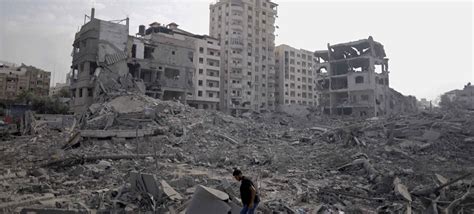
Only 15 kilometers from Pokrovsk, Rodynske is no longer a peripheral zone. As Russia seeks to encircle the city and cut off its supply arteries, this once-stable region has become a front-line outpost in all but name. Gunfire rattles constantly, drones circle above, and the drone threat has reached such intensity that Ukrainian soldiers, like those of the 5th Assault Brigade, delay deployment for days, waiting for cloud cover or wind to protect them from aerial detection.
A Shift in Russian Tactics and the Rise of Drone Dominance
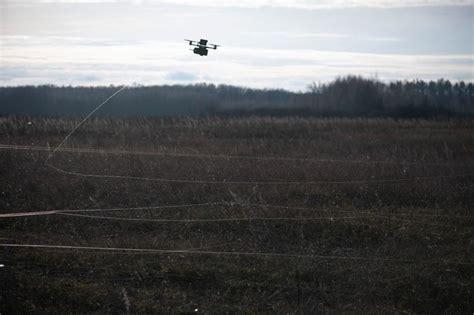
Faced with stalling ground offensives, Russian forces have shifted to encirclement strategies and a crushing air and drone campaign. This shift was dramatically evident during recent escalations when Rodynske was swarmed by unmanned aerial vehicles (UAVs). As Ukrainian troops dove for cover, fibre optic drones hovered above — impossible to jam, nearly impossible to escape.
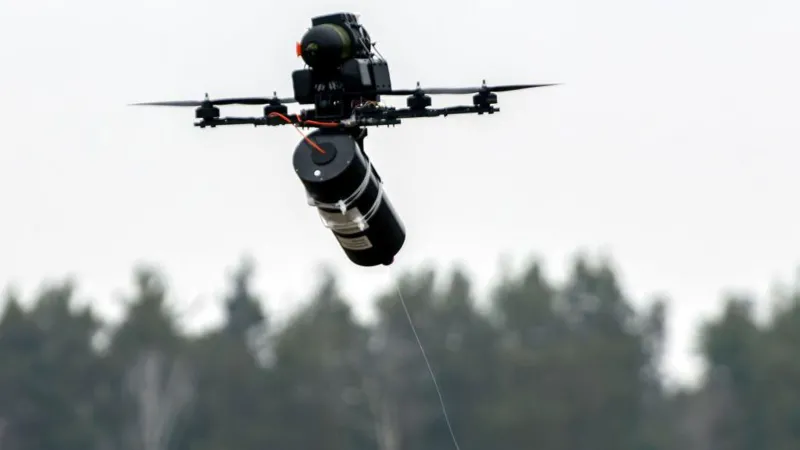
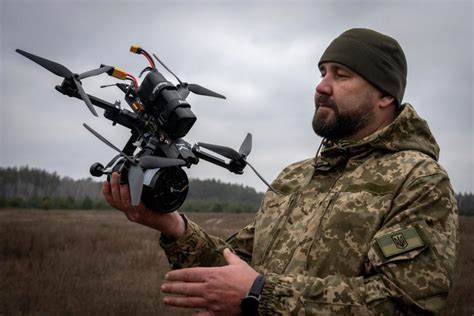
These drones do not rely on radio frequency communications. Instead, they are controlled through physical fibre optic cables, spooled out over tens of kilometers, connecting the drone to its pilot directly. This advancement renders traditional electronic warfare countermeasures largely obsolete.
The Deadliest Innovation: What Makes Fibre Optic Drones So Lethal
The technical breakthrough of fibre optic drones lies in their resistance to electronic jamming. Conventional anti-drone tactics — electronic jammers and signal disruptors — are rendered useless. According to a drone engineer with the 68th Jaeger Brigade, known by his callsign “Moderator,” the drone sends real-time video and command signals directly through the optic cable, maintaining uninterrupted communication even in contested environments.
This not only allows the drones to operate deeper within enemy territory but also enables new tactics: low-altitude reconnaissance, indoor surveillance, and pin-pointed targeting in urban warfare. Ukrainian drone pilot Venia, also with the 68th Jaeger Brigade, explained that these drones can fly into houses and actively search for targets — a chilling new dimension of urban warfare.
Ukrainian Response: Outgunned, Outranged, But Adapting Fast
Ukraine has been urgently working to match Russia’s early deployment of these systems. While Russian troops had already integrated fibre optic drones into their tactical routines, Ukrainian forces were still testing prototypes. The production ramp-up is underway, but the technological and industrial lag is proving dangerous in the meantime.
Despite its strengths, the fibre optic drone is not without limitations. It moves slower, and its tethered cable can become tangled in trees or debris. Yet, in the open expanses and shattered towns of Donetsk Oblast, those drawbacks matter little. These drones make transporting soldiers far more dangerous than combat itself. As Serhii, an artilleryman in the 5th Assault Brigade, remarked, “We joke about carrying scissors to cut the cords — but there’s not much laughing at the front.”
Life Under the Lens: Psychological Toll on Soldiers
The human cost of this relentless aerial surveillance is profound. Soldiers like Oles, Chief Sergeant of a reconnaissance unit, now spend weeks in forward positions. What used to be a 3-7 day deployment rotation has stretched into 30, 90, even 120 days. Once spotted, a soldier’s window to act — or live — is measured in minutes.
Infantryman Maksym, who worked at a beverage company before the war, now endures blood, mud, and sleepless nights under drone threat. “Three days without sleep, waiting for the next wave,” he recalls. “Even a blink at the wrong moment, and you’re gone.” The front lines are no longer clean demarcations, but shifting, entangled spaces where a Russian squad can appear on a quad bike or motorcycle without warning.
Civilians Caught in the Crossfire
The drone menace isn’t limited to military targets. Towns like Bilytske, further from the direct front, are increasingly targeted. Civilian infrastructure — homes, bakeries, even small zoos — are in ruins. Svitlana, 61, returned to the charred remains of her home to salvage what she could. “It’s not just sounds in the distance anymore. It’s us. We’re the target now,” she said, staring at a heap of rubble where her kitchen once stood.
Strategic Consequences: The Redrawn Battle Map of Donetsk
These new drone capabilities have redrawn the conflict’s tactical map. With fibre optic drones surveilling and targeting from newly captured positions east of Pokrovsk — along the road to Kostyantynivka — Russia has pushed deeper than at any point since January. Though Ukrainian resistance remains fierce, the advances have strained supply lines and exposed critical transport routes.
Yet the broader strategic picture remains murky. Gains are measured not in kilometers, but in temporary control and survival. The fighting has devolved into a chessboard of constantly shifting squares, with no clear lines and even less certainty. The conventional idea of a “front” has eroded. What remains is an unpredictable sprawl of fire, movement, and mechanical eyes in the sky.
International Implications and Future Threat Scenarios
The advent of fibre optic drones carries implications beyond Ukraine. Their resistance to electronic warfare marks a seismic shift in drone combat doctrine. Nations worldwide — especially those heavily invested in electronic countermeasures — will need to rethink both strategy and equipment. The battle in Donetsk may well be the first major testbed for post-electronic drone warfare.
For Ukraine, the need is immediate and desperate: increased support, faster deliveries of advanced drones, and above all, strategies to counteract fibre optic surveillance. With NATO still hesitant on direct military involvement and supplies often delayed, Ukraine’s drone race remains largely asymmetric — fast-evolving, but reactionary.
A War Fought by Engineers and Fathers
The brutal paradox of this war is captured in the daily life of its fighters. Maksym, still dusty from the trenches, wipes tears away as he speaks about his two-year-old son. He gets to see him only on video calls. “Everything’s as fine as it could be,” he says quietly.
Behind every terrifying drone strike is a pilot. Behind every front-line soldier, a family. Behind every ruined town, a community that once thrived. The fibre optic drone may be the terrifying new weapon of this war — but the true tragedy lies in how quickly such horror becomes normal.