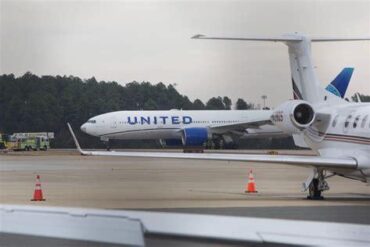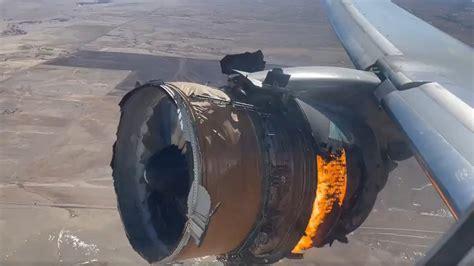
Late Wednesday night, panic erupted aboard a United Airlines flight as passengers were forced to evacuate via inflatable emergency slides following a sudden mid-air mechanical failure. Departing from Washington Dulles International Airport, the flight was en route to Charleston International Airport when one of the aircraft’s engines reportedly failed mid-flight, igniting alarms and sending shudders of fear through the cabin.
Mid-Flight Terror: Engine Failure Over South Carolina Skies
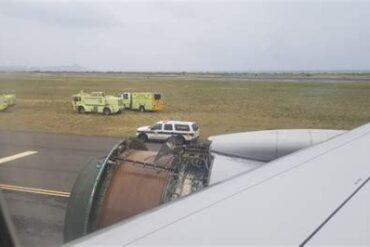
Shortly before midnight, calm turned into chaos. What began as a routine domestic flight turned into a harrowing ordeal when a sudden mechanical issue silenced one of the jet’s engines. Crew members sprang into action as alert systems blared and standard emergency protocols were initiated.
Passengers described the atmosphere as “tense and disorienting,” with flight attendants urgently securing the cabin while communicating with the cockpit. Despite the serious engine malfunction, the pilots executed a controlled descent and a smooth touchdown at Charleston. But the ordeal was far from over.
Chaos on the Tarmac: Passengers Flee Aircraft in Fear
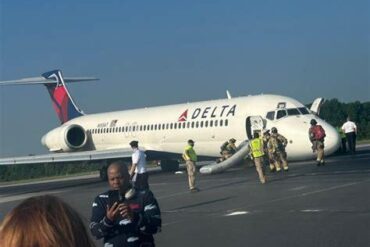
Upon landing, emergency slides deployed within seconds, cascading from the aircraft’s exits. In the pitch black of night, passengers leapt into the darkness, their only directive being to get out quickly and safely. Witnesses on the ground reported seeing streams of people emerging from the aircraft, many of them visibly shaken, barefoot, or clutching belongings.
Though no injuries were officially reported, emotional trauma was widespread. Families were separated in the confusion, and some passengers required assistance from ground personnel to cope with the distress. Emergency teams quickly escorted evacuees to the terminal via ground transportation, ensuring everyone was accounted for.
Official Statement and Emergency Response
Charleston International Airport’s Deputy Executive Director Spencer Pryor confirmed that the emergency was mechanical in nature. Although the specific cause of the engine failure remains under investigation, he commended the flight crew and emergency response teams for their swift, efficient actions that undoubtedly averted further catastrophe.
“The emergency evacuation was executed with precision,” said Pryor. “All passengers and crew were safely removed from the aircraft and transported to the terminal.”
Federal aviation authorities and United Airlines have both initiated comprehensive inspections and internal reviews, but as of Friday morning, the airline has yet to issue a full public statement detailing the aircraft model or cause of the failure.
A Broader Crisis: Aircraft Safety Under The Microscope
This incident is not isolated. As summer travel season intensifies, U.S. airlines are facing mounting scrutiny over aging fleets, maintenance schedules, and staffing shortages. The industry continues to recover from the pandemic’s impact, yet demand has returned at full force—often exceeding capacity.
With increasing flight volumes, the strain on aircraft maintenance, engineering crews, and logistics systems has reached a tipping point. Travelers expect reliability, not emergency landings and nighttime slide evacuations. Events like this amplify concerns and provoke hard questions for industry leaders.
United Airlines, in particular, must now reckon with a growing public demand for transparency—not only about what happened, but about how similar issues will be prevented moving forward. Operational efficiency must not come at the cost of passenger safety.
Ripple Effects Across the Travel Ecosystem
While no one was physically harmed, the disruption had far-reaching consequences. Charleston International Airport, a hub for both business and leisure traffic, experienced temporary rerouting of flights and emergency runway protocols. Nearby airports, including those in Atlanta and Charlotte, were put on alert.
Delayed connections and aircraft reassignment cascaded into regional flight schedule upheaval. The airline had to reorganize crew scheduling and maintenance inspections for the rest of the week—one emergency creating ripples through hundreds of passengers’ travel plans.
Inside the Aircraft: Passenger Accounts
Survivors of the flight recounted the eerie silence when the engine failed, followed by a wave of panic. One passenger, who requested anonymity, said, “When we heard the engine die and felt the plane shift, I thought this might be it. People grabbed hands, others started praying.”
Another traveler described the descent as “surreal,” adding, “The landing itself felt fine, but then we hit the ground and the slides popped out. That’s when you realize—this was serious.”
These testimonies highlight the often underestimated psychological impact of near-emergency experiences. It’s not just about physical safety—passenger trust is equally fragile, and it shatters easily.
The Mechanics of Emergency Slide Deployment
For the uninitiated, the decision to deploy emergency slides may seem abrupt. But aviation safety protocols are rigid for good reason. After any mechanical failure, particularly an engine issue during descent, crews are trained to assume worst-case scenarios.
Emergency slides, capable of inflating in under 10 seconds, are designed to evacuate a fully loaded commercial aircraft in under 90 seconds. This minimizes risk from fire, fuel leaks, or electrical hazards. Even if no external signs of danger exist, protocols dictate immediate evacuation until systems are fully inspected.
Operational Recovery and FAA Investigation
Charleston International Airport resumed standard operations by early Thursday morning, but behind-the-scenes investigations are ongoing. Runway surfaces were inspected, emergency systems reviewed, and airline coordination recalibrated.
The Federal Aviation Administration has launched an official inquiry, standard procedure for incidents involving mechanical failure and emergency evacuation. They will be examining the aircraft’s black boxes, maintenance logs, and crew communication transcripts to determine exactly what went wrong—and whether it could have been prevented.
Restoring Passenger Confidence in a Post-Incident World
What follows an incident like this is a delicate dance between crisis management and customer reassurance. United Airlines now faces the difficult task of restoring traveler confidence—not only for those onboard but for the broader flying public.
Passengers are likely to demand:
- Real-time updates during delays or emergencies
- Greater visibility into aircraft maintenance records
- Enhanced training protocols for ground and air crews
- Clear compensation policies for affected travel plans
The airline’s long-term response will set a precedent. With social media capturing moments in real-time, reputational damage happens instantly. Only proactive communication and policy reform can mitigate the fallout.
How Flyers Can Stay Prepared
Though air travel remains statistically safe, flyers should take personal responsibility to stay informed and ready. This includes reviewing in-flight safety cards, noting emergency exits, and staying aware of airline safety records.
Additionally, travelers may consider:
- Enrolling in airline safety alert programs
- Investing in comprehensive travel insurance
- Keeping essential items (medications, IDs) on their person during flight
These small steps can provide critical support during unexpected situations—offering peace of mind in moments of chaos.
The Bigger Picture: Industry-Wide Implications
This event is a wake-up call for the entire airline industry. With increased competition, tighter schedules, and resource constraints, safety cannot be treated as a checkbox. Every incident—no matter how minor in terms of casualties—represents a test of preparedness and accountability.
Federal regulators, airline executives, and aviation unions must come together to reexamine:
- Aircraft retirement schedules
- Technician staffing ratios
- Maintenance outsourcing practices
- Emergency response coordination between airports
Passenger lives hang in the balance, and so does the public’s willingness to board that next flight without fear.
Conclusion: A Narrow Escape and a Clear Warning
The emergency landing and evacuation of United Airlines’ flight from Dulles to Charleston was not a tragedy—but it was a stark reminder of how thin the line can be between routine and disaster. Thanks to well-executed protocols and level-headed flight crews, a major catastrophe was averted. But the questions it raised must not be ignored.
Airlines owe their customers more than a ticket and a seat—they owe them transparency, safety, and trust. If those aren’t guaranteed, then every engine hum becomes a potential warning, and every takeoff a leap of faith.