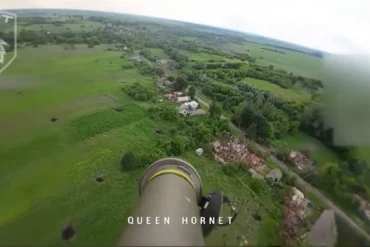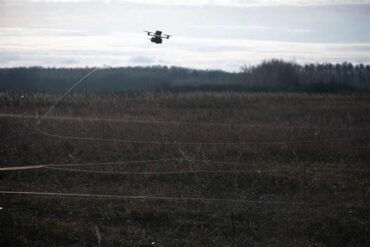
In the tangled, war-scarred canopies of Serebryansky Forest, a new form of combat is quietly asserting its dominance—not through explosions or sonic booms, but with shimmering strands of light-conducting cable. A new video released by Ukraine’s Ministry of Defense offers a glimpse into this invisible war, showing dense spiderwebs of fiber-optic wires laced across the treetops. These cables are the nervous system of a new era in battlefield technology: unjammable fiber-optic drones, now proliferating across Ukraine’s frontline defenses.
The footage, shared by the 63rd Mechanized Brigade, reveals a chilling beauty: sunlight catches on reflective wires draped through the forest like the residue of some futuristic predator. The visual chaos belies the organized precision of what’s really happening—an intentional, high-tech countermeasure to one of the most disruptive modern threats: electronic warfare.
The End of the Signal War: Fiber Optics Take the Lead
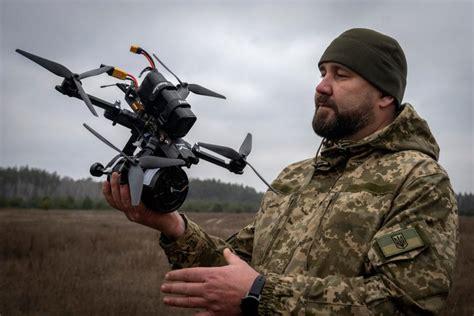
Conventional drones have long relied on radio frequencies for operation, making them vulnerable to the growing capabilities of electronic jamming. As both Russia and Ukraine intensified the use of radio-frequency interference, many aerial operations became ineffective. Drones lost signal, spun out, or plummeted. In response, engineers turned to an older, yet elegant solution: direct hardwiring.
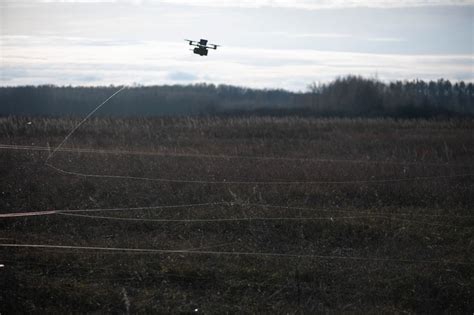
Fiber-optic drones are tethered by ultra-thin, lightweight cables that physically link them to their operators. This connection not only bypasses radio-frequency jamming entirely, but also offers unprecedented signal clarity, even in signal-hostile environments. There is no spoofing, no interception, and critically—no jamming.
The Serebryansky footage shows how extensive these operations have become. In some zones, the ground and canopy are laced with crisscrossing strands, evidence of repeated drone missions over the same corridors. Each strand may represent a reconnaissance flight, a search-and-destroy mission, or a surveillance task monitoring enemy troop movements. The sheer volume of wires suggests dozens, possibly hundreds of active drone sorties have occurred in this one location alone.
From Stopgap to Strategic: Evolution of Fiber-Optic Drone Warfare
When Russia first introduced fiber-linked drones in 2023 as a solution to electronic interference, Ukraine was forced to adapt quickly. At the time, many analysts speculated whether these hardwired systems would be a temporary patch or a long-term standard. The question now seems answered. Ukraine not only adopted the concept but is actively iterating and scaling it.
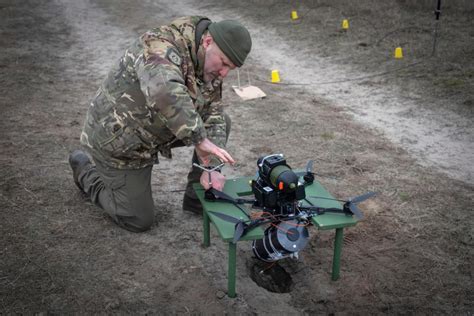
Fiber-optic drones are especially effective in short-range tactical operations, often under 5 kilometers, where cable management remains practical. Open terrain, urban edges, and low tree-density environments are prime arenas for deployment. However, in dense forests like Serebryansky, their usage is more complex. Cables get tangled, break, or restrict maneuverability. But as the video shows, Ukrainian forces have managed to overcome even these environmental challenges, marking a significant evolution in field tactics.
Serebryansky Forest: A Symbol of Adaptation
Located in Luhansk Oblast, southeast of Kharkiv and just north of the embattled city of Bakhmut, Serebryansky Forest has been a hot zone for months. This natural preserve has transformed into a testbed for advanced drone warfare. The volume of fiber-optic webbing filmed suggests it has become a strategic waypoint or operational hub, likely chosen for its cover, elevation, and proximity to key conflict lines.
That the Ukrainian Ministry of Defense chose to highlight this forest in official footage underscores its symbolic importance. It’s not merely about showing tactical innovation—it’s about broadcasting resilience and technological superiority to both domestic and foreign audiences.
The Russian Precedent and Ukrainian Response
Russia’s initial deployment of fiber-optic drones introduced a new paradigm in Eastern European warfare. Ukrainian defense planners, ever adaptive, quickly mirrored the approach. The result is a technological arms race, not in range or firepower, but in signal integrity and operational continuity.
Despite their strengths, fiber-optic drones are not without vulnerability. They are tethered, which means they can’t be sent on long-range missions or into environments with too many obstacles. The cable itself is a liability—if spotted, it can be tracked, cut, or followed back to the operator.
To mitigate this, Ukrainian units have employed shotguns and other close-range kinetic weapons to defend against incoming drones. As one frontline unit shared with Business Insider, manually shooting down these drones remains the most practical countermeasure available.
Battle-Tested Innovation: A Rapidly Scaling Industry
Since Russia’s full-scale invasion in 2022, Ukraine’s drone industry has boomed, bolstered by necessity and rapid militarization of civilian tech startups. The country’s defense sector is now a vibrant web of engineers, manufacturers, and field testers working closely with the military to develop customized aerial platforms.
Incorporating fiber-optics into drone systems reflects this broader innovation trend. Developers have improved spool-and-reel deployment systems, lightweight cable sheathing, and drones that can even deploy their own tethers mid-flight. These advances make today’s fiber-optic drones significantly more capable and battle-hardened than early 2023 prototypes.
Furthermore, Ukraine is exploring hybrid systems—drones that can switch between fiber and radio, depending on signal conditions. There is even talk of integrating AI flight management to automate tether pathfinding and obstacle avoidance, reducing the chance of entanglement in forests or urban structures.
Beyond the Forest: Implications for Modern Warfare
The rise of fiber-optic drones is more than a tactical adaptation—it is a paradigm shift in military communications and battlefield dominance. Their proliferation represents a larger trend toward signal-secure warfare, where information denial and disruption are becoming more dangerous than bullets.
Just as trench warfare defined World War I and armored columns defined World War II, the current war in Ukraine may be remembered as the first large-scale drone-centric conflict, where the battle for the sky was less about air superiority and more about data sovereignty.
In this context, the fiber-optic drone is not just a workaround—it is a statement: that even under digital siege, Ukraine will maintain eyes in the sky. The visual of those silver threads cutting through the forest canopy is not just tactical—it is symbolic.
The Next Frontier: AI, Autonomy, and the Future of Cable-Tethered Flight
While today’s drones are often manually piloted, the future points toward semi-autonomous tethered drones using AI to navigate, target, and return without constant human input. These systems could use encrypted, high-speed fiber lines not just for control, but for real-time high-definition video transmission, sensor relays, and even energy supply.
The fusion of AI-driven decision-making with fiber-optic infrastructure could redefine how militaries approach reconnaissance, logistics, and urban warfare. It’s conceivable that future drones will deploy in swarms, each connected to a mobile node through fiber optics, acting as a collective unit that can’t be jammed or deceived.
For now, though, Ukraine’s fiber-optic drones remain one of the most tangible successes in countering electronic warfare. While imperfect, they offer a level of reliability and tactical assurance unmatched by wireless systems. And in a war where every signal can be the difference between life and death, that reliability is priceless.
Conclusion: Wires of War in a Digital Age
As the war in Ukraine evolves, so too does the technology driving it. The fiber-optic drones sweeping through Ukraine’s forests represent a striking convergence of old-school cabling and next-gen warfare strategies. They are quiet, unassuming, and devastatingly effective.
The battlefield is no longer defined by trenches and tanks alone—it is now a grid of light, data, and control. And with every shimmering wire strung through the trees of Serebryansky, it becomes more clear: the future of war is not just unmanned, it’s unjammable.