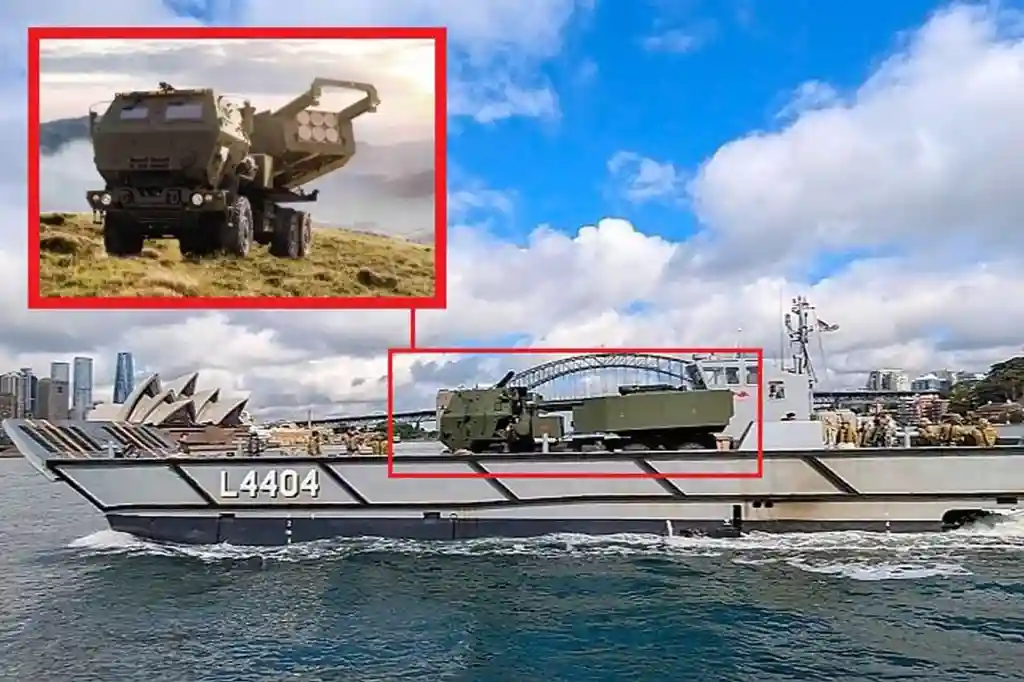
Australia has entered a decisive phase in its defence modernization journey, conducting at-sea trials of the M142 HIMARS rocket artillery system aboard the HMAS Canberra and its embarked landing craft. This move is more than a technical demonstration — it signals the emergence of a future maritime-mobile strike doctrine, one capable of delivering precision fires across long distance by sea-based maneuver forces, especially throughout the increasingly contested Indo-Pacific.
On 2 December 2025, the Australian Defence Force embarked a HIMARS unit in Sydney Harbour, validating how long-range fires can travel with amphibious ready groups, move between ship and shore, and generate land-attack effects from unexpected directions. The trial was conducted quietly, but the implication is loud: Australia no longer intends to keep its rocket artillery anchored inland.
The integration of HIMARS on a landing helicopter dock represents a transformation in the way strike power can be distributed, concealed and rapidly positioned. By combining the operational mobility of amphibious vessels with the reach of precision artillery, Australia is sharpening a deterrence posture built on flexibility rather than mass, on movement rather than fixed infrastructure.
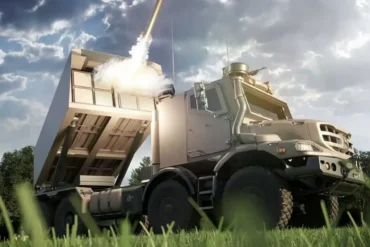
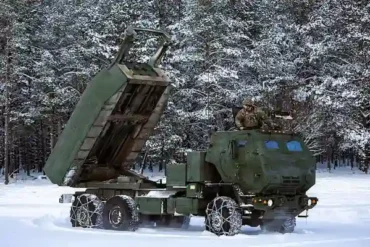
The HIMARS launcher — a 6×6 wheeled precision rocket system — has become one of the most influential artillery platforms of modern conflict. Australia has committed to 42 units under U.S. Foreign Military Sales, with the first operational systems assigned to 54th Siege Battery, 10th Brigade, the linchpin of the Army’s long-range fires structure. The Sydney trials represent the second major deployment environment HIMARS has entered this year, following previous air transport validation.
Mounted inside the cavernous vehicle decks of HMAS Canberra, HIMARS did not simply arrive as a standalone launcher. The trial included its dedicated resupply truck and ammunition trailer, forming an integrated firing detachment rather than a symbolic single launcher. The critical challenge was proving storage, securing, movement pathways and deck handling under operational sea conditions. Early results show that Canberra-class Landing Helicopter Docks can move HIMARS as a full combat-capable package, not just as cargo.
Why HIMARS-At-Sea Matters For Indo-Pacific Strategy
The Indo-Pacific is an operating theatre of water, archipelagos and littoral choke-points. In such a geography, a weapon that can sail quietly, land unexpectedly, fire and relocate before counter-battery sensors react is an asymmetric advantage. Australia is signalling that its future rocket batteries will not sit defensively inside Australia’s interior — they will maneuver offshore, ashore and between islands.
The implications are profound:
- Launchers become fluid nodes in a moving strike network.
- Adversaries must track ships, shore detachments and islands — not just fixed bases.
- A system previously limited to inland training grounds now becomes an instrument of regional denial.
This new amphibious-fires model complicates any adversary’s targeting calculus. A HIMARS detachment might deploy to a beachhead in the Timor Sea, then reposition the next day aboard a landing craft, later appear across a distant island chain. Mobility becomes survivability. Distance becomes influence.
Inside The Sydney Trial: From Deck To Landing Craft
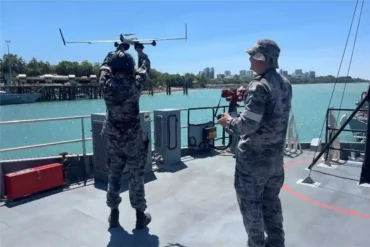
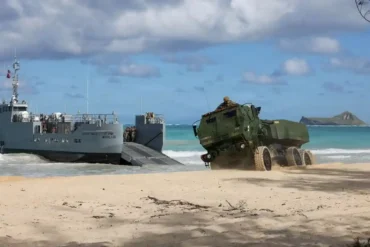
During testing, the launcher was first embarked onto the HMAS Canberra, then rolled into one of the ship’s LHD landing craft. Manoeuvring a large precision-strike system through the confined interior of a warship is not trivial — but these sea trials proved that HIMARS fits, moves and locks down under motion. Navy crews practiced lashing, securing and deck placement, while Army gunners trained to operate within the limits of a shipboard environment.
This marks a cultural shift as much as a technical milestone. Soldiers are learning to think like sailors, sailors are learning to move artillery like armoured vehicles. When interoperable efficiency becomes muscle memory, Australia gains a strike capability suited for expeditionary forward posture, coalition reinforcement and crisis rapid response.
A Maritime-Mobile Future For Precision Strike
As the ADF modernises with new Army landing craft (LAND 8710), additional HIMARS units, and evolving missile inventories, what began as a trial may soon grow into a routinely deployed capability. A future amphibious task group might insert a HIMARS platoon onto an island without a port, launch long-range fires in support of a joint task force, then re-embark before satellites detect firing signatures.
This is mobility as deterrence, precision as strategy, and littoral manoeuvre as force projection. The Sydney demonstration proves the foundation is real, not conceptual.
In time, Australia’s rocket batteries will not just move by road or C-17 — they may arrive by sea, fire from shore, and vanish again into the blue.