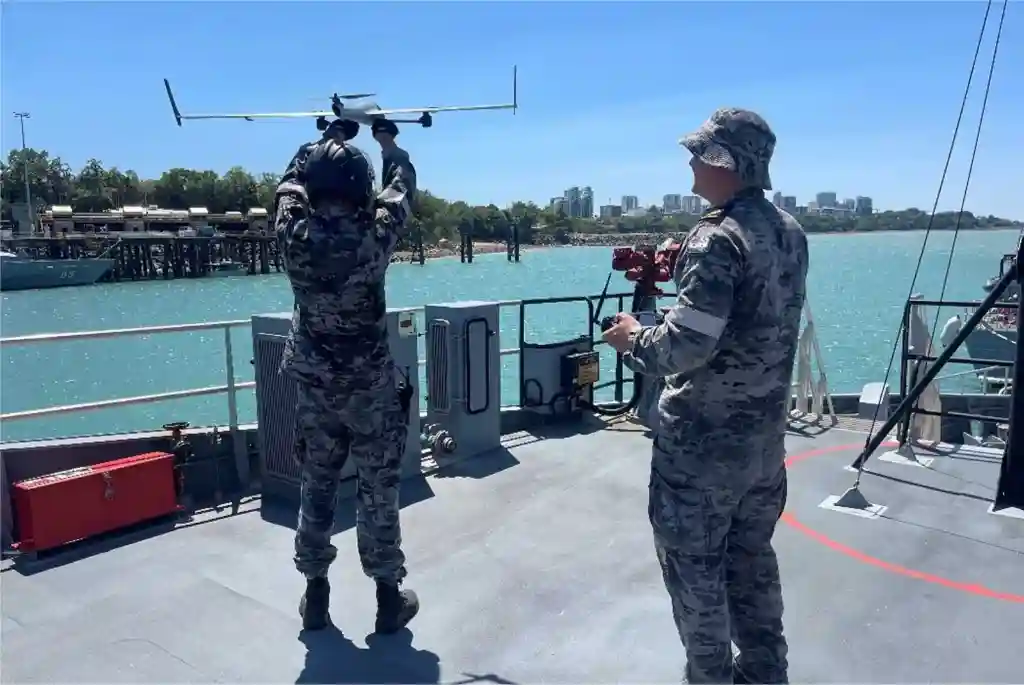
The Royal Australian Navy has moved a significant step closer to fully integrating lightweight unmanned systems into frontline maritime patrol missions after completing the first-of-class trials of the Edge 130 tri-copter drone aboard the patrol boat HMAS Cape Pillar. Announced by the Australian Ministry of Defence on 1 December 2025, the results signal a substantial advancement in small-ship surveillance capability, demonstrating how compact uncrewed assets can extend a vessel’s eyes far beyond its traditional sensor limits.
Testing took place throughout September in Darwin Harbour and nearby littoral environments—precisely the kind of cluttered coastal waters where patrol boats face limited visibility and unpredictable conditions. The Navy’s objective was clear: validate safe deck operations, assess sensor extension value, and determine whether a 1.2-kilogram drone could meaningfully reshape maritime domain awareness for minor warships.
The system’s stable behaviour across wind conditions, vessel motion, and complex terrain allowed crews to observe how unmanned aerial systems can integrate seamlessly into daily patrol rhythms. Officers participating in the evaluation reported improved situational understanding, faster contact classification, and reduced dependence on manned aviation assets. These results underscore the broader shift toward unmanned augmentation across modern naval forces.
A Lightweight Maritime Intelligence Asset With High-Tempo Capability
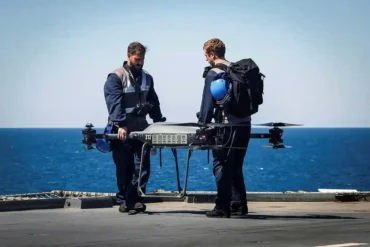
The Edge 130 is engineered for rapid deployment aboard small vessels that lack dedicated aviation facilities. Its compact frame houses swappable lithium-ion batteries, a modular sensor suite, and beyond-visual-line-of-sight (BVLOS) communications that allow operators to push surveillance coverage far past the patrol boat’s organic radar and visual horizon.
Despite weighing just over a kilogram, the drone’s real advantage lies in its ability to operate from confined deck space while providing overhead intelligence that would otherwise require a much larger unmanned platform or a helicopter. For Australia, which monitors a vast northern maritime region with limited air support availability, such capability fills a long-standing operational gap.
A Multi-Phase Test Campaign Across Complex Coastal Terrain
Trial activities aboard HMAS Cape Pillar began with technical integration, calibration, and operator training. Once baseline procedures were established, the drone commenced progressively demanding test flights in coordination with HMAS Coonawarra. Engineers and sailors assessed launch velocity, recovery reliability, autopilot accuracy, and endurance across shifting coastal wind patterns.
The final assessment phase took place in open waters west of Darwin, where the Edge 130 executed surveillance and imagery tasks reflecting real patrol missions. These included overflights of mangrove networks, shallow estuary approaches, and offshore monitoring routes, all replicating scenarios encountered by Joint Task Force 639 during routine border protection operations.
Expanding the Tactical Utility of Small Ships Through Persistent Aerial Overwatch
The value of compact drones for minor warships becomes most apparent in operations requiring rapid awareness and reduced risk to personnel. In constabulary patrols, the system offers real-time video and thermal imaging capable of identifying illegal fishing activity, smuggling attempts, and unregistered small craft navigating remote coastlines.
During search-and-rescue missions, the tri-copter can establish immediate overwatch and guide small boats toward potential survivors. In tactical interdiction efforts—particularly in confined or shallow waters unsuitable for large aircraft—it provides early warning, target tracking, and terrain reconnaissance.
These advantages align with Australia’s movement toward distributed maritime operations, a doctrine that uses numerous small, networked platforms to maintain persistent surveillance across wide regions. Drones like the Edge 130 act as force multipliers, extending the reach of Cape-class patrol boats without adding crew burden or logistical strain.
Outstanding Performance in Multi-Ship Coordination and Fleet-Level Activities
Late-stage trials included a multi-ship formation event off Charles Point, where the Edge 130 gathered high-resolution imagery of HMAS Cape Pillar, HMAS Albany, and HMAS Cape Woolamai maneuvering together. The exercise validated the drone’s suitability for fleet-level reconnaissance, confirming both its imaging quality and its ability to operate safely around multiple moving vessels.
The tri-copter also showed resilience during offshore turbulence and directional wind shifts—conditions that often hinder small unmanned aircraft. Its stability during approach and recovery was highlighted as a core strength, particularly for maritime environments where deck movement is constant.
Operationalisation and Future Role in Australian Maritime Security
The system is already supporting mission activities through Joint Task Force 639, where drones have been used to monitor mangrove-dense territory for illegal fishing operations. These real-world deployments showcase how the drone can replace helicopter or fixed-wing aircraft sorties in low-threat, high-endurance surveillance tasks, drastically reducing operational costs.
As Australia faces growing surveillance demands across the Indo-Pacific—especially in its vast northern maritime approaches—the integration of uncrewed systems offers scalable, cost-effective capability expansion. The success of the Edge 130 trial positions it as a meaningful addition to frontline patrol missions and a foundational element of future unmanned fleet architectures.
A Strategic Milestone for Australia’s Evolving Naval Doctrine
The completion of these first-of-class trials represents more than a single platform achievement—it signals the Royal Australian Navy’s accelerating transition toward unmanned-enabled maritime defence. As distributed operations, persistent surveillance, and remote sensing become central to Indo-Pacific naval strategy, the Edge 130 stands as a proven, operationally ready capability.
Its success aboard HMAS Cape Pillar demonstrates how even the smallest patrol assets can achieve extended surveillance reach, improved crew safety, and better situational control through lightweight autonomous systems. With this milestone achieved, the drone is now positioned to influence future acquisition plans, tactical doctrine development, and collaboration with allied navies seeking similar small-vessel force multipliers.