The Boeing F-47 is being developed as a sixth-generation fighter designed around an unusually demanding combination of stealth, speed, sensors, survivability, and long-range performance. Although the aircraft remains highly classified, its engineering challenges are already encouraging comparisons with earlier American aerospace programs that pushed aircraft technology into unfamiliar territory. One of the most intriguing examples is not a modern fighter at all, but a NASA SR-71 Blackbird experiment from the 1990s.
NASA’s work with the SR-71 produced an extraordinary collection of flight-test data because the Blackbird could operate at altitudes and speeds that few other crewed aircraft could approach. Among those projects was the Laser Air Data Sensor (LADS) program, which investigated whether lasers could measure an aircraft’s surrounding airflow without relying entirely on conventional pitot tubes and static pressure ports. Decades later, the underlying concept looks remarkably relevant to the problems faced by a highly stealthy aircraft such as the F-47.
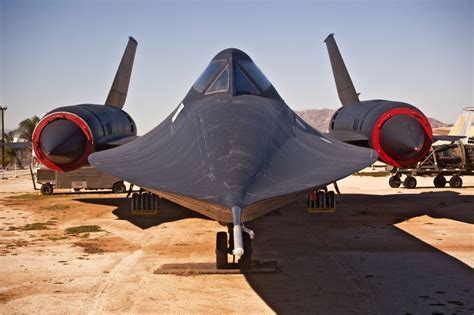
The connection should not be overstated. There is no public evidence that Boeing is directly adapting NASA’s LADS hardware for the F-47, nor is there enough information available about the classified fighter to determine exactly how its air-data system works. Yet the engineering problem is compelling. If a future fighter must combine an extremely low radar signature with high-speed flight and sophisticated sensor fusion, conventional external probes can become an increasingly awkward part of the design.
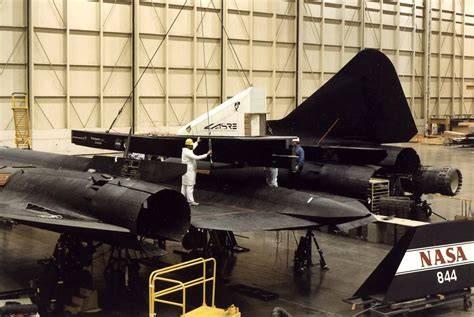
The story becomes even more interesting because the LADS program was only one part of NASA’s extensive use of the SR-71 as a high-speed research platform. The agency also used a modified Blackbird for the Linear Aerospike SR-71 Experiment (LASRE) during 1997 and 1998. LASRE investigated aerodynamic and propulsion questions associated with reusable launch vehicles. Together, these programs demonstrate why the retired spy plane became such a valuable flying laboratory for technologies that extended far beyond traditional reconnaissance.
Why NASA Turned the SR-71 Into a Flying Laboratory
The SR-71 was already an extraordinary research platform before NASA began modifying it for experimental missions. Developed by Lockheed’s Skunk Works, the Blackbird was designed to cruise at approximately 80,000 feet and above Mach 3, creating an operating environment that remained inaccessible to most conventional aircraft. Those characteristics were essential to its original reconnaissance mission, but they also made the aircraft uniquely useful to researchers.
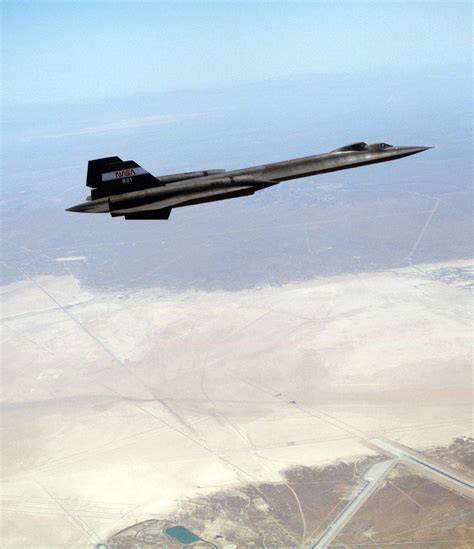
NASA ultimately operated two Blackbirds, an SR-71A and an SR-71B, after the Air Force retired the aircraft from operational service. The agency used them for a range of scientific and aerodynamic investigations before retiring its experimental aircraft in 1999. At extreme altitude and speed, researchers could examine airflow, propulsion behavior, atmospheric conditions, and vehicle performance in ways that were difficult or impossible to reproduce in ordinary wind tunnels.
NASA described the SR-71 during LASRE research as effectively functioning like a flying wind tunnel. That description captures the central advantage of the aircraft. Instead of testing a technology only in a laboratory environment, engineers could expose it to real atmospheric conditions while collecting measurements from an aircraft already capable of sustaining extreme flight regimes.
That distinction mattered because aerodynamic flows around real aircraft can become extraordinarily complicated. Temperature, pressure, shock waves, turbulence, boundary-layer behavior, vehicle geometry, and propulsion effects interact differently in actual flight than they do in simplified laboratory conditions. A platform such as the SR-71 therefore offered researchers an opportunity to validate theoretical predictions against real-world data.
This accumulated knowledge is potentially important for sixth-generation aircraft. The F-47 is expected to operate across a broad flight envelope while integrating highly sophisticated sensors and propulsion systems. Even though the details remain classified, its requirements imply that engineers must solve many of the same fundamental problems that NASA explored decades ago: how to measure the atmosphere accurately, understand airflow, and maintain aircraft control while minimizing the physical features exposed to that airflow.
The 1990s Laser Air Data Sensor Experiment
The Laser Air Data Sensor project attacked one of aviation’s oldest measurement problems from an unusual direction. Conventional aircraft typically depend on a pitot-static system to obtain essential flight information. Forward-facing pitot tubes measure ram or dynamic pressure, while static ports measure surrounding atmospheric pressure. Computers then use these measurements to determine parameters such as airspeed, altitude, Mach number, and vertical speed.
The system is proven, reliable, and deeply embedded in aviation. However, it also requires physical openings and structures interacting directly with the airflow. For a conventional transport aircraft, that is rarely a fundamental design problem. For an extremely stealthy aircraft, every external feature deserves careful consideration.
NASA’s LADS experiment investigated whether laser light could measure airflow remotely. The system used multiple sheets of laser light projected from the aircraft. As microscopic particles naturally present in the atmosphere passed through those illuminated regions, their movement could be analyzed to determine the direction and velocity of the surrounding air.
That approach was technologically ambitious because it effectively attempted to turn the atmosphere itself into the sensing medium. Rather than relying exclusively on pressure changes at physical probes, the aircraft could theoretically obtain aerodynamic information by observing particles moving through an illuminated measurement volume.
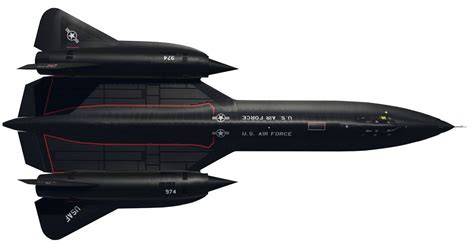
The SR-71 was an especially useful platform for such an experiment. Its extreme speed and altitude created a demanding environment in which an advanced air-data system could be evaluated under conditions far beyond those encountered by ordinary aircraft. If a sensor could function accurately in that environment, the resulting data could help determine whether optical air-data measurement was practical for future high-performance aircraft.
The concept also illustrates an important shift in aerospace engineering: moving sensors from exposed mechanical structures toward integrated electronic and optical systems. That transition is particularly significant for stealth aircraft because designers increasingly seek to make sensors conform to the aircraft’s outer mold line rather than protrude into the airstream.
Why Optical Air Data Could Matter to the F-47
The potential relevance to the F-47 begins with stealth. A fighter optimized for very low observability cannot simply treat every sensor as an isolated component. Antennas, apertures, probes, cooling arrangements, control surfaces, and other features must be considered as part of the aircraft’s overall electromagnetic and aerodynamic design.
A conventional pitot probe projects into the airflow and creates a physical feature that must be incorporated into the aircraft’s radar-signature strategy. It also has to withstand aerodynamic heating, environmental exposure, icing conditions, debris, and potentially combat damage. An optical system embedded within the aircraft’s skin could theoretically eliminate or reduce some of those complications.
The word “theoretically” is critical, however. LADS demonstrated a promising research concept, but the technology did not become a standard replacement for conventional air-data systems across today’s aircraft fleet. That fact alone shows that the engineering challenges were substantial.
An operational fighter requires exceptionally reliable measurements across changing atmospheric conditions. Laser-based sensing must contend with atmospheric particles, optical performance, signal processing, calibration, environmental interference, and the enormous computational demands associated with converting optical observations into trustworthy flight parameters. A concept that works in a research aircraft therefore still has a long journey before becoming an operational aviation system.
Nevertheless, the F-47’s requirements make the underlying idea attractive. The aircraft is expected to emphasize extreme stealth, advanced sensor fusion, high-speed performance, and survivability across a wide flight envelope. Those requirements create strong incentives to integrate as many functions as possible into the aircraft’s skin and internal systems.
There is already a precedent for this general design philosophy. Modern stealth fighters such as the F-22 Raptor and F-35 Lightning II use sophisticated flush air-data approaches rather than relying solely on traditional exposed probes for every flight measurement. These systems demonstrate the broader direction of fighter design, although the exact technologies planned for the F-47 remain classified.
The most reasonable conclusion is therefore not that the F-47 will use the 1990s LADS system. Instead, NASA’s experiment illustrates a technological path that could become increasingly valuable as aircraft designers pursue more deeply integrated sensing architectures.
LASRE Shows How the SR-71 Supported Radical Aerospace Research
The LADS program is particularly interesting for the F-47 because of its sensor implications, but the SR-71’s NASA career also included another extraordinary experiment: LASRE.
The Linear Aerospike SR-71 Experiment was designed to gather flight data relevant to reusable launch vehicles. NASA mounted a roughly 20-percent-scale, semispan model associated with Lockheed Martin’s X-33 program on a modified SR-71. The installation included an experimental linear aerospike rocket engine together with fuel and oxidizer tanks and associated propellant systems.
The X-33 itself was intended as a technology demonstrator for the proposed VentureStar reusable spaceplane. Its development focused on technologies that could potentially reduce the cost and complexity of reaching orbit. The linear aerospike engine was particularly attractive because of its theoretical ability to maintain efficient performance across changing atmospheric pressures.
LASRE was intended to provide real-flight information that could be compared with wind-tunnel results and computational fluid dynamics. In other words, NASA was using the Blackbird to validate the calculations and assumptions that engineers were making about a highly unusual vehicle and propulsion system.
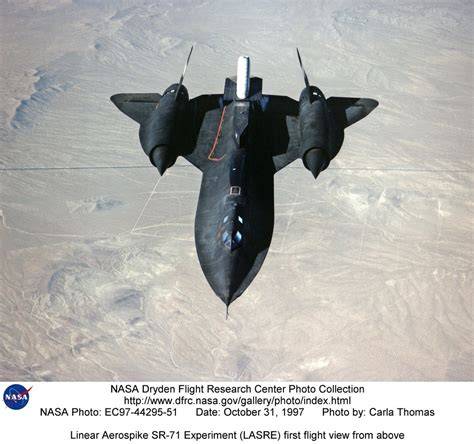
The rocket engine was not ultimately fired during flight testing, and the X-33 program was canceled in 2001. Yet the experiment still generated useful aerodynamic information. Its importance today is less about the eventual fate of the aerospike engine and more about what it demonstrates regarding the value of flight-testing advanced technologies on an existing high-performance platform.
That philosophy remains relevant. Aerospace programs rarely begin with completely new knowledge. Engineers build on decades of experiments, test reports, computational methods, manufacturing experience, and lessons learned from programs that sometimes failed to reach their original objectives.
What NASA’s SR-71 Research Could Teach Boeing
The most fascinating possibility is therefore not a direct technological transfer but an institutional inheritance of aerospace knowledge. NASA research from the 1990s remains part of the publicly available technical record. Engineers working decades later can study the experimental methodology, identify what worked, understand what failed, and determine whether modern electronics and computing have changed the feasibility of old concepts.
That distinction is particularly important with LADS. Computing power, optical sensors, signal processing, materials, and embedded electronics have advanced enormously since the 1990s. A concept that was difficult to implement at the time could become more practical when paired with modern digital processing and sensor fusion.
A future optical air-data system could potentially combine information from multiple sensing methods rather than completely replacing conventional systems. That would create redundancy, allowing the aircraft to cross-check measurements and maintain accurate flight information if one sensor became unreliable.
For a sixth-generation fighter, such redundancy could be valuable. The aircraft may have to operate at high speed, in electronically contested environments, and under conditions where conventional navigation or external sensing could be degraded. Integrating air-data measurements into a broader sensor-fusion architecture could potentially allow the flight-control system to derive a more comprehensive picture of the aircraft’s aerodynamic state.
But none of this proves that Boeing is doing so.
The F-47 Remains Far More Mysterious Than the SR-71
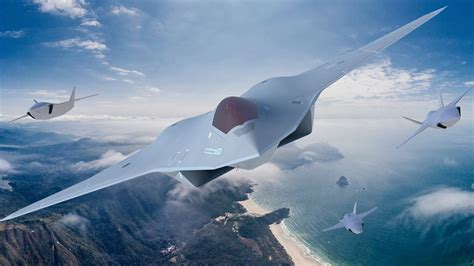
The biggest challenge in assessing the F-47 is the lack of public technical information. Unlike the SR-71, which has been extensively documented after decades of service, the F-47 is a current highly classified development program. Public images reveal very little about its actual configuration, and even official material is deliberately limited.
That means almost any claim about individual sensors, propulsion arrangements, aerodynamic features, or internal architecture must be treated carefully. It is entirely reasonable to examine historical NASA research and ask whether it could be relevant. It is not reasonable to turn that possibility into a claim that the F-47 definitely incorporates the technology.
The same caution applies to LASRE. Its data may remain useful to aerospace engineers studying high-speed aerodynamics and computational fluid dynamics, but there is no public evidence demonstrating that its aerospike-specific findings directly shaped modern Boeing, SpaceX, or Blue Origin launch vehicles.
The value of historical experiments is often subtler than direct hardware lineage. An experiment does not need to produce an operational component to influence aerospace engineering. Its measurements, methods, failures, and analytical techniques can become part of the collective knowledge used by later generations of engineers.
A 1998 Experiment With Modern Relevance
The 1998 NASA SR-71 research programs belong to an era when engineers were exploring technologies that often seemed ahead of their time. The Blackbird was already an extraordinary aircraft, yet NASA used it to investigate lasers, reusable spacecraft aerodynamics, propulsion integration, atmospheric research, and other advanced concepts.
More than two decades later, the engineering problems facing the F-47 have changed in detail but not necessarily in principle. Designers still need to understand airflow, measure aircraft performance, control vehicles operating at extreme speeds, integrate sensors without compromising aerodynamics, and reduce vulnerabilities created by exposed hardware.
The Laser Air Data Sensor is therefore worth remembering not because it proves what Boeing has placed inside the F-47, but because it illustrates where aerospace engineering has been heading for years: toward sensors that are more integrated, more computationally capable, and less dependent on protruding mechanical hardware.
If modern optical sensing has finally overcome the limitations encountered during NASA’s 1990s experiments, the technology could eventually find applications in aircraft where stealth and aerodynamic performance are paramount. Whether that happens on the F-47 is unknown.
What is certain is that the Blackbird’s research legacy remains remarkably relevant. The SR-71 may have disappeared from active service in 1998, but the engineering knowledge generated around it continues to offer a valuable archive for the aerospace industry. And if Boeing’s F-47 truly represents the next major leap in American fighter technology, some of the ideas behind that leap may have roots much farther back than its futuristic silhouette suggests.